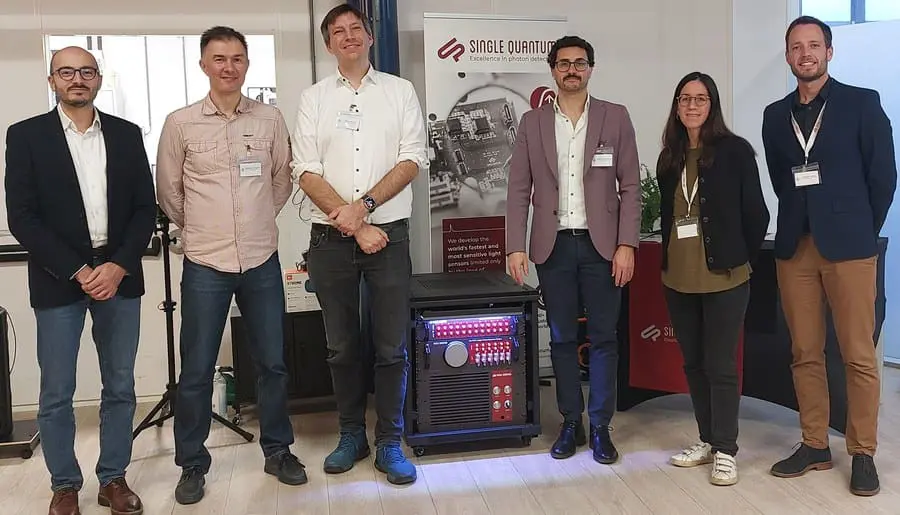
Researchers in Dresden are working to develop portable quantum sensors for use in neurosurgery, with the goal of improving the precision and completeness of tumor removal. The project, known as PoQus, is being led by Professors Oliver Bruns, Tareq Juratli, and Dr. Andriy Chmyrov, in collaboration with the Dutch company Single Quantum and French consultancy Absolut System SAS.
The team aims to harness the power of superconducting nanowire single photon detectors, currently used in quantum computing, to create a highly sensitive sensor that can be integrated into a time-resolved fluorescence microscope.
This technology has the potential to revolutionize tumor operations by providing real-time imaging and enabling more reliable detection of malignant cells while sparing healthy tissue. The European Union is supporting the project with a grant of nearly five million euros over four years, which will be used to develop and implement the new technology.
Introduction to Quantum Sensors in Neurosurgery
The integration of quantum sensors into neurosurgery is a novel approach that aims to improve the precision and completeness of tumor removal during cancer operations. Researchers from Dresden, in collaboration with the Dutch company Single Quantum and the French cryogenic engineering consultancy Absolut System SAS, are working on developing portable quantum sensors for use in operating rooms. These sensors, made of superconducting nanowire single photon detectors (SNSPDs), can potentially revolutionize tumor operations through highly precise, real-time imaging.
The research alliance’s joint project, known as PoQus, has received an EU grant totaling EUR 5 million over four years to support developing and launching novel products on the market. The close collaboration between science and clinical application at NCT/UCC Dresden and UKD is a major asset in this endeavor. With specialized companies at their side, they have partners with extensive expertise in both quantum technology and cryotechnology for superconducting systems.
The PoQus project aims to develop a portable quantum sensor that is integrated into a time-resolved fluorescence microscope for use in operating rooms. The prototype will consist of a compact cryogenic cooling system, optimized detectors for maximum efficiency and speed, and software for image analysis. This technology has the potential to enable more reliable detection of malignant cells while sparing healthy tissue, which has direct benefits for patient care.
The Technology Behind Quantum Sensors
Real-time imaging is crucial in neurosurgery, and it must become more accurate and capable of penetrating deeper tissue layers. One solution is to combine two existing methods: fluorescence lifetime imaging microscopy and superconducting nanowire single photon detectors (SNSPDs). Fluorescence lifetime imaging microscopy provides insights into the microenvironment of tumors and allows tumor tissue to be distinguished from healthy tissue by exploiting the lifespan of fluorescent molecules in their excited states.
However, SNSPDs require intense cooling, and the systems used so far are too bulky for clinical use. The PoQus project aims to develop a portable quantum sensor that can overcome these limitations. By using SNSDPs as a basis, they want to create a compact cryogenic cooling system, optimized detectors for maximum efficiency and speed, and software for image analysis.
Funding and Support
The EU provides funding for research and innovation, particularly through the Horizon Europe program. PoQus is part of a funding line that only supports collaborative projects known as ‘Global Challenges and European Industrial Competitiveness,’ in Cluster 4: Digital, Industry and Space. The project will receive a total of EUR 4,986,529 in funding, with almost EUR 1.1 million going to the Faculty of Medicine at TU Dresden and around EUR 1.2 million to the German Cancer Research Center (DKFZ).
Researchers Involved
The researchers involved in the PoQus project have extensive expertise in their respective fields. Oliver Bruns, who studied biochemistry and molecular biology at the University of Hamburg, has worked at the Leibniz Institute of Virology in Hamburg and the Massachusetts Institute of Technology (MIT, USA). He currently holds a Chair at TU Dresden’s Faculty of Medicine, which is funded by the German Cancer Research Center (DKFZ).
Tareq Juratli, who completed his medical studies at Philipps-Universität Marburg, has worked at University Hospital Dresden (UKD) and has received neurooncological research scholarships to Harvard University and Massachusetts General Hospital in the United States. He currently heads the research group “Translational Neuro-Oncology and Skull Base Tumor Surgery” at the Department of Neurosurgery.
Andriy Chmyrov, who studied applied mathematics at Sumy State University in Ukraine, has worked at the Max Planck Institute for Biophysical Chemistry in Göttingen, Germany, and has been working at Helmholtz Munich since 2015. He currently serves as Deputy Head of the Department of Functional Imaging in Surgical Oncology at NCT/UCC Dresden.
Conclusion
The integration of quantum sensors into neurosurgery is a promising approach that has the potential to improve patient care. The PoQus project, with its collaborative effort between science and industry, is well-positioned to develop and launch novel products on the market. With the support of the EU funding, the researchers involved in the project are working towards creating a portable quantum sensor that can provide highly precise, real-time imaging during tumor operations. This technology has the potential to enable more reliable detection of malignant cells while sparing healthy tissue, which is a major breakthrough in the field of neurosurgery.
External Link: Click Here For More