Researchers detected dissipative chaos and integrability in open many-body systems using a superconducting processor. Complex spacing ratios revealed a ‘donut-shaped’ distribution for chaotic circuits and a peak for integrable systems. Increasing circuit depth induced a transition from integrability to chaos, demonstrating noise-driven dissipation.
The behaviour of complex quantum systems, traditionally studied in isolation, is increasingly understood to be shaped by interactions with their surroundings. This interplay between a system and its environment introduces dissipation – the loss of energy – and fundamentally alters the dynamics, leading to what researchers term ‘dissipative chaos’. A collaborative team, comprising Kristian Wold and Sergey Denisov from OsloMet – Oslo Metropolitan University, Zitian Zhu, Feitong Jin, Xuhao Zhu, Zehang Bao, Jiarun Zhong, Fanhao Shen, Pengfei Zhang, Hekang Li, Zhen Wang, Chao Song, Qiujiang Guo and H. Wang from Zhejiang University, Lucas Sá from the University of Cambridge, and Pedro Ribeiro from Universidade de Lisboa, have now reported the first experimental observation of this phenomenon. Their work, detailed in a paper entitled ‘Experimental Detection of Dissipative Quantum Chaos’, utilises a superconducting processor to demonstrate how spectral correlations – the relationships between energy levels – reveal the transition from order to chaos in open quantum systems, establishing a new avenue for exploring many-body physics.
Observation of Dissipative Chaos in a Superconducting Quantum Processor
Researchers have, for the first time, experimentally observed dissipative chaos and integrability within open many-body systems, utilising a superconducting quantum processor. The study confirms theoretical predictions regarding level repulsion – the tendency of energy levels to avoid each other – in open quantum systems and establishes a new benchmark for quantum investigations of non-unitary dynamics.
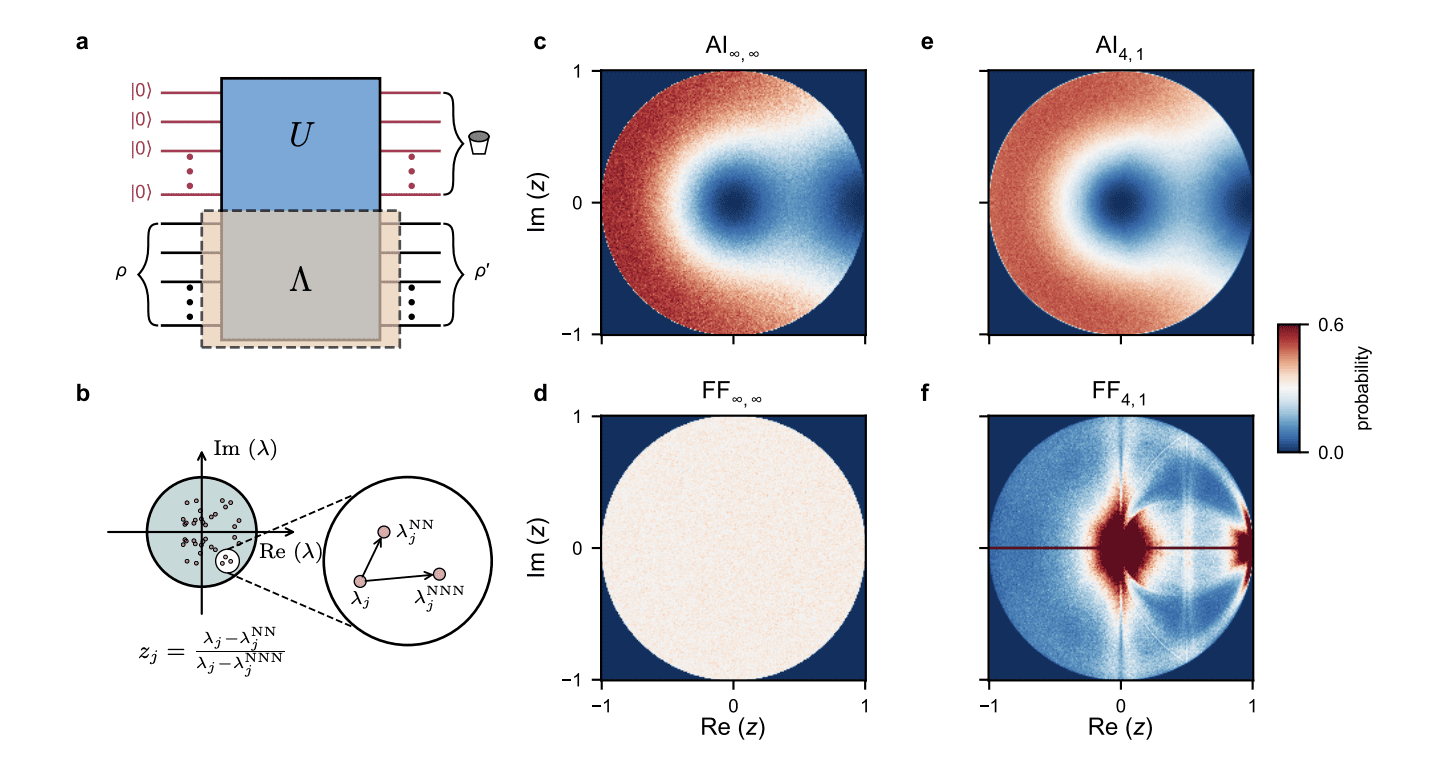
The research centres on analysing the spectral properties of quantum circuits, specifically through the measurement of complex spacing ratios (CSRs). CSRs provide a sensitive probe of the statistics of energy levels, differentiating between chaotic systems – characterised by random, uncorrelated levels – and integrable systems, which exhibit correlated levels due to underlying symmetries and conservation laws.
The team observed a distinctive ‘donut-shaped’ distribution of CSRs in chaotic, dissipative circuits. Dissipation refers to the loss of energy from the system to the environment, a crucial distinction from traditional studies of chaos which largely focused on closed systems where energy is conserved. This observation validates theoretical expectations and confirms the presence of level repulsion, a hallmark of quantum chaos.
Integrable circuits, conversely, exhibited a sharp peak at the origin of the CSR distribution, indicating a lack of spectral correlations, consistent with theoretical models. Increasing the complexity – or ‘depth’ – of the integrable circuit induced a transition towards chaotic behaviour. Significantly, this transition was not solely driven by circuit design, but was actively contributed to by inherent noise within the superconducting processor itself.
Researchers employed gradient-based tomography to retrieve the CSR distributions, enabling detailed analysis of spectral correlations. They meticulously validated their findings through comparisons with theoretical predictions and numerical simulations, strengthening the credibility of their results. Supplemental material details how the team accounted for approximate symmetries within the circuits and the impact of hardware noise on these symmetries. Symmetry breaking was quantified by calculating the expectation value of a conserved quantity (Q) for each eigenvector of the quantum map, demonstrating that noise increasingly disrupts symmetry as circuit depth increases.
These findings establish superconducting processors – typically employed for simulating unitary (energy-conserving) quantum systems – as viable platforms for exploring dissipative many-body phenomena. The observed universal spectral features provide a foundation for understanding the behaviour of open quantum systems and offer insights into the interplay between coherence, dissipation, and chaos in complex quantum dynamics. This work expands the capabilities of quantum hardware and opens new avenues for investigating fundamental questions in quantum physics and potentially developing novel quantum technologies.
👉 More information
🗞 Experimental Detection of Dissipative Quantum Chaos
🧠 DOI: https://doi.org/10.48550/arXiv.2506.04325