Researchers at The Yokohama National University, Hiroshima Universityand The University of Tokyo, led by H. Kurokawa, have demonstrated a significant advance in scalable quantum technology through the chip integration of diamond colour centres. Their work details the development of a chip-integrated diamond photonic crystal cavity containing nitrogen-vacancy (NV) centres, achieving cryogenic operation and a substantial Purcell enhancement of emission via optical fibre coupling. This achievement represents a crucial step towards realising practical, flexible diamond-based quantum communication platforms. It addresses a key challenge in the field of quantum photonics by enabling efficient integration of stable single-photon sources into scalable chip-based architectures.
Cryogenic photonic crystal cavity boosts diamond colour centre light emission
A Purcell enhancement of NV-centre emission reached a factor of 2.7×10⁴, representing a substantial improvement over previous demonstrations and a critical advancement in the efficiency of light extraction from these quantum emitters. Prior to this work, the lack of integrated cryogenic operation severely limited the practical application of diamond colour centres, as thermal noise disrupted the delicate quantum states necessary for coherent photon emission. Diamond NV centres possess long spin coherence times and high photon emission rates, making them promising candidates for quantum photonic information processing, but these properties are typically only maintained at cryogenic temperatures. The 300nm-wide photonic crystal cavity overcomes this barrier, providing a means to confine and enhance the emitted light, thereby increasing the signal strength and facilitating detection.
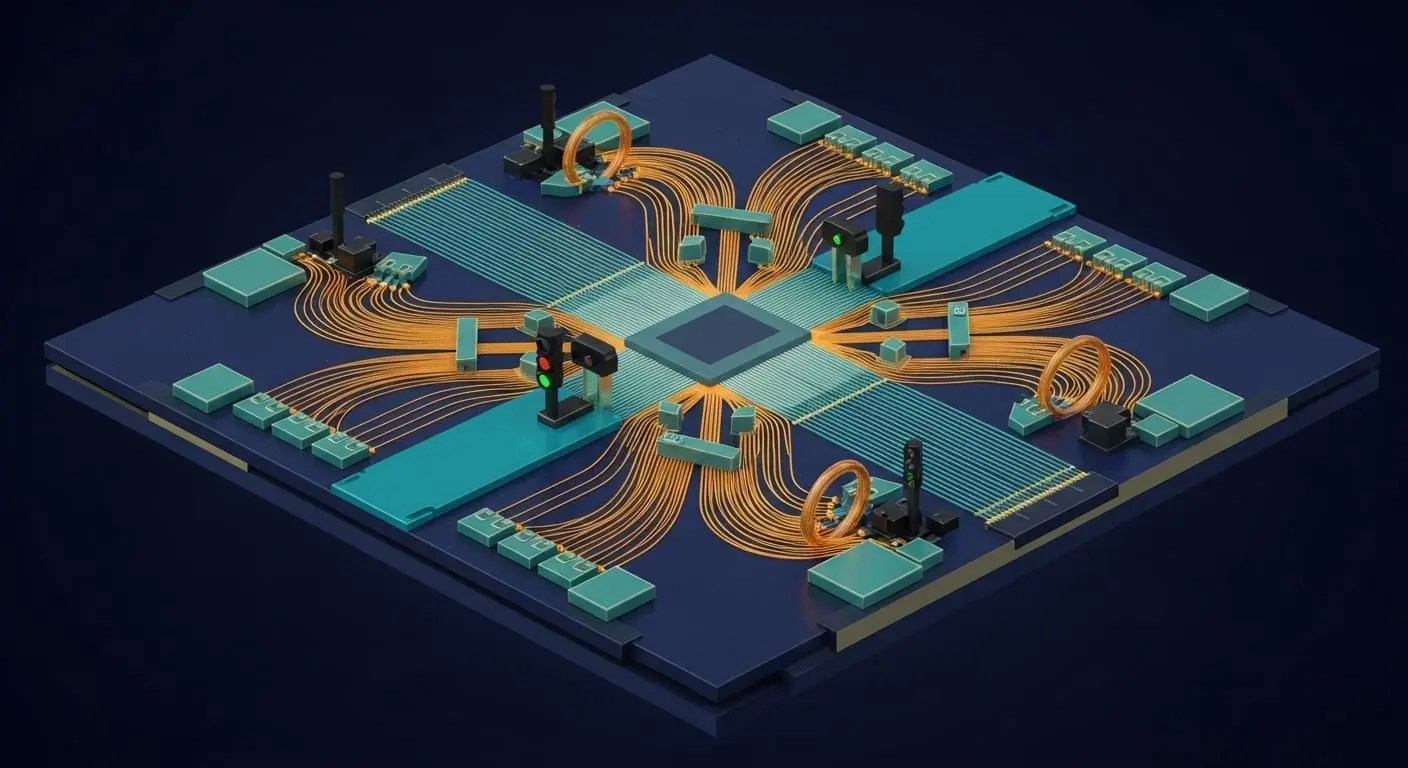
The integrated chip, meticulously combining diamond, a silicon nitride waveguide, and optical fibre coupling, now enables stable, high-performance operation essential for building scalable quantum technologies. The design prioritised efficient photon collection over extended coherence, making it particularly suited for quantum communication networks where reliable photon transmission is paramount. Cryogenic operation of the integrated chip was confirmed by observing the Purcell enhancement, a phenomenon rooted in the modification of the spontaneous emission rate of an emitter when placed within a resonant optical cavity. This enhancement arises from the increased interaction between the emitter and the cavity’s electromagnetic field, effectively accelerating the emission process. The cavity acts as a resonator, reflecting photons back towards the NV centre, increasing the probability of emission in a desired direction.
The fabricated photonic crystal cavity, measuring 300nm in width and 200nm in thickness, achieved a quality factor of 2.7x 10⁴ without hole optimisation, indicating a high degree of light confinement within the cavity. This figure reduced to 1.7x 10⁴ with optimised hole shapes, and further to 1.0x 10⁴ with the addition of an underlying silica layer, demonstrating the sensitivity of the cavity’s performance to structural modifications. Diamond nanofabrication and silicon nitride waveguide creation, utilising a precise pick-and-place technique, enabled the physical integration of these components with nanometric accuracy. Careful assessment of transmission losses identified the diamond-silicon nitride interface, waveguide propagation, and silicon nitride-fibre coupling as key areas impacting performance; simulated alignment tolerances suggest vertical offset is the primary contributor to coupling loss, highlighting the need for precise alignment during fabrication and assembly. The silicon nitride waveguide serves to channel the emitted photons from the cavity to an optical fibre, enabling efficient transmission of quantum information.
Cryogenic limitations hinder scalable quantum photonics integration
Embedding diamond colour centres within a chip-based photonic crystal cavity is a vital step towards practical quantum technologies, promising more compact and efficient devices compared to traditional bulky optical setups. However, maintaining the necessary cryogenic environment for optimal performance, typically around 4 Kelvin, complicates integration and limits wider application, as it requires to be sophisticated and energy-intensive cooling systems. The degree to which this integrated system can be scaled up, producing multiple functional cavities on a single chip, remains an open question and a significant area of ongoing research. Achieving high-density integration will require addressing challenges related to thermal management and minimising cross-talk between adjacent cavities.
Diamond colour centres, tiny defects within the diamond lattice, specifically nitrogen-vacancy (NV) centres where a nitrogen atom replaces a carbon atom adjacent to a vacancy, offer exceptional potential for quantum communication due to their ability to emit single photons, which carry quantum information in the form of their polarisation or phase. These centres exhibit stable emission even at room temperature, but their coherence times are significantly enhanced at cryogenic temperatures. Diamond NV centres offer exceptional potential for quantum communication. They are able to emit single photons, which carry quantum information in the form of their polarisation or phase. This approach combines these centres with a carefully structured photonic crystal cavity designed to trap and amplify light, alongside an optical waveguide to efficiently transfer photons. The combination allows for potential scalability towards complex quantum circuits, enabling the implementation of quantum algorithms and protocols. The cavity’s design facilitates efficient photon extraction, a critical factor for building practical devices and enabling complex quantum circuits, as it minimises losses and maximises the number of photons available for transmission. Furthermore, the use of a photonic crystal cavity allows for tailoring the spectral properties of the emitted light, ensuring compatibility with existing optical communication infrastructure.
The development of on-chip cryogenic systems, or the exploration of alternative materials and cavity designs that can maintain coherence at higher temperatures, are crucial next steps. Future research will focus on improving the quality factor of the photonic crystal cavities, reducing fabrication imperfections, and developing efficient methods for coupling multiple cavities together to create larger, more complex quantum networks. The ultimate goal is to create a fully integrated, room-temperature quantum photonic platform that can be deployed in a wide range of applications, including secure communication, quantum sensing, and distributed quantum computing.
The researchers successfully integrated nitrogen-vacancy centres within a diamond photonic crystal cavity on a chip, demonstrating enhanced photon emission at cryogenic temperatures. This achievement represents progress towards building scalable quantum technologies, as diamond colour centres are promising materials for quantum communication. The integrated device combines the light-emitting centres with a cavity and optical waveguide to efficiently capture and transmit photons. The authors intend to focus on improving cavity quality and reducing fabrication imperfections to develop larger quantum networks.
👉 More information
🗞 Scalable on-chip integration of diamond color centers for cryogenic quantum photonics
🧠 ArXiv: https://arxiv.org/abs/2604.06984