

Understanding how correlations emerge and evolve is fundamental to many areas of physics, yet directly observing and controlling these interactions remains a significant challenge, now addressed by research led by Z. T. Wang, Si-Yun Zhou, and Yun-Hao Shi, alongside colleagues including Kaixuan Huang and Z. H. Yang. This team investigates the dynamics of two-particle correlations within specially designed superconducting circuits, effectively creating a controllable system to mimic the behaviour of interacting particles. Their experiments demonstrate a clear transition from particles clustering together to actively avoiding each other as the strength of their interaction changes, revealing how this interaction shapes their movement. The findings extend the possibilities for simulating complex correlated systems using superconducting technology and offer new insights into the fundamental behaviour of interacting particles in various physical contexts.
Understanding how quantum correlations emerge and evolve is central to many areas of physics, yet precisely controlling and characterizing these correlations remains a significant challenge. This research experimentally investigates the dynamics of two-particle correlations within quantum systems, using superconducting qutrit arrays with tunable interactions.
Tunable Qubit Coupling and Transmon Characteristics
The team fabricated superconducting qubits known as transmons, utilizing advanced manufacturing techniques to enhance qubit connectivity and control. These qubits feature tunable coupling, allowing researchers to dynamically adjust the strength of interactions between them. This precise control, combined with the ability to accurately control and measure individual qubits, is crucial for implementing complex quantum simulations. The system demonstrates sufficient qubit coherence, enabling the observation of quantum phenomena over relevant timescales.
Tunable Qutrit Arrays Demonstrate Strong Correlations
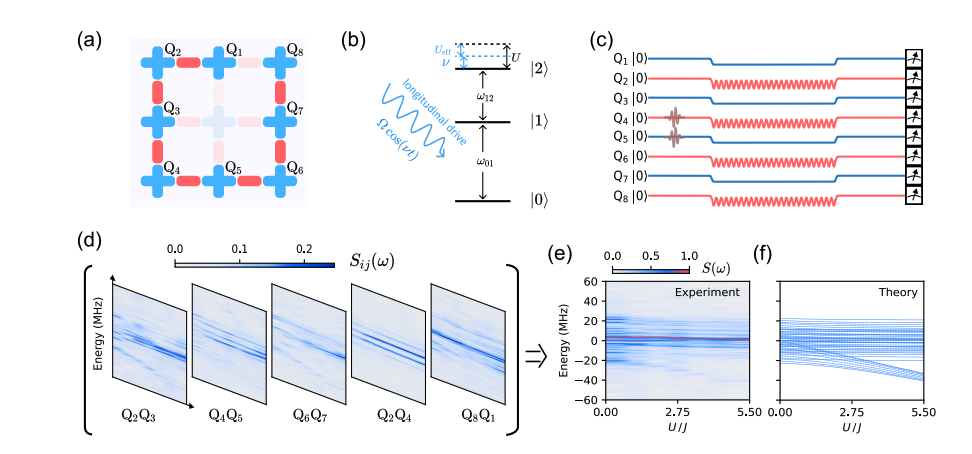
Researchers have demonstrated precise control over the behavior of particles within a specially designed superconducting circuit, revealing new insights into quantum correlations. The team engineered an array of qutrits, quantum bits capable of existing in three states, and used a technique to tune the interactions between them. This allowed for detailed study of how particles correlate and move within the system. Experiments confirmed the ability to manipulate particle interactions and demonstrated a transition in the energy spectrum as interaction strength increased, a result supported by theoretical calculations.
Measurements revealed how the probability of particle transfer between qutrits changed with varying interaction strengths, demonstrating that increasing interaction strength can either suppress or enhance transfer depending on the initial conditions. Measurements of the density-density correlator revealed a shift from particles grouping together to particles avoiding each other as interaction strength increased, indicating a change in their quantum statistics. This transition, observed through a specific interference technique, confirms the ability to control particle correlations within the system. These findings extend the possibilities for simulating correlated systems using superconducting circuits and offer a platform for exploring complex quantum phenomena.
Tunable Qutrit Interactions Control Correlation Propagation
This research experimentally investigates the dynamics of correlations within arrays of superconducting qutrit systems, revealing how interactions influence the propagation of quantum information. The team successfully demonstrates control over these correlations through tunable interactions, observing transitions between different types of correlation depending on the strength of these interactions. Specifically, they find that the propagation of certain measures of correlation can be suppressed or remain stable, depending on the initial state of the system and the interaction strength. The study highlights the importance of interaction in shaping quantum dynamics and extends the capabilities of superconducting circuits for simulating correlated systems.
Results show that entanglement can persist throughout particle walks when interactions are minimal, but this is generally not the case as interaction strength increases. The authors acknowledge that their observations are currently limited to a specific timescale and that longer-term dynamics, particularly within the two-particle system, require further investigation. Future work could explore these longer timescales and potentially reveal more complex behaviours in these engineered quantum systems, furthering our understanding of quantum correlations and their control.
🗞 Observing Two-Particle Correlation Dynamics in Tunable Superconducting Bose-Hubbard Simulators
🧠 ArXiv: https://arxiv.org/abs/2509.02180


