

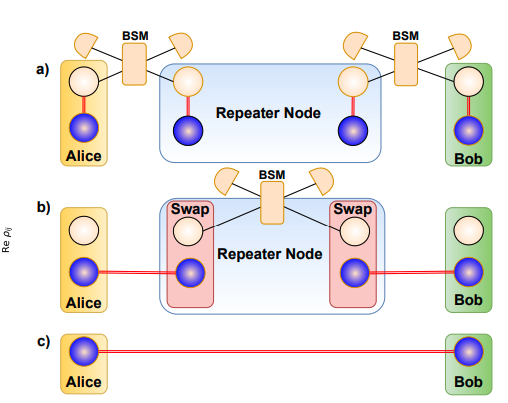
The development of practical quantum networks necessitates overcoming the inherent limitations of transmitting quantum information over significant distances, primarily photon loss and decoherence. Researchers are actively investigating quantum repeaters, devices that extend communication range without compromising the fragile quantum states of transmitted qubits. A new study, detailed in the article ‘Quantum Repeater Chains via Cavity Magnon for Scalable Quantum Networks’, proposes an architecture utilising cavity magnons – collective excitations of magnetic moments in materials – as a means of efficiently swapping quantum information across multi-hop networks. Mughees Ahmed Khan, from the Qatar Center for Quantum Computing at Hamad Bin Khalifa University, and Syed Shahmir, from the Division of Information and Computing Technology at the same institution, lead the investigation, alongside M. Talha Rahim, Saif Al-Kuwari, Tasawar Abbas and colleagues. Their numerical simulations, employing realistic parameters, analyse the performance and scalability of this cavity-magnon system across various network configurations, suggesting a potentially advantageous platform compared to existing quantum memory technologies.
Quantum communication represents a fundamental shift in information transfer, utilising the principles of quantum mechanics to enhance security and capability. It employs qubits, which, through the quantum phenomenon of superposition, can represent 0, 1, or both simultaneously, a distinction from classical bits limited to representing either 0 or 1. This foundational difference enables secure key distribution via quantum cryptography and facilitates distributed quantum computing, offering potential computational advantages over classical systems. Realising large-scale quantum networks, however, presents considerable challenges related to maintaining the fragile quantum states of qubits over extended distances.
A primary obstacle arises from signal degradation during transmission, specifically photon loss and decoherence. Photon loss occurs when photons, the carriers of quantum information, are absorbed or scattered during transmission. At the same time, decoherence, resulting from interactions with the surrounding environment, collapses quantum superposition, thereby destroying the encoded information. These effects limit the reliable transmission distance, necessitating the development of quantum repeaters. Classical repeaters are unsuitable for quantum communication due to the no-cloning theorem – which prohibits the creation of identical copies of an unknown quantum state – and the Heisenberg uncertainty principle, which fundamentally restricts the precision with which certain pairs of physical properties can be known.
Consequently, quantum repeaters employ a different strategy, dividing long-distance communication into shorter segments and utilising entanglement swapping to extend the quantum state. This process allows for the creation of entanglement between qubits that have never directly interacted, effectively teleporting quantum information. Building effective quantum repeaters requires suitable quantum memories, capable of storing qubits for extended periods while preserving their quantum properties, and various physical systems, including atomic ensembles, nitrogen-vacancy centres in diamond, and solid-state spin systems, are being investigated as potential platforms.
Recent research details a promising architecture utilising cavity-magnon
Recent research details a promising architecture utilising cavity-magnon systems as quantum repeaters. This approach focuses on leveraging the unique properties of magnons – quasiparticles representing collective spin waves in magnetic materials – to mediate entanglement between superconducting qubits. This architecture exploits the frequency tunability and relatively long coherence times achievable in magnonic systems, offering a potentially advantageous alternative to existing repeater technologies. The core of this proposed system lies in the interaction between superconducting qubits and magnons confined within carefully designed cavities, enhancing coupling and improving entanglement generation and transfer efficiency.
Crucially, the frequency of the magnons can be precisely tuned, allowing for the multiplexing of multiple entangled qubit pairs over the same communication channel. This spectral multiplexing, analogous to dense wavelength division multiplexing (DWDM) used in conventional fibre optic networks, significantly increases network capacity and throughput. Comprehensive numerical simulations, employing realistic experimental parameters, have been conducted to analyse the performance of this cavity-magnon repeater architecture across various deployment scenarios and network scales. These simulations demonstrate the viability of the approach, revealing critical factors influencing performance and scalability, and researchers have modelled both short-range and long-distance implementations, assessing the impact of signal loss, decoherence, and imperfect entanglement generation.
The results indicate that cavity-magnon systems offer significant integration advantages over existing memory technologies commonly used in quantum repeaters, potentially simplifying the construction and operation of complex quantum networks. Maintaining the coherence of both qubits and magnons is paramount, as any disruption to their quantum states can lead to errors in communication. Optimising entanglement generation efficiency is also crucial, as the rate at which entangled pairs can be created directly impacts network performance. Furthermore, scaling up the network to accommodate a large number of nodes requires addressing practical limitations in the fabrication and control of the necessary components.
The study highlights the potential integration advantages of cavity-magnon systems compared to existing quantum memory technologies, such as atomic ensembles or trapped ions, which can present challenges in terms of scalability and compatibility with existing fibre optic infrastructure. Magnons offer a viable alternative, potentially streamlining the integration of quantum communication with established telecommunications networks. Researchers actively model the impact of various network parameters, such as signal loss and decoherence rates, to optimise system performance.
This research demonstrates that cavity-magnon systems represent a
This research demonstrates that cavity-magnon systems represent a promising platform for building scalable quantum repeater networks. By carefully controlling the interaction between magnons and photons, researchers achieve efficient entanglement swapping and extend the range of quantum communication. This work contributes to the ongoing development of secure communication protocols, distributed quantum computing, and other applications reliant on long-distance quantum information transfer.
The use of microwave frequencies aligns with established technologies like DWDM, potentially accelerating the deployment of a quantum internet by leveraging existing fibre optic networks. Future work focuses on experimentally validating the simulation results and addressing remaining challenges, including developing more robust quantum memories based on magnonic materials, improving the fidelity of entanglement generation and distribution, and scaling up the system to larger network sizes. Investigating novel magnonic materials with enhanced coherence properties represents a key area for ongoing research. Further exploration will also concentrate on developing advanced quantum networking protocols tailored to the specific characteristics of cavity-magnon repeaters, optimising entanglement routing algorithms and implementing error correction schemes to mitigate the effects of noise and decoherence.
🗞 Quantum Repeater Chains via Cavity Magnon for Scalable Quantum Networks
🧠 DOI: https://doi.org/10.48550/arXiv.2507.04499


