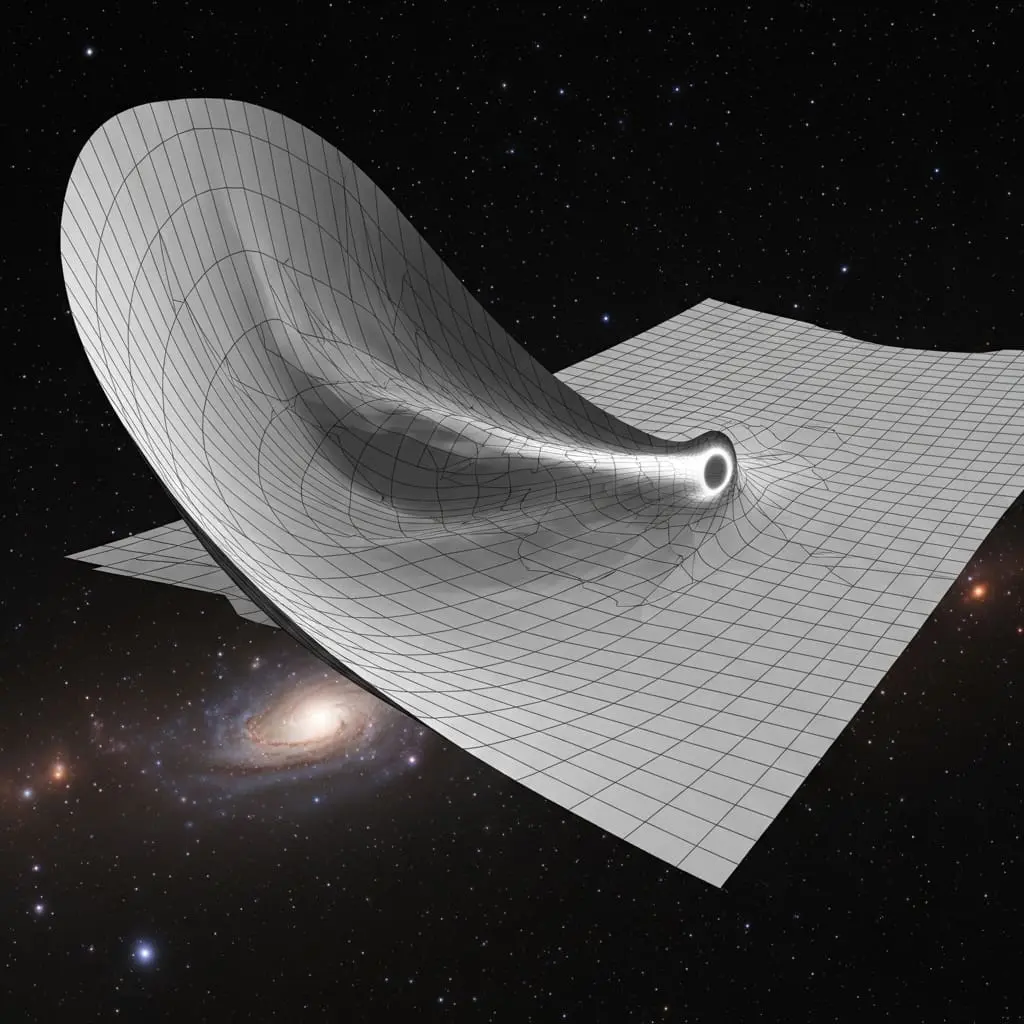
Scientists are increasingly focused on understanding the ultimate fate of black holes and the mechanisms driving their evaporation. Victor H. Alencar from Universidade Federal do Rio de Janeiro, alongside colleagues, demonstrate a novel perspective on this process, proposing that black hole evaporation occurs via topological tunneling. Their research quantifies the electromagnetic field surrounding a Schwarzschild black hole, revealing a quantum atmosphere that contributes positively to the system’s specific heat and potentially its thermodynamic stability. Crucially, the team show that this evaporation represents a transition between topologically distinct spacetimes, from the black hole’s curved geometry to flat spacetime, governed by the Gibbons, Hawking, York boundary term. This work not only supports the established Parikh-Wilczek model of Hawking radiation but also frames Euclidean black holes as gravitational instantons, offering a deeper insight into the interplay between gravity, quantum mechanics, and topology.
Topological Tunneling and the Quantum Origin of Black Hole Evaporation suggest a profound connection between seemingly disparate phenomena
Topological Mechanics of Black Hole Evaporation
Topological Mechanisms Driving Black Hole Tunneling
Scientists have uncovered a topological mechanism driving black hole evaporation, revealing that these cosmic phenomena tunnel between fundamentally different spacetimes. This work quantifies the electromagnetic field surrounding a Schwarzschild black hole using Euclidean path integrals, demonstrating the existence of a “quantum atmosphere” of photons at a temperature of TH = 1/8πGM.
The research establishes a direct link between black hole evaporation and a change in the Euler characteristic, a topological invariant, as the black hole transitions from a Schwarzschild spacetime (χ = 2) to flat spacetime (χ = 1). This finding corroborates the Parikh-Wilczek picture of Hawking radiation and reinforces the interpretation of Euclidean black holes as gravitational instantons.
Researchers calculated the contribution of this quantum atmosphere to the black hole’s specific heat, finding it to be positive, suggesting a potential for thermodynamic stabilization. Algebraic methods were favoured over analytical techniques, such as the Chern-Gauss-Bonnet theorem, to study the topological effects of D-dimensional black holes.
Furthermore, the research extends a two-dimensional formula to D-dimensional spacetimes, providing a nonlocal method for evaluating the Hawking temperature of a spacetime. This work proposes a quantum interpretation of Euclidean black holes as solutions describing tunnelings between topologically inequivalent spacetimes, offering a novel perspective on the fate of information within these enigmatic objects and potentially paving the way for a deeper understanding of quantum gravity.
Quantifying black hole evaporation via Euclidean path integrals and topological transitions requires careful regularization and interpretation
Quantifying Vacuum Energy Using Euclidean Path Integrals
Calculating Vacuum Energy using Euclidean Path Integrals
Euclidean path integrals underpinned the quantization of the electromagnetic field near the event horizon of a Schwarzschild black hole. This work computed the vacuum energy, revealing a black hole surrounded by a finite volume atmosphere at approximately 1/8πGM. Specifically, a Schwarzschild spacetime (S2 × R2) transitions to flat spacetime (R4) via Hawking radiation, evidenced by a change in the Euler characteristic from χ(MBH) = 2 to χ(MFlat) = 1.
This process shares similarities with instanton-driven tunneling observed in Yang-Mills theories, where topologically non-trivial solutions dominate vacuum amplitude. These algebraic calculations remain consistent across any dimension due to the Künneth formula, simplifying complex integrations that arise with increasing dimensionality.
A new computation of the Hawking temperature for D-dimensional Schwarzschild-Tangherlini black holes was achieved using this generalized formula, providing a nonlocal, global method for its evaluation. The resulting partition function describes an evaporating black hole surrounded by this atmosphere of photons at the Hawking temperature of 1 over 8πGM.
Thermodynamic Implications for Black Hole Stability
Implications for Black Hole Thermodynamic Stability
Analysis of the total entropy reveals contributions from both the quantum atmosphere and the Bekenstein entropy, with the atmosphere’s contribution to the black hole specific heat being positive. This positive correction suggests a potential thermodynamic stabilization of the black hole due to the presence of the quantum atmosphere.
Analyzing Spacetime Structure through Homology Groups
Homology group analysis further elucidates the topological features of black hole evaporation, revealing a variation in the Euler characteristic of the spacetime during the process. The study establishes a quantum interpretation of Euclidean black holes as solutions describing tunnelings between topologically inequivalent spacetimes, reproducing WKB results for Hawking radiation and reinforcing the understanding of black hole evaporation as a tunneling phenomenon. The Euler characteristic can be considered a quantum number characterising the black hole state, analogous to atomic properties.
Hawking radiation as topological tunneling and a black hole phase transition suggests a deeper connection between quantum gravity and thermodynamics
Scientists have quantified the electromagnetic field surrounding a Schwarzschild black hole, predicting the existence of a quantum black hole atmosphere. This atmosphere, a finite volume of photons at the black hole’s Hawking temperature, contributes to both the black hole’s entropy and its specific heat.
Calculations reveal a positive contribution to the specific heat above a critical temperature, suggesting black hole evaporation may represent a phase transition. The research establishes a link between black hole evaporation and changes in spacetime topology, demonstrating that the process resembles a tunneling effect between topologically distinct spacetimes.
Analysis of homology groups confirms this tunneling, mirroring instanton-driven tunneling observed in Yang-Mills theories. The findings support the Parikh-Wilczek model of Hawking radiation and reinforce the understanding of Euclidean black holes as gravitational instantons. The authors acknowledge that extending this methodology to rotating, Kerr black holes presents a significant challenge due to the reduced symmetry, preventing a straightforward simplification of the calculations. Future work could focus on applying this approach to more complex black hole scenarios and exploring the implications for Yang-Mills theories within the Schwarzschild background.
🗞 Black Hole Evaporation as a Topological Tunneling
🧠 ArXiv: https://arxiv.org/abs/2602.02357