Desiree Lim and colleagues have created defect-free atom arrays containing up to 1024 atoms. The arrays were achieved using a new cryogenic platform operating at 4 K. This setup incorporates high numerical aperture optics and extends trapping lifetimes to approximately 5000 seconds, a sharp increase in experimental time. The ability to reliably prepare large-scale, defect-free arrays unlocks new possibilities for both analogue and digital quantum computation
Extended Lifetimes and Scalability in 1024-Atom Neutral Atom Arrays
Defect-free neutral atom arrays now extend to 1024 atoms, a significant leap from previous limitations of 800 atoms. This advancement represents a crucial step towards realising scalable quantum technologies. The new platform, operating at 4 Kelvin, sustains trapping lifetimes of around 5000 seconds, offering an unprecedented duration for complex quantum experiments and manipulations. Previously, atomic lifetimes of only a few hundred seconds severely restricted the creation of large-scale, reliable quantum systems, hindering the exploration of complex quantum phenomena. This breakthrough surpasses those constraints, enabling more intricate experimental designs and longer observation periods. Neutral atom arrays are particularly attractive for quantum information processing due to their long coherence times and the ability to individually address and control each atom. The coherence time, representing how long an atom maintains its quantum state, is vital for performing complex calculations without introducing errors.
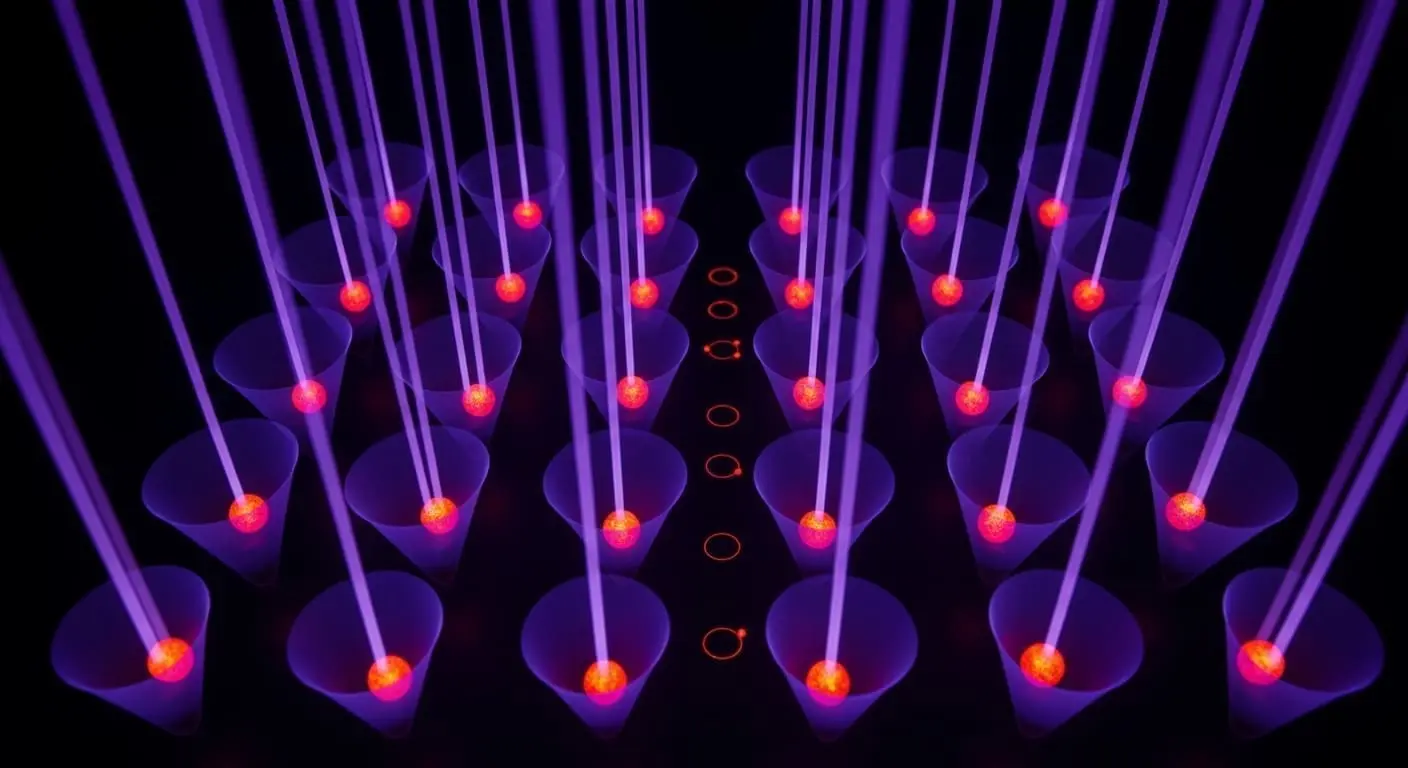
Two trapping lasers at differing wavelengths were key to building these extended arrays, effectively increasing the density and scale of trapped atoms. This dual-laser approach allows for finer control over the inter-atomic spacing and the overall array geometry. The differing wavelengths enable the creation of a more complex potential landscape for the atoms, optimising the packing arrangement and minimising unwanted interactions. Careful management of atom loss during rearrangement and imaging proved important, as minimising these losses directly extended the trapping lifetimes. Atom loss can occur through collisions with background gas molecules or through spontaneous emission of photons. Reducing these losses requires maintaining an ultra-high vacuum environment and carefully optimising the imaging process to minimise excitation of the atoms. High numerical aperture optics, incorporated into the cryogenic design, further enhance the precision and stability of these atom arrangements, paving the way for advanced quantum simulations and computation. These optics allow for tighter focusing of the trapping lasers, resulting in stronger trapping potentials and more stable atom positions. The high numerical aperture also improves the resolution of the imaging system, enabling more accurate characterisation of the atom arrays.
The system’s design incorporated windows on the thermal shields to interrupt direct paths between warmer and colder regions, reducing contamination and maintaining the ultra-high vacuum essential for long-duration experiments; this is akin to insulating a cold drink to prevent it from warming up quickly. Maintaining such a low temperature and high vacuum is a considerable engineering challenge. The thermal shields act as barriers to radiative heat transfer, minimising the influx of heat from the warmer environment. A 4 Kelvin cryogenic platform, incorporating lenses with a wide acceptance angle, precisely arranges and controls the atoms. The wide acceptance angle of the lenses allows for a larger range of atom positions to be effectively trapped, increasing the robustness of the array against imperfections in the initial atom distribution. Although the system demonstrates high performance, the current defect rate of 0.3 percent indicates further refinement is needed before these arrays can reliably support the error correction essential for practical quantum computation. Error correction is crucial for building fault-tolerant quantum computers, as it allows for the detection and correction of errors that inevitably occur during quantum operations. This approach was favoured to improve vacuum performance over previous iterations, as a better vacuum directly translates to longer trapping times and reduced atom loss.
Dual-laser lattice formation and cryogenic vacuum optimisation
Successfully assembled defect-free arrays contain up to 1024 atoms, with an average defect rate of 0.3 percent. This technique involved creating independent trap arrays, effectively building a more extensive lattice than possible with a single laser. The process resembles constructing a wall using both large and small bricks to fill every space efficiently. By interleaving the traps created by the two lasers, the researchers were able to achieve a higher density of atoms and a more uniform array structure. This approach also allows for greater flexibility in the design of the array geometry, enabling the creation of more complex lattice structures. The independent control of each laser allows for precise tuning of the trap positions and strengths, optimising the array for specific quantum simulations or computations.
Extended atom trapping times pave the way for scalable quantum computation experiments
Arrays of over a thousand atoms, held stable for over an hour, represent a major step towards building practical quantum devices. Extending atom trapping times to over half an hour is a significant engineering achievement, even without demonstrated quantum calculations. The ability to maintain stable atom arrays for extended periods is essential for performing complex quantum algorithms, which require a many quantum operations. The platform can prepare atoms in Rydberg states, a technique used to create strong interactions between atoms and perform quantum operations, but it doesn’t demonstrate any actual quantum calculations or entanglement. Rydberg states are formed when an atom is excited to a very high energy level, resulting in a greatly enhanced interaction with other atoms. These strong interactions can be used to implement quantum gates, the fundamental building blocks of quantum circuits.
Maintaining control of over a thousand atoms for such durations previously proved exceptionally difficult using optical tweezers, which employ highly focused lasers to hold individual atoms. This prolonged stability unlocks possibilities for more complex experiments, allowing careful preparation and manipulation of these atomic arrays; it addresses a key bottleneck in building larger, more reliable quantum processors. The combination of extended lifetimes and large array sizes unlocks opportunities for exploring complex quantum phenomena and building more sophisticated quantum simulators. Quantum simulators can be used to model the behaviour of complex quantum systems, such as materials and molecules, providing insights that are inaccessible through classical computation. This new platform extends the practical limits of neutral atom array technology, achieving stable manipulation of 1024 atoms for approximately 5000 seconds, and employs lenses to focus light tightly, integral to precisely arranging and controlling these atoms within the cryogenic, or ultra-cold, environment. The precise control afforded by this system promises to accelerate research in quantum information science and unlock new avenues for quantum technology development.
The researchers successfully created a system capable of trapping and maintaining arrays of up to 1024 atoms for around 5000 seconds. This extended trapping lifetime is significant because it provides more time to prepare and manipulate atoms for complex experiments. The platform utilises cryogenic cooling to 4 K and high numerical aperture optics to achieve this stability, addressing a major challenge in building larger quantum processors. The authors suggest this technology will enable exploration of complex quantum phenomena and the development of more sophisticated quantum simulators.
👉 More information
🗞 Defect-free arrays at the thousand-atom scale in a 4-K cryogenic environment
🧠 ArXiv: https://arxiv.org/abs/2604.07205