Antiferromagnets exhibit squeezed magnon pseudospins—analogous to electronic spin—enhanced by manipulating quantum fluctuations. Calculations using nickel oxide and hematite demonstrate control over coupling between magnonic modes and other excitations. This research establishes a qubit spectroscopy protocol for detecting superpositions within these squeezed states, applicable to coupled bosonic systems.
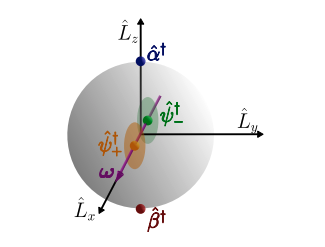
The manipulation of quantum states offers potential advances in information processing and sensing. Recent research focuses on antiferromagnetic materials, which exhibit collective spin excitations known as magnons, and their potential for creating squeezed states – quantum states with reduced noise in specific measurable properties. These squeezed states, when applied to coupled magnonic excitations forming a ‘magnon pseudospin’ – analogous to the spin of an electron – could offer enhanced control over these excitations and their interactions. A team led by Anna-Luisa E. Römling, Johannes Feist, and Francisco J. García-Vidal at the Universidad Autónoma de Madrid, in collaboration with Akashdeep Kamra from the Rheinland-Pfälzische Technische Universität Kaiserslautern-Landau, details these findings in their article, ‘Squeezing and quantum control of antiferromagnetic magnon pseudospin’. They demonstrate, using nickel oxide and hematite as examples, how engineering fluctuations in the ground state can enhance coupling between magnonic modes and other excitations, and propose a spectroscopic protocol for detecting superposition states within the squeezed pseudospin.
This work details how rotation operators transform a pair of operators, α and β, relevant to the study of antiferromagnetic materials and their associated magnonic excitations. The central finding demonstrates that a rotation operator, Ry(θ), induces a mixing of these operators analogous to a two-dimensional rotation in the α-β plane, providing a foundational understanding of their dynamics under rotational influence. Researchers employ a series expansion based on the Baker-Campbell-Hausdorff (BCH) formula – a mathematical identity simplifying expressions involving nested exponentials of operators – to rigorously establish this transformation, moving beyond approximations commonly used in similar analyses.
The investigation builds upon recent experimental observations of
The investigation builds upon recent experimental observations of coherently coupled magnonic excitations in antiferromagnets, which exhibit behaviour analogous to electronic spin – termed a ‘magnon pseudospin’. Scientists meticulously detail the transformation properties of operators representing these excitations, revealing how they respond to rotational influences and establishing a crucial link between theoretical models and experimental findings. This work provides a foundational understanding of magnon pseudospin dynamics, potentially enabling the development of novel spintronic devices and quantum technologies.
Researchers systematically derive the transformation equations using the BCH formula, expanding the exponential of the rotation operator into a series of commutators. They carefully calculate these commutators, refining the approximation and ensuring accuracy. This meticulous approach allows scientists to precisely determine the effect of rotation on the operators, providing a robust framework for analysing their dynamics. The resulting transformation equations are: Ry(θ) α Ry†(θ) = cos(θ/2) α + sin(θ/2) β and Ry(θ) β Ry†(θ) = cos(θ/2) β + sin(θ/2) α. These equations demonstrate that the rotation mixes the α and β operators, with the mixing angle dependent on the rotation angle θ.
Researchers emphasise the broad applicability of their findings,
Researchers emphasise the broad applicability of their findings, extending beyond antiferromagnets to encompass any system involving coupled bosons. They suggest avenues for future research that will further expand our understanding of these materials.
🗞 Squeezing and quantum control of antiferromagnetic magnon pseudospin
🧠 DOI: https://doi.org/10.48550/arXiv.2506.06064