

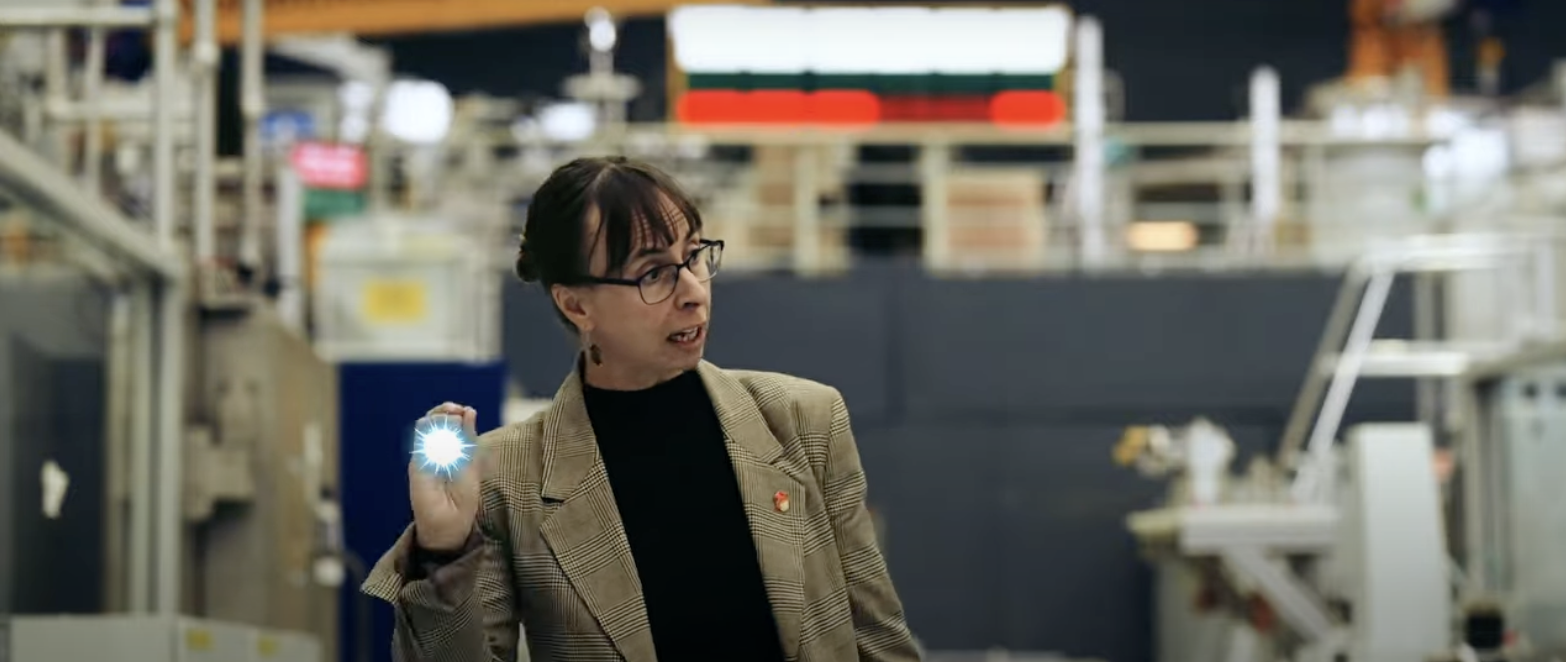
Researchers at the Australian Nuclear Science and Technology Organisation (ANSTO) are investigating quantum materials utilising quantum-based techniques to explore fundamental aspects of quantum theory, which elucidates the discrete nature of energy at the subatomic level. This framework posits that energy exists in quantifiable units termed quanta, manifesting across the electromagnetic spectrum – encompassing radio waves, visible light, and X-rays – where quantum energy is directly proportional to radiation frequency. Observations of wave-particle duality, exemplified by phenomena such as interference patterns in bubble formations and photovoltaic energy generation in solar cells, demonstrate that electromagnetic radiation and subatomic particles, including electrons, exhibit both wave-like and particulate behaviours; a principle central to understanding the behaviour of matter and energy at the smallest scales. This research, presented during National Science Week, focuses on decoding the underlying languages of nature through the application of quantum principles to material science.
Quantum Fundamentals
Quantum fundamentals underpin much of modern physics, extending beyond theoretical constructs into practical applications at ANSTO and globally. The exploration of these fundamentals centres on the premise that energy, at its most basic level, is not continuous but quantized – existing in discrete units known as quanta.
This concept, central to quantum theory, dictates that energy can only be absorbed or emitted in multiples of these quanta, a principle rigorously investigated through experiments involving electromagnetic radiation and subatomic particles. The electromagnetic spectrum, encompassing wavelengths from radio waves to gamma rays, provides a tangible demonstration of this quantization.
Each frequency within this spectrum corresponds to a specific energy level, dictated by Planck’s equation (E=hf, where E is energy, h is Planck’s constant, and f is frequency). This relationship explains observable phenomena such as the colour changes observed when heating materials; as temperature increases, photons emitted possess higher frequencies and energies, progressing from red (lower energy) to yellow and ultimately white (higher energy).
A crucial aspect of quantum behaviour is wave-particle duality, a concept challenging classical physics’ distinct categorization of waves and particles. Electromagnetic radiation, including visible light, exhibits interference patterns – demonstrable in phenomena like the iridescent colours observed in soap bubbles – characteristic of wave behaviour.
Simultaneously, this same radiation interacts with matter as discrete packets of energy, photons, capable of inducing effects like photoelectric emission in solar cells, thereby behaving as particles. This duality extends beyond electromagnetic radiation to encompass matter itself.
Subatomic particles, such as electrons, traditionally considered particles, demonstrate wave-like characteristics through phenomena like electron diffraction. This behaviour is mathematically described by the de Broglie wavelength (λ = h/p, where λ is wavelength, h is Planck’s constant, and p is momentum), establishing a fundamental connection between a particle’s momentum and its associated wavelength.
The implications of this quantum wave duality are profound, necessitating a probabilistic rather than deterministic understanding of the behaviour of matter at the quantum level. Research at ANSTO leverages these quantum principles in the investigation of quantum materials, seeking to understand and manipulate their unique properties.
These investigations employ techniques sensitive to the quantized nature of energy and matter, furthering our understanding of the fundamental languages governing the universe and potentially enabling novel technologies. Further exploration into these areas is ongoing, with funding sourced from national research grants and collaborative partnerships with international institutions.
More information
External Link: Click Here For More


