
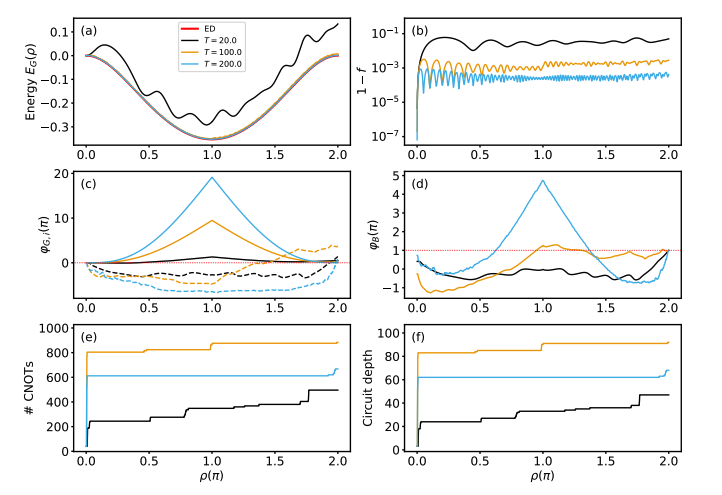
A computational method efficiently calculates the Berry phase in topological Hamiltonians, utilising adaptive state preparation and evolution. Benchmarking on four-site dimerised Fermi-Hubbard chains demonstrates accurate simulations across non-interacting and interacting regimes, achieving circuit depths of up to 279 layers and confirming robustness across parameter variations.
The behaviour of electrons in materials exhibiting complex topological properties dictates many advanced material characteristics, and accurate calculation of the Berry phase, a geometric property arising from the adiabatic evolution of a quantum system, is crucial for understanding these behaviours. This is particularly challenging in strongly correlated systems where interactions between electrons significantly complicate calculations. Researchers at Ames National Laboratory and Iowa State University, led by Martin Mootz and Yong-Xin Yao et al, present a novel computational approach to determine the Berry phase in topological Hamiltonians efficiently. Their work, detailed in the article ‘Efficient Berry Phase Calculation via Adaptive Variational Quantum Computing Approach’, utilises adaptive variational quantum algorithms to optimise circuit efficiency and maintain accuracy in simulating these complex systems, demonstrating performance on dimerized Fermi-Hubbard chains and highlighting potential for advancements in the simulation of topological materials.
Quantum computing currently encompasses a broad spectrum of research, ranging from foundational theoretical development to the creation of specific algorithms and their practical applications. Reviews consistently indicate the potential for transformative change across numerous fields, specifically by addressing problems currently considered computationally intractable for classical computers. Core algorithms, such as Shor’s algorithm for factoring large numbers and Grover’s algorithm for database searching, demonstrate the possibility of substantial speedups, opening new avenues for scientific discovery and technological innovation.
A considerable research focus centres on variational quantum algorithms, notably the Variational Quantum Eigensolver (VQE). VQE is a hybrid quantum-classical algorithm used to find the ground state energy of a molecule or material. These algorithms represent a near-term approach to quantum computation, offering a pathway to harness quantum power despite the limitations of current hardware, specifically limited coherence – the duration a quantum bit, or qubit, maintains its quantum state – and gate fidelities – the accuracy of operations performed on qubits. Applications of quantum simulation, particularly to molecular vibrations and many-body physics, demonstrate the potential to tackle complex problems in chemistry and materials science, areas where classical simulations are often computationally prohibitive. Concurrent theoretical work on error mitigation techniques, which aim to reduce the impact of noise on quantum computations, underscores the critical importance of addressing these imperfections for reliable and accurate results.
The demonstration of quantum supremacy in 2019, where a quantum computer performed a specific calculation demonstrably faster than the most powerful classical supercomputer, marks a significant milestone. While the practical utility of that specific calculation remains limited, the achievement sparked considerable debate and accelerated both hardware and software development within the field. The prevalence of research disseminated via arXiv preprints, a publicly accessible archive, indicates the dynamic and rapidly evolving nature of quantum computing, with research constantly pushing the boundaries of what is possible. Categorisation of research areas, from fundamental theory to practical applications, provides a clear structure for understanding the diverse landscape of investigation.
Recent research explores the use of adaptive VQEs to efficiently simulate Berry phases in topological systems. A Berry phase is a geometric phase acquired by a quantum system as it undergoes a cyclic evolution, and is crucial for understanding the behaviour of electrons in materials. This offers a viable pathway for advancing simulations of topological materials, which exhibit unique electronic properties due to their non-trivial topology, and computing geometric phases in complex quantum systems. This is achieved by carefully balancing computational accuracy and efficiency, focusing on a well-defined model system and leveraging adaptive algorithms that refine the quantum circuit during the computation. The ability to accurately calculate the Berry phase is fundamental to understanding and potentially harnessing the unique properties of topological materials for future technologies, representing a significant step towards realising that potential. This work offers a powerful tool for exploring the frontiers of quantum physics and materials science.
👉 More information
🗞 Efficient Berry Phase Calculation via Adaptive Variational Quantum Computing Approach
🧠 DOI: https://doi.org/10.48550/arXiv.2506.19150