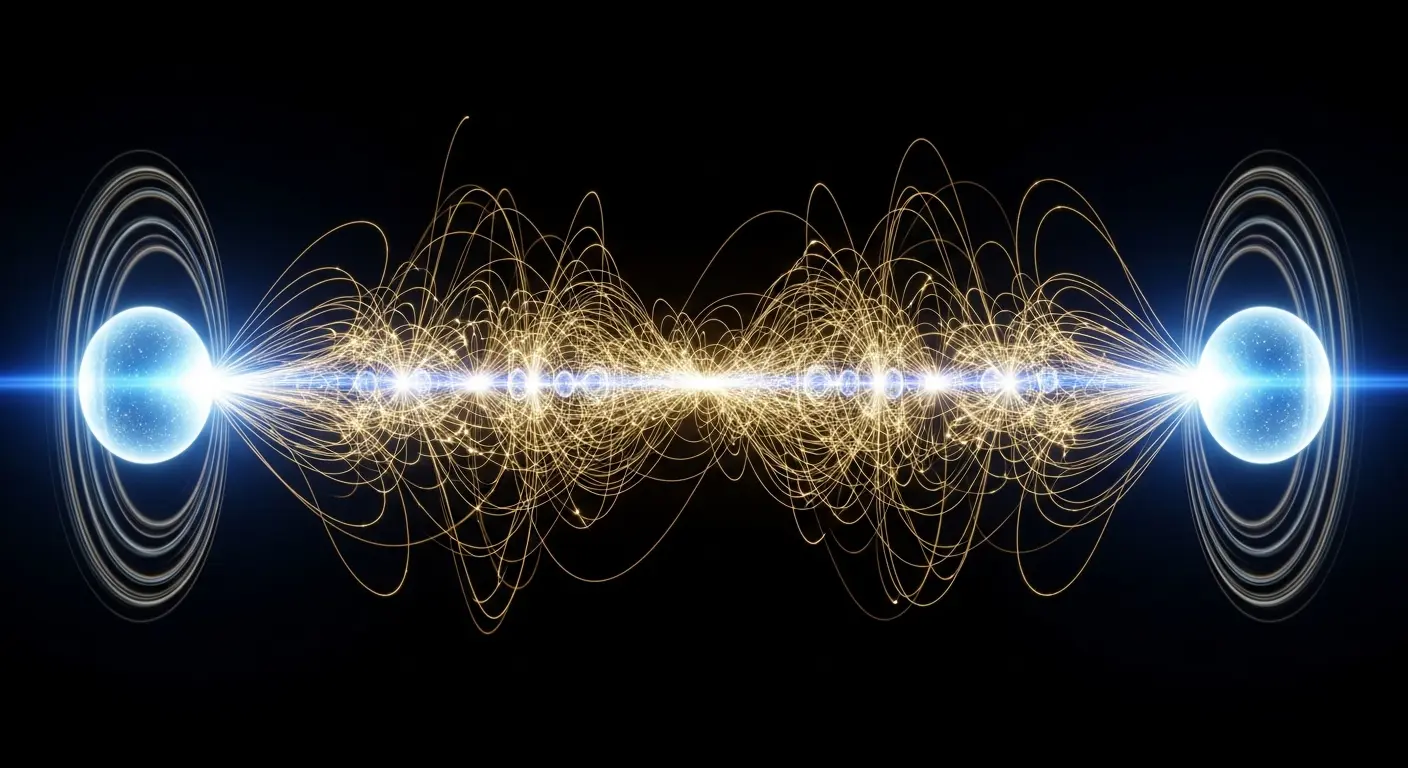
A new interface for terahertz (THz) quantum technologies generates entanglement between quantum emitters via a THz channel. Yanis Le Fur and colleagues at Departamento de Física Teórica de la Materia Condensada and Condensed Matter Physics Centre (IFIMAC) and Institute of Fundamental Physics IFF-CSIC demonstrate steady-state entanglement between polar quantum emitters using THz photons, achieving a concurrence exceeding 0.9 under realistic conditions. The interface establishes a hybrid visible-THz quantum interface, enabling qubit-qubit entanglement mediated by a THz channel while maintaining full optical control and readout, thus circumventing the need for direct THz manipulation and detection.
High-concurrence visible-terahertz entanglement via optically driven polar quantum emitters
Entanglement measures now exceed 0.9, a substantial improvement over previously attainable values. Until recently, achieving such high concurrence demanded parameters impractical for most laboratories, often requiring cryogenic temperatures and highly specialised equipment. This breakthrough establishes a functional visible-THz quantum interface, enabling qubit-qubit entanglement mediated by a terahertz channel while retaining full optical control and readout, circumventing the need for direct terahertz manipulation and detection. The significance of this lies in the simplification of experimental setups and the potential for integration with existing optical quantum technologies. Terahertz frequencies, positioned between microwave and infrared radiation in the electromagnetic spectrum, offer potential for high-bandwidth quantum communication and spectroscopy, but have historically been difficult to control at the single-photon level.
The team’s approach utilises strong visible-light driving to create Rabi-split dressed eigenstates, effectively new energy levels tuned into the terahertz regime, allowing for collective dissipative dynamics and, ultimately, stable entanglement. These dressed states arise from the interaction of the quantum emitter with a strong coherent light field, modifying its energy landscape. The strength of the driving field is crucial; it must be sufficient to induce a significant splitting of the energy levels without causing unwanted transitions. Coherent manipulation and quantum state tomography are demonstrated entirely through optical means, a substantial simplification over previous methods which often relied on complex THz sources and detectors. Two polar quantum emitters have demonstrated stable entanglement, achieving a concurrence exceeding 0.9 under laboratory conditions. Polar quantum emitters, possessing a strong dipole moment, are particularly well-suited for mediating interactions with THz photons due to their enhanced coupling to the electromagnetic field.
This high level of entanglement relies on mediating interactions via terahertz photons, and the system exhibits Purcell decay rates, where the cavity enhances the emission of light from the emitters, contributing to the entanglement generation process. The Purcell effect effectively accelerates the spontaneous emission rate, increasing the efficiency of the entanglement process. Analytical modelling confirms the stabilisation of a ‘dark state’, a key requirement for sustained entanglement, when primary Mollow sidebands are spectrally aligned and secondary Mollow triplets overlap, demonstrating a pathway to optical control. Mollow sidebands are spectral features that appear when an atom is driven by a strong coherent light source, providing information about the energy levels and transition rates within the system. The alignment of these sidebands is critical for establishing the necessary conditions for entanglement.
Consider a single swing that, when pushed at the right frequency, splits into two swings with slightly different motions; this illustrates how the energy levels diverge. Visible light was carefully tuned to position the energy separation of these ‘split’ states into the terahertz (THz) regime, a region of the electromagnetic spectrum with frequencies between microwave and infrared light. This tuning process is analogous to adjusting the driving frequency of the swing to achieve the desired splitting of the energy levels. Concurrence values exceeding 0.9 were achieved under experimentally feasible parameters, including detuning close to the THz transition frequency and optical driving fields of 499.8GHz and 497.4GHz. A lossy single-mode resonator served as the THz channel, operating in a regime where collective dissipation and coherent driving stabilised the entangled state. The lossy resonator, while introducing some degree of signal attenuation, is crucial for establishing the collective dissipative dynamics necessary for entanglement generation. The specific frequencies employed (499.8GHz and 497.4GHz) were chosen to optimise the coupling between the emitters and the THz channel.
Establishing entanglement via terahertz photons offers a promising route to next-generation quantum devices, particularly in areas such as quantum communication and sensing. The higher frequencies associated with terahertz radiation allow for increased data transmission rates and improved spatial resolution. However, scaling up this approach presents considerable hurdles. Extending this to larger, more complex systems, necessary for practical quantum computation, remains a significant challenge. Maintaining coherence, the delicate quantum state underpinning these technologies, over extended timescales is a known limitation; this fragility could severely restrict the complexity of computations possible. Environmental noise, such as temperature fluctuations and electromagnetic interference, can disrupt the coherence of the quantum state, leading to decoherence and loss of entanglement.
Despite acknowledged limitations concerning maintaining quantum coherence for complex calculations, this demonstration of terahertz-mediated entanglement is a vital step forward. The need for direct terahertz control and detection is bypassed, simplifying system design; working with terahertz frequencies is currently technically demanding, requiring specialised and expensive equipment. Establishing an optically accessible, hybrid quantum interface unlocks new possibilities for building and controlling terahertz quantum technologies, even with present-day constraints on coherence times. This optical control allows for precise manipulation of the quantum emitters, enabling the creation and manipulation of entangled states with high fidelity.
Scalability is now a primary focus, prompting questions regarding extending entanglement beyond two emitters. Investigating the feasibility of creating multi-emitter entangled states is crucial for building more complex quantum circuits. Steady-state entanglement between quantum emitters has been demonstrated, establishing a key link between optical and terahertz quantum systems. Visible light serves to control emitters and induce interactions at terahertz frequencies, considerably simplifying experimental setups. The resulting hybrid interface allows for qubit-qubit entanglement mediated by terahertz photons, a key requirement for developing future terahertz quantum technologies, and provides a foundation for further investigation into multi-emitter entanglement. Future research will likely focus on improving coherence times, increasing the number of entangled emitters, and exploring potential applications in quantum sensing and communication.
Steady-state entanglement between quantum emitters was achieved using terahertz photons, demonstrating a crucial connection between optical and terahertz quantum systems. This matters because it bypasses the need for direct terahertz control and detection, simplifying the construction of terahertz quantum technologies which currently require specialised equipment. The researchers optically controlled the emitters to induce interactions at terahertz frequencies, resulting in high concurrence values exceeding 0.9. The authors intend to focus on improving coherence times and increasing the number of entangled emitters in future work.
👉 More information
🗞 Entanglement of two optical emitters mediated by a terahertz channel
🧠 ArXiv: https://arxiv.org/abs/2604.21723



See today’s quantum computing news on Quantum Zeitgeist for the latest breakthroughs in qubits, hardware, algorithms, and industry deals.