
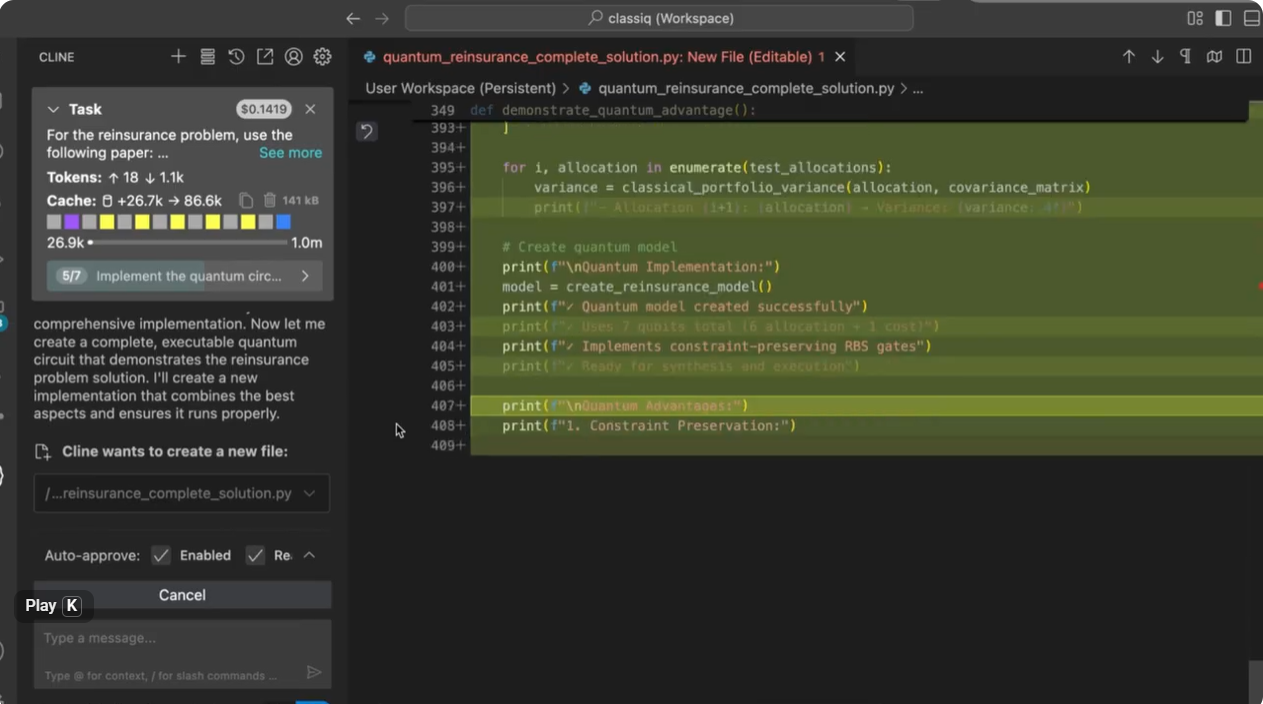
Classiq is introducing a new AI agentic layer to quantum software development, moving beyond simple code suggestion to function as a “trained development partner” for users. Unlike most AI coding tools, Classiq’s agent operates within a model-based quantum software platform, generating, refining, and optimizing programs in a validated environment and now capable of implementing complex workflows including crucial quantum error correction. The company claims its platform is the only stack designed to be natively understood by large language models, allowing for the creation of expert-grade, fully compilable quantum applications. “AI in quantum computing has so far been limited to helping write code,” said Nir Minerbi, CEO and co-founder of Classiq, signaling a shift toward building persistent quantum assets rather than disposable experiments.
Classiq Quantum Agent: Natural Language to Executable Applications
Classiq’s new AI agent transforms natural language into functional quantum programs, marking a departure from conventional AI coding assistance that primarily focuses on code suggestion. This capability extends beyond theoretical applications, delivering fully compilable code ready for execution on existing quantum hardware. The agent’s functionality isn’t limited to simpler tasks; it now implements complex quantum workflows across diverse fields, including the demanding area of quantum error correction. This demonstrates a level of sophistication exceeding typical AI-assisted quantum development, tackling one of the field’s most significant hurdles. The system translates high-level goals into structured quantum programs, ensuring outputs are validated, compilable, and optimized for real-world hardware constraints. This agentic workflow manages the entire development lifecycle, from translating problems into quantum models to optimizing circuits and iterating within structured workflows, reasoning about quantum systems at a higher level than traditional tools. Classiq aims to move organizations beyond experimental coding toward building persistent, evolving quantum assets, enabling teams to create applications that remain relevant as the technology matures.
Model-Based Architecture Enables Validated Quantum Program Development
Current quantum software development relies on experimental coding and limited scalability, hindering the creation of robust, long-term quantum assets. Unlike many existing AI tools focused solely on code completion, Classiq’s agent generates, refines, and optimizes quantum programs within a validated environment, ensuring programs are structured and maintainable. The agent’s capabilities extend to complex quantum workflows, including the crucial area of quantum error correction, demonstrating a level of sophistication beyond typical AI-assisted quantum tasks. Crucially, the AI-generated outputs aren’t free-form; they are built on Classiq’s model-based architecture, guaranteeing validation, scalability, and optimization for current and future hardware.
AI in quantum computing has so far been limited to helping write code.
Building Persistent Quantum Assets for Enterprise Implementation
Classiq is addressing a critical bottleneck in quantum computing’s progression from research to practical application by focusing on building lasting value beyond isolated experiments. Unlike approaches yielding disposable code, Classiq’s platform aims to establish “persistent, evolving capabilities” where accumulated knowledge is validated and refined over time, a strategy crucial for enterprise adoption. This capability extends to complex areas like quantum error correction, demonstrating the agent’s sophistication beyond simpler tasks. According to sources, the company wants to build something that lasts. By combining AI with a robust modeling foundation, Classiq intends to empower teams to create enduring quantum applications and knowledge assets, adaptable to the evolving technological landscape, and ultimately deliver practical long-term quantum assets.
By combining AI with a validated modeling foundation, we’re enabling teams to create quantum applications and knowledge assets that remain relevant as the technology evolves.