

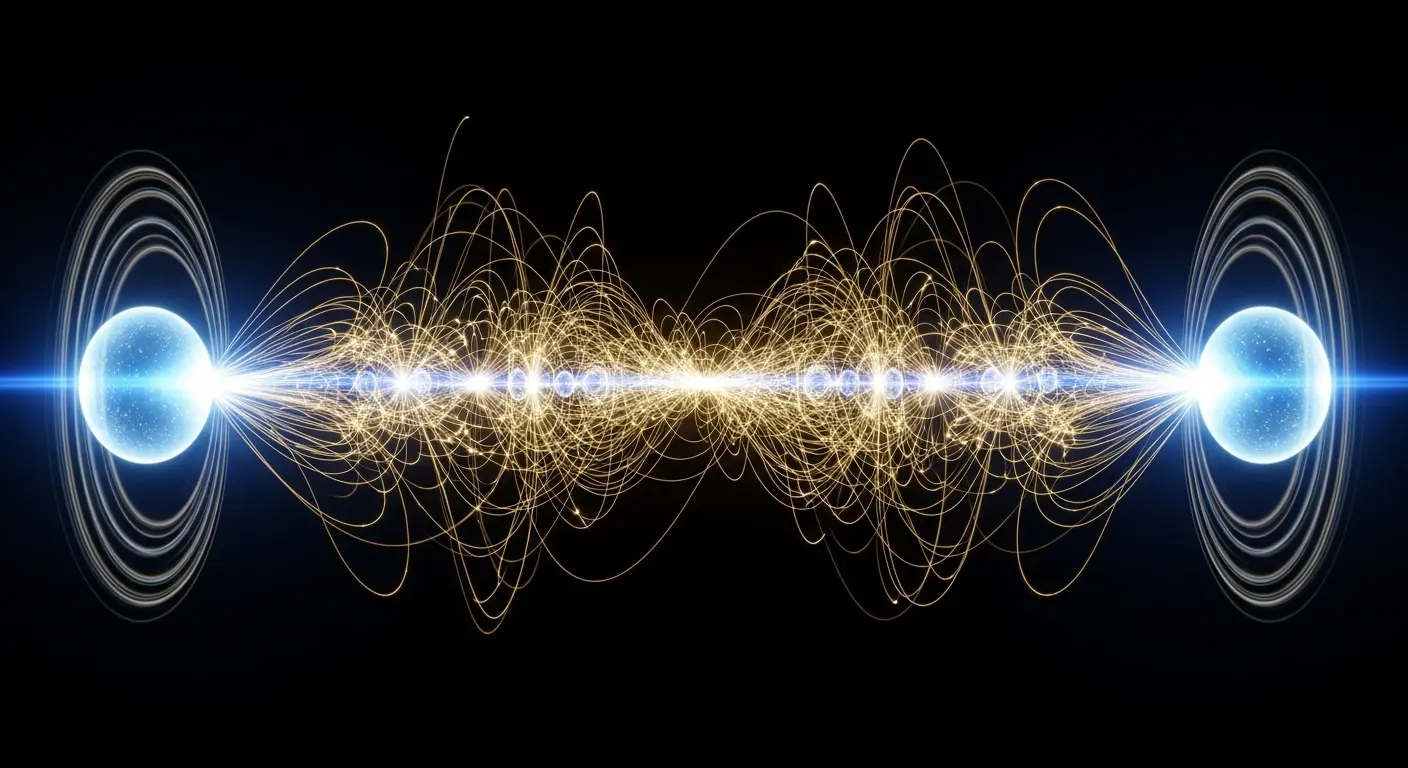
A thorough investigation of the quantum kicked top, a foundational model in quantum chaos, clarifies the connection between classical nonlinear dynamics and quantum behaviour. Avadhut V. Purohit and Udaysinh T. Bhosale at the Visvesvaraya National Institute of Technology present an introduction to this system, which uniquely possesses a finite-dimensional Hilbert space enabling both analytical and numerical control. Their work details the model’s phase space structure, symmetries, and quantum description using Floquet theory, revealing signatures of quantum chaos and linking it to quantum information measures such as entanglement entropy. By bridging classical and quantum realms, this research highlights the quantum kicked top as a key set of tools for exploring the emergence of chaotic behaviour.
Simplifying chaotic dynamics through finite-dimensional Hilbert space representation
Floquet theory proved central to unlocking the dynamics of the quantum kicked top, enabling analysis of a periodically driven system much like understanding the repeating pattern of a bouncing ball. It represents the system’s evolution over each period of the ‘kick’ as a unitary operator, a set of instructions governing how the quantum state changes with each pulse. Applying Floquet theory to the quantum kicked top allowed David Awschalom and collaborators to work within a well-defined, finite-dimensional space, a $(2j+1)$-dimensional Hilbert space, simplifying complex calculations without sacrificing the richness of the chaotic behaviour. This finite dimensionality was deliberately chosen to simplify calculations and avoid ambiguities present in systems with infinite-dimensional spaces, allowing for thorough analysis across both quantum and semi-classical regimes. The model can also be interpreted as a system of interacting qubits, enabling connections with quantum information measures like entanglement entropy and reduced density matrices.
Entanglement entropy and classical Lyapunov exponents correlate in a finite quantum system
A sharp advance has been made with the correlation of entanglement measures and classical Lyapunov exponents in the quantum kicked top, surpassing previous infinite-dimensional models where such connections remained ambiguous. This model provides a uniquely controllable platform linking classical nonlinear dynamics with quantum behaviour, and enables investigations into quantum chaos using tools like reduced density matrices. The finite-dimensional structure circumvents limitations inherent in infinite systems, enabling exploration of the complete quantum-to-semiclassical transition previously hampered by mathematical inconsistencies.
Within this system, entanglement entropy, a measure of quantum connection, directly correlates with classical Lyapunov exponents. Few-qubit systems have experimentally realised the model, enabling precise measurements of entanglement dynamics and offering potential for quantum control strategies to improve fidelity in quantum gates. It also enables the study of quantum correlations like quantum discord and concurrence, revealing unexpected mimicry of classical chaotic behaviour. However, these findings do not yet predict how effectively this model can be scaled to address complex, real-world quantum computing challenges.
Towards scalable quantum systems and sustained chaotic dynamics
Despite its success as a model system, the quantum kicked top doesn’t fully address the challenge of scaling up to more complex scenarios. The finite-dimensional Hilbert space offers analytical advantages, but it remains a simplified representation of the infinite-dimensional systems encountered in practical quantum technologies. Igor Lukaševičius and colleagues acknowledge that demonstrating sustained, controllable chaos in larger, more realistic quantum devices presents a key hurdle; current few-qubit realisations, though promising, are limited in their ability to mimic the behaviour of truly complex systems.
Acknowledging that scaling these systems remains a considerable engineering challenge does not diminish the value of this foundational work. The quantum kicked top provides a uniquely tractable arena for testing theoretical predictions about quantum chaos and its connection to classical behaviour. Understanding these fundamental principles is vital, informing the development of more complex quantum technologies and potentially unlocking new approaches to quantum computing and sensing, even if practical realisation at scale is some way off.
The quantum kicked top offers a uniquely controllable system for investigating the emergence of chaotic behaviour, bridging classical and quantum descriptions of dynamics. This finite-dimensional structure distinguishes it from many other chaotic models which rely on infinite dimensions, allowing for both analytical and numerical study. Linking classical phase space structures with quantum indicators like entanglement clarifies how chaotic behaviour manifests in the quantum realm. David Awschalom and his team continue to refine understanding of this simplified model for exploring quantum chaos, and next-generation experiments will likely expand these systems, potentially beginning to bridge the gap between theoretical models and practical quantum technologies.
The research demonstrated a detailed analysis of the quantum kicked top, a model used to explore the link between classical chaotic behaviour and quantum mechanics. This model is valuable because its finite-dimensional structure allows researchers to study chaotic systems in a way that is analytically and numerically manageable, unlike many other chaotic systems. By connecting classical dynamics with quantum indicators such as entanglement, the study clarifies how chaos appears in the quantum world. The authors suggest future work will focus on expanding these systems to better reflect more complex, realistic quantum technologies.
👉 More information
🗞 Quantum Kicked Top: A Paradigmatic Model
🧠 ArXiv: https://arxiv.org/abs/2604.12345




See today’s quantum computing news on Quantum Zeitgeist for the latest breakthroughs in qubits, hardware, algorithms, and industry deals.



