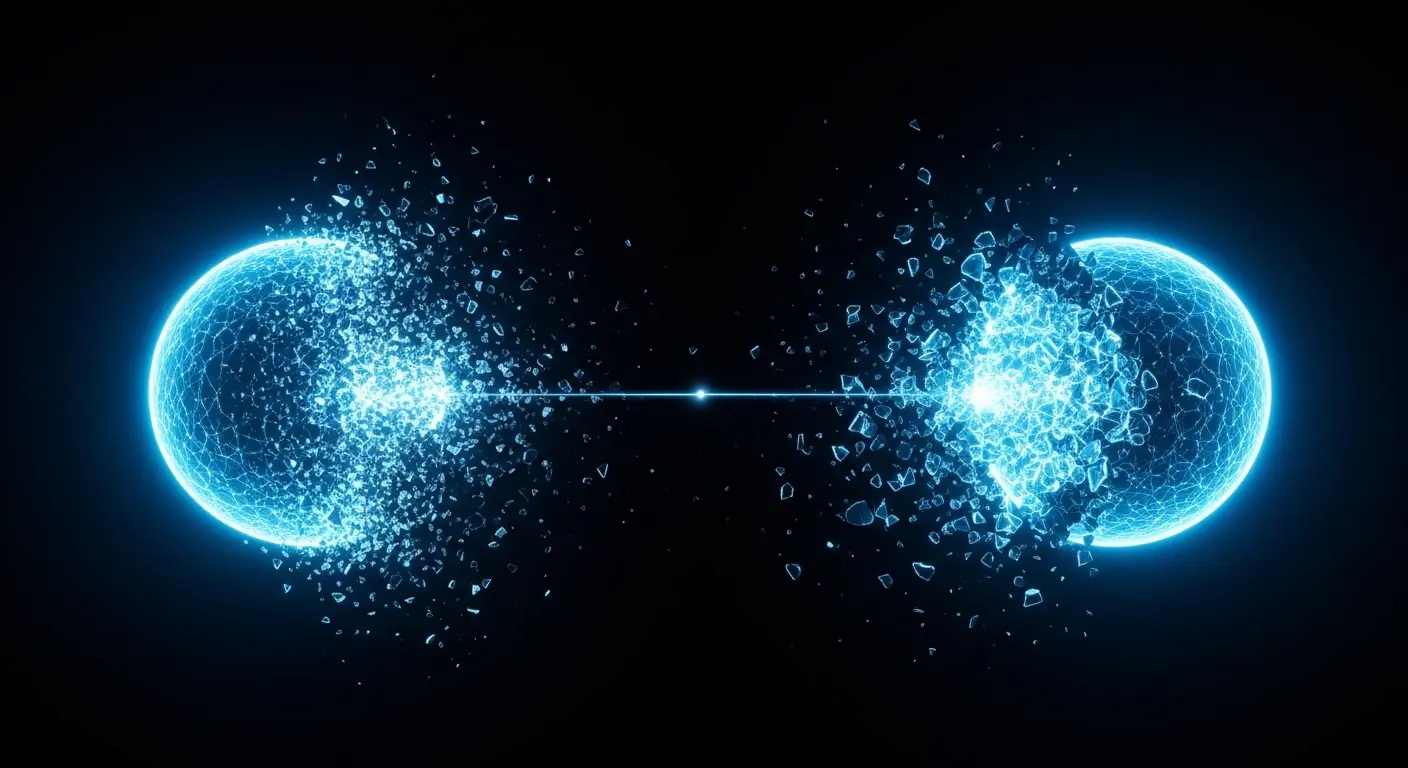
A new advance in quantum networking enables the emission and absorption of microwave photons in distinct temporal modes across a 30-metre link. Alonso Hernández-Antón and colleagues of the ETH Zurich (Department of Physics, Quantum Center), in collaboration with Institute of Fundamental Physics (CSIC), and Universidad Carlos III de Madrid (Department of Physics), generate individual photons shaped in three mutually orthogonal temporal modes using superconducting quantum circuits. The experiment showcases the ability to selectively absorb a chosen mode at the receiver, reflecting the remaining two with a selectivity ratio of 40, and thereby expands the possibilities for encoding and transferring quantum information over distance. This introduces a key degree of freedom for microwave-frequency quantum communication, moving beyond conventional methods that rely on symmetric photon wavepackets.
Demonstrated selective photon absorption enables strong quantum information transfer
A selectivity ratio of 40 now distinguishes between temporal modes of microwave photons, a substantial improvement over previous methods limited to symmetrical wavepackets. This capability unlocks new avenues for encoding and transferring quantum information, expanding the potential of microwave-frequency quantum communication. Selective absorption of a chosen mode at the receiver and reflection of unwanted modes with high precision were previously unattainable, but this threshold signifies an important step beyond simple signal transmission. The significance lies in the potential to multiplex quantum information. By utilising different temporal modes, more information can be carried within a single photonic channel, increasing the bandwidth and efficiency of quantum communication systems. This is particularly relevant as quantum networks scale, demanding higher data throughput and more robust communication links.
Shaped photons, created in three mutually orthogonal temporal modes, were successfully transmitted across a 30-metre cryogenic link, demonstrating the strong qualities of this approach. Qubit population dynamics revealed plateaus during emission, directly corresponding to nodes within the photon’s waveform for each temporal mode, confirming the generated microwave photons exhibit distinct characteristics. These temporal modes aren’t simply variations in frequency. They represent different distributions of energy over time, effectively creating photons with unique ‘shapes’. The superconducting circuits employed are designed to precisely control the emission of these photons, tailoring their temporal profiles. Detailed analysis of these population dynamics matched theoretical predictions without requiring any adjustable parameters, unequivocally demonstrating the photons were shaped as intended. This validation is crucial, as it confirms the fidelity of the photon generation process and the accuracy of the theoretical model used to describe it. The use of a cryogenic environment, typically around 4 Kelvin, is essential to minimise thermal noise and maintain the coherence of the superconducting qubits, which are highly sensitive to environmental disturbances.
Experiments transferring single microwave photons across a 30-metre cryogenic link, a supercooled environment, showed that the orthogonality of modes allows for selective absorption at the receiver, reflecting other modes. The group velocity of these photons was measured, consistent with the waveguide’s length and cabling. Achieving a selectivity ratio of 40 extends the microwave-frequency quantum communication set of tools with a new photonic degree of freedom. The waveguide, acting as the transmission channel, is carefully engineered to preserve the temporal shape of the photons during propagation. The measured group velocity confirms that the photons are travelling at the expected speed within the waveguide, indicating minimal distortion of the temporal modes. The current setup does not include a circulator for direct photon measurement, meaning these results do not yet represent performance in a complete, practical quantum communication system. A circulator would allow for efficient separation of the emitted and reflected photons, enabling direct measurement of the absorbed mode. Further development will focus on integrating this technology into a full system for real-world application, including the implementation of error correction protocols and the optimisation of the waveguide design for long-distance transmission.
Improving quantum communication necessitates higher precision temporal mode distinction
While this demonstration of temporal mode control expands the possibilities for encoding quantum information, a selectivity ratio of 40 remains a considerable hurdle. Current error rates would likely negate any benefits gained from this increased complexity, meaning achieving truly strong quantum communication demands far greater precision in distinguishing between these temporal modes. The challenge stems from the inherent difficulty in precisely shaping and discriminating between subtle differences in the temporal profiles of photons. Imperfections in the superconducting circuits, variations in the waveguide properties, and environmental noise all contribute to signal degradation and reduced selectivity. A selectivity ratio of 40 implies that for every 40 photons of the desired mode successfully absorbed, approximately one photon of an unwanted mode is also detected. This error rate is unacceptable for many quantum communication protocols, which require extremely low error rates to ensure reliable information transfer.
Despite the challenges, a selectivity ratio of 40 does present a pathway for long-distance transmission, as it offers an additional way to encode quantum information, expanding the options for building quantum networks and connecting quantum computers. Successfully transferring these shaped photons over 30 metres confirms the principle and opens avenues for exploring more complex quantum communication protocols, potentially enhancing quantum error correction and increasing the capacity of future quantum channels. Quantum error correction relies on encoding quantum information in a redundant manner, allowing for the detection and correction of errors without destroying the quantum state. By utilising multiple temporal modes, it may be possible to implement more efficient and robust error correction schemes. Generating photons with distinct temporal modes, in effect different waveforms in time, and selectively absorbing them at a distance establishes a new method for encoding and transmitting quantum information, moving beyond conventional symmetrical wavepackets. This work now prompts investigation into how these refined photonic tools can be adapted to improve signal integrity and extend the range of quantum communication. Future research will likely focus on improving the selectivity ratio through advanced circuit design, optimised waveguide fabrication, and the implementation of sophisticated signal processing techniques. The ultimate goal is to create a practical and scalable quantum communication system that can leverage the full potential of temporal mode multiplexing.
The researchers successfully generated and transmitted individual microwave photons shaped in three distinct temporal modes across a 30-metre cryogenic link. This demonstrates a new way to encode quantum information using the waveform of photons, offering an additional degree of freedom for quantum communication. While a selectivity ratio of 40 indicates some signal degradation, the ability to selectively absorb these modes at a distance expands the possibilities for building quantum networks. The authors intend to improve this selectivity through further refinement of circuit design and signal processing.
👉 More information
🗞 Emission and Absorption of Microwave Photons in Orthogonal Temporal Modes across a 30-Meter Two-Node Network
🧠 ArXiv: https://arxiv.org/abs/2604.12947




See today’s quantum computing news on Quantum Zeitgeist for the latest breakthroughs in qubits, hardware, algorithms, and industry deals.