

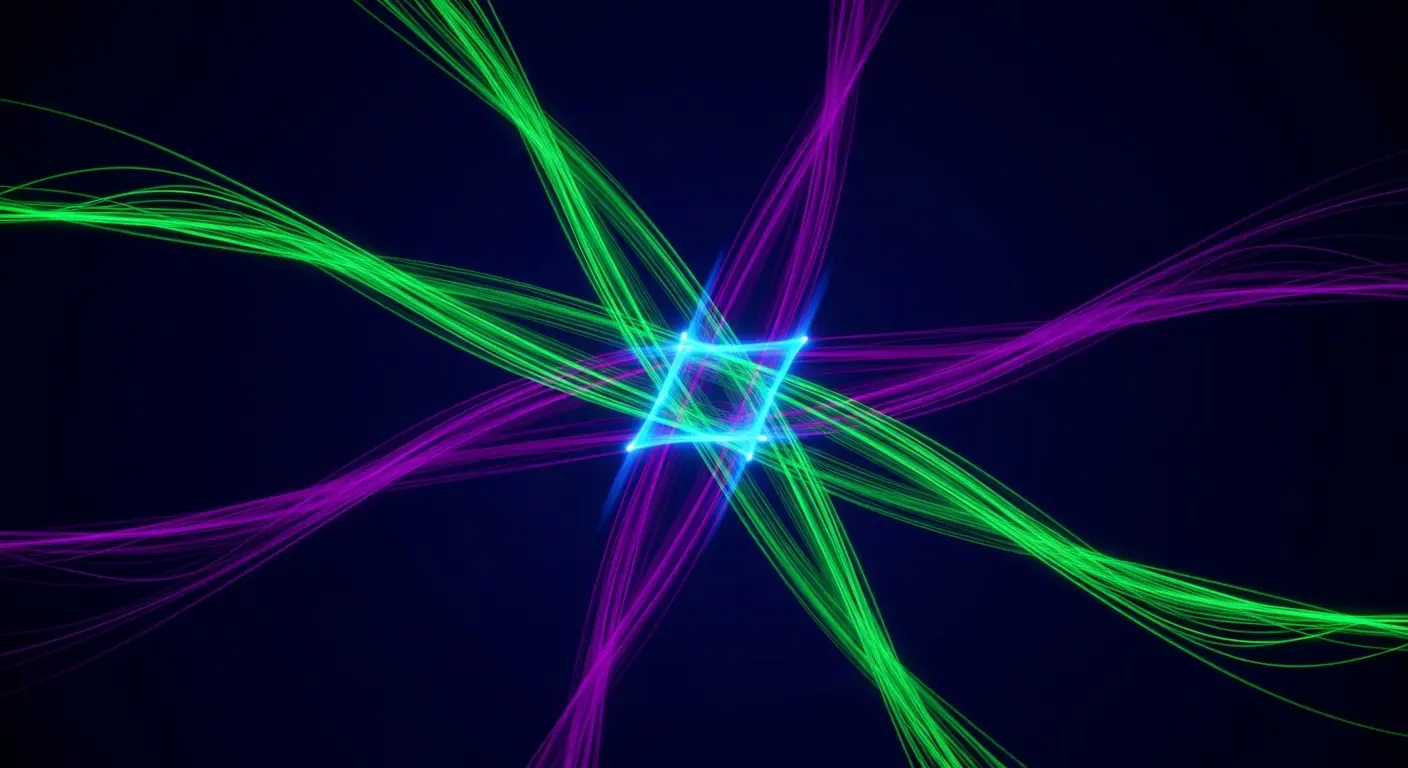
Barbara Dietz and colleagues at the Max-Planck Institute for the Physics of Complex Systems in collaboration with Institute of Theoretical Physics and Institute for Basic Science (IBS) investigate the complex behaviour of relativistic quantum chaos using a new model system: neutrino billiards. These billiards simulate the dynamics of spin-1/2 particles confined within a planar domain. The research reviews the key characteristics of these systems, contrasting predictable, integrable dynamics with chaotic behaviour, and importantly, draws parallels to potential experimental realisations using graphene-based structures. Understanding relativistic quantum chaos offers insights into fundamental physics and may inform future developments in quantum technologies. The study of quantum chaos, traditionally focused on non-relativistic systems, gains new depth when considering the effects of special relativity, particularly for particles possessing intrinsic angular momentum, or spin. This is because relativistic effects can significantly alter the energy spectrum and wavefunctions of confined particles, leading to behaviours not observed in their non-relativistic counterparts.
Relativistic spin-1/2 particle confinement necessitates a Green’s theorem boundary-integral equation
Investigations into relativistic quantum billiards model systems with spin-1/2 particles confined within a planar area by specific boundary conditions. These ‘neutrino’ billiards differ from standard quantum billiards because their states cannot be simply classified by mirror symmetry, a consequence of the relativistic Dirac equation governing spin-1/2 particles. In conventional quantum billiards, the wavefunction’s symmetry properties often simplify the analysis and allow for straightforward classification of energy levels. However, the Dirac equation introduces spinor components, which transform differently under spatial reflections, complicating this classification. A boundary-integral equation, derived from Green’s theorem, was therefore developed to determine particle wavefunctions. Green’s theorem provides a powerful mathematical tool for solving boundary value problems, allowing the wavefunction to be determined by specifying its behaviour on the boundary of the confining region. This mathematical tool proved key to discerning the behaviour of these relativistic quantum systems, elegantly incorporating the specific boundary conditions imposed on the particles. It provides an exact method for determining the particle’s wavefunction within the billiard’s confines, based solely on its behaviour at the edges, offering an alternative to methods reliant on symmetry classifications. The integral equation effectively transforms the problem from a partial differential equation defined over the entire area of the billiard into an integral equation defined only on its boundary, significantly simplifying the computational challenge.
Relativistic spinor states unlock odd reflection spectra in quantum billiards
Previously, spectral peaks corresponding to an odd number of reflections in neutrino billiards remained undetectable. This limitation stemmed from the challenges in accurately modelling the relativistic effects and the complex behaviour of the spinor components of the wavefunction. Detailed analysis of spinor states has now crossed this threshold, revealing distinctions from nonrelativistic quantum billiards and linking behaviour to classical billiard dynamics. Relativistic quantum billiards allow exploration of how established theories of quantum chaos, the Bohigas-Giannoni-Schmit (BGS) and Berry-Keating (BT) conjectures, apply in relativistic conditions. The BGS conjecture posits that the energy spectrum of a chaotic quantum system exhibits statistical properties similar to that of a random matrix ensemble, while the BT conjecture relates the number of classically allowed periodic orbits to the number of resonances in the quantum spectrum. Investigating these conjectures within a relativistic framework provides a rigorous test of their universality.
Spectral characteristics in relativistic quantum billiards have been identified, extending beyond the previously observed limit of two reflections and revealing behaviour linked to classical billiard dynamics. Describing particles with intrinsic angular momentum, or spin, detailed analysis of spinor states demonstrates distinctions from their nonrelativistic counterparts. The spinor components, representing the particle’s spin state, exhibit unique behaviour under reflections, leading to the emergence of spectral features not present in non-relativistic billiards. Furthermore, investigations into graphene billiards, constructed from finite sheets of graphene, show a correspondence between their spectral properties and the relativistic Dirac equation governing spin-1/2 particles. Graphene’s unique band structure, characterised by Dirac cones, provides a natural setting for realising relativistic quantum mechanics in a condensed matter system.
These structures exhibit Dirac points, regions of unique electronic behaviour, alongside van Hove singularities resembling those found in graphene itself. The conformal mapping method, previously used for calculating eigenstates, contained fundamental errors, as the analysis demonstrates. This necessitated a refined approach to accurately model particle behaviour at the boundaries of the billiards, ultimately confirming the existence of spectral peaks corresponding to an odd number of reflections. The errors in the conformal mapping stemmed from its inability to accurately account for the relativistic effects and the spinor nature of the wavefunction. Correcting these errors required a more sophisticated mathematical treatment, leading to the successful prediction and observation of the previously elusive spectral peaks.
Graphene realisation offers a route to verifying relativistic quantum billiard predictions
Exploring how these models might be realised using graphene, a single-layer sheet of carbon atoms, offers a tangible pathway towards experimental verification of these theoretical concepts. This is particularly important given the inherent challenges of observing quantum chaos directly. Quantum chaos is notoriously difficult to observe directly due to the rapid decoherence of quantum states in macroscopic systems. Creating a system where quantum effects are dominant and decoherence is minimised is crucial for experimental verification. Graphene, a single-atom-thick carbon sheet, presents a promising material for building these ‘quantum billiards’ and testing these complex theories experimentally. Scientists are now linking relativistic quantum mechanics with quantum chaos, exploring how particles behave in confined, chaotic spaces. The ability to fabricate graphene structures with precisely defined boundaries allows for the creation of tailored quantum billiards with specific geometries and properties.
While establishing a link between relativistic quantum mechanics and quantum chaos is a striking achievement, the current work primarily reviews existing features rather than presenting entirely new calculations. This reliance on established theoretical frameworks, dating back to the foundational work of Berry and Mondragon in 1987 (Proc. R. Soc. A 412 53), raises whether genuinely novel predictions can emerge from this approach. Nevertheless, acknowledging that this work largely synthesises established theory does not diminish its value; it provides a vital, consolidated overview of relativistic quantum billiards, a complex field bridging quantum mechanics and chaos theory. Further research focusing on novel geometries and boundary conditions could potentially lead to new insights and predictions.
This work establishes a framework connecting relativistic quantum mechanics, the study of particles at speeds approaching that of light, with the long-studied field of quantum chaos. By examining ‘neutrino billiards’, theoretical systems modelling spin-1/2 particles within confined spaces, scientists have broadened the scope of established conjectures regarding energy levels in chaotic systems. The analysis reveals distinctions between relativistic and nonrelativistic billiards, offering a new perspective through which to view quantum behaviour, specifically through the characteristics revealed by the analysis of spinor states. The ability to model these systems accurately and potentially realise them in materials like graphene opens up exciting possibilities for exploring the interplay between relativity, quantum mechanics, and chaos, potentially leading to advancements in our understanding of fundamental physics and the development of novel quantum technologies.
This research demonstrated a connection between relativistic quantum mechanics and quantum chaos through the study of ‘neutrino billiards’. These theoretical systems, modelling spin-1/2 particles in confined planar domains, provide a framework for understanding energy levels in chaotic systems and highlight differences between relativistic and nonrelativistic behaviours. Scientists reviewed existing features of these billiards, including those with integrable and chaotic dynamics, and explored the potential for creating them using graphene structures. The work consolidates current understanding and suggests that further investigation into novel geometries may yield additional insights.
👉 More information
🗞 Relativistic Quantum Chaos in Neutrino Billiards
🧠 ArXiv: https://arxiv.org/abs/2604.13003



See today’s quantum computing news on Quantum Zeitgeist for the latest breakthroughs in qubits, hardware, algorithms, and industry deals.



