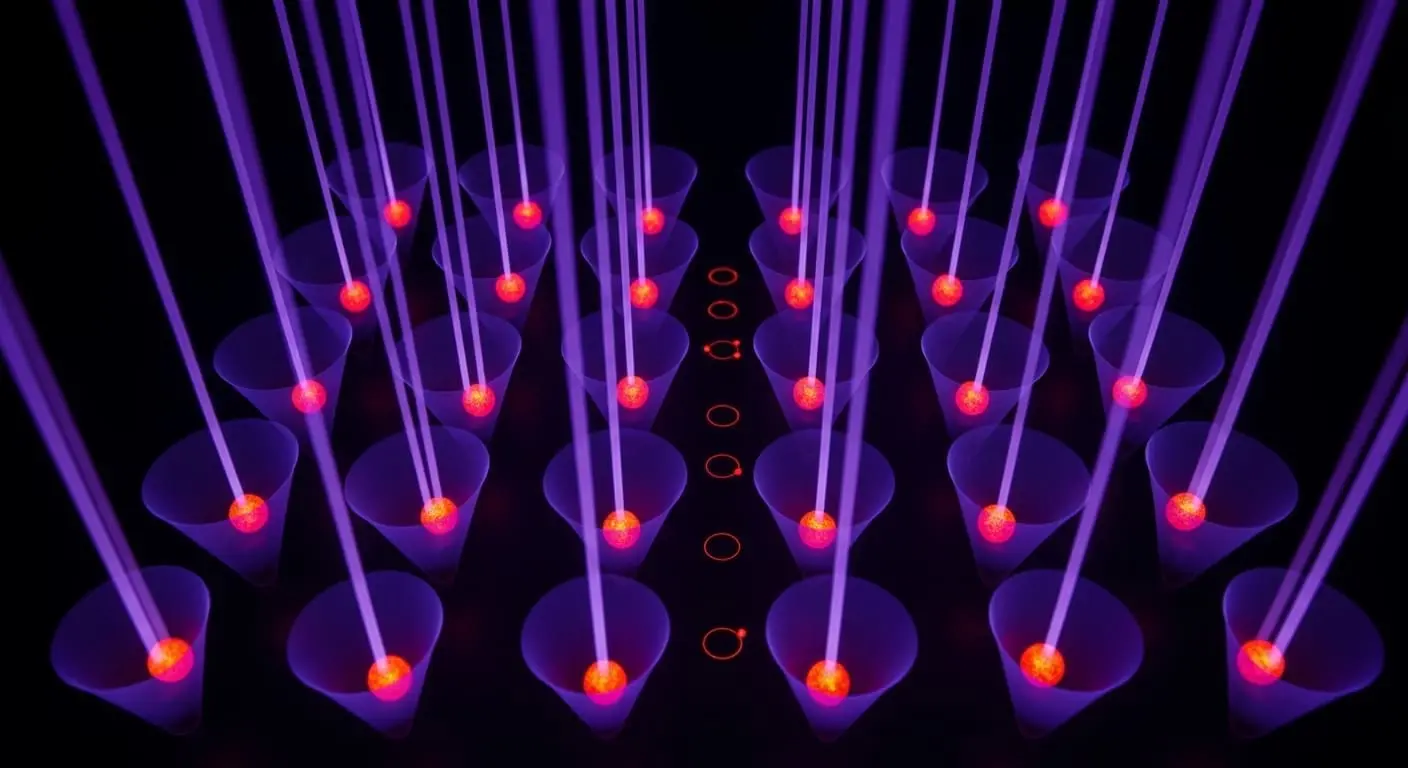
Leonardo Ermann and colleagues have revisited a 150-year-old debate concerning the foundations of irreversibility, now from a quantum perspective. The chaotic diffusion of cold atoms within a harmonic trap and pulsed optical lattice exhibits a remarkable property: it can be reversed in time with near-perfect efficiency. This finding sharply contrasts with classical physics, where even small errors rapidly destroy time reversibility, and suggests that quantum systems retain a degree of reversibility absent in their classical counterparts. The research highlights the potential to experimentally explore the long-standing Boltzmann-Loschmidt dispute using current technology.
Complete Reversal of Quantum Chaos Diffusion in Cold Atomic Systems
Complete time reversal of quantum chaos diffusion in cold atoms has been achieved with up to 100% efficiency, exceeding the limitations of previous methods which suffered from exponential error growth in classical systems. A harmonic trap and pulsed optical lattice were utilised to achieve this complete reversal, opening new possibilities for experimentally investigating the long-standing Boltzmann-Loschmidt dispute concerning irreversibility and atomic motion. This represents a fundamental departure from classical physics, where even minimal disturbances rapidly degrade the possibility of perfect reversibility. The harmonic trap, a potential well created by external forces, confines the cold atoms, allowing for precise control over their initial conditions and subsequent dynamics. The pulsed optical lattice, formed by interfering laser beams, introduces a periodic potential that governs the atoms’ movement and facilitates the controlled chaotic diffusion. This combination allows researchers to manipulate the atoms’ quantum states with high precision.
The challenge to the statistical interpretation of irreversibility originating in classical mechanics is directly addressed, offering a pathway to revisit this debate using quantum systems. Quantum chaos diffusion of cold atoms, or ions, in a harmonic trap and pulsed optical lattice can be inverted back in time with up to 100% efficiency. Numerical simulations, employing double-precision calculations with round-off errors of approximately 10−16, demonstrated a return to the initial state after a reversal time of 30 units, with energy diffusion restarting after 60 units. Fidelity remained relatively stable, exhibiting a value of approximately 0.85 at the return time for a noise amplitude of 0.1, even with quantum phase noise. This builds upon earlier theoretical work concerning the Loschmidt echo and fidelity decay, established concepts in the study of quantum chaos, and current experimental skills enable highlighting the Boltzmann-Loschmidt dispute from a quantum perspective, a debate originating from the question of how irreversible thermalization can appear from reversible dynamical equations. The Loschmidt echo, a measure of the system’s ability to return to its initial state after time reversal, is particularly sensitive to chaotic behaviour. Fidelity, representing the overlap between the reversed state and the initial state, provides a quantitative measure of the time reversal’s accuracy. The use of double-precision calculations minimises numerical errors, ensuring the reliability of the simulation results. The observed stability of fidelity even in the presence of noise is a crucial finding, demonstrating the robustness of the time reversal process.
Quantum reversibility of chaotic diffusion in controlled cold atom dynamics
This perfect time reversal was demonstrated within a specific, controlled quantum system, cold atoms in a harmonic trap and pulsed optical lattice, and does not constitute proof of universal applicability to all quantum chaotic systems. Complete time reversal is contingent upon atoms possessing a fractional quasimomentum close to zero, as the process degrades for other values. Interactions between atoms contribute to a reduction in the return signal, limiting the duration and effectiveness of the time reversal; these constraints highlight the delicate balance required to observe the reported effect and suggest that scaling to more complex systems may present significant challenges. Quasimomentum, a quantum mechanical analogue of classical momentum, describes the atom’s motion within the periodic potential of the optical lattice. Maintaining a quasimomentum close to zero ensures that the atoms remain confined within a specific region of the lattice, facilitating the time reversal process. Interatomic interactions, even weak ones, introduce correlations between the atoms, disrupting the coherent evolution required for perfect time reversal. The strength of these interactions must be carefully controlled to maximise the duration and efficiency of the reversal. The limitations imposed by these factors underscore the importance of precise experimental control and the challenges associated with extending these findings to more complex, many-body quantum systems.
Analytical and numerical results form the focus of this work, although experimental verification remains a possibility. Previous investigations, including experiments with spin echos, acoustic waves, and electromagnetic waves, have led to applications such as seismic analysis, and existing experimental techniques are sufficient to explore the Boltzmann-Loschmidt dispute from a quantum perspective. The authors also reference prior proposals for realising time reversal with Bose-Einstein condensates within kicked optical lattices. Spin echoes, for example, utilise magnetic fields to reverse the spin of particles, demonstrating time reversal in a different physical context. Acoustic and electromagnetic waves have also been used to explore wave phenomena and their time-reversal properties. The existing experimental infrastructure for manipulating and detecting cold atoms, including laser cooling, trapping, and imaging techniques, provides a solid foundation for verifying these theoretical predictions. Bose-Einstein condensates, a state of matter formed at extremely low temperatures, offer a highly coherent system for studying quantum phenomena, and kicked optical lattices provide a means of inducing controlled chaos.
Quantum Reversal of Diffusion Resolves Century-Old Irreversibility Debate
Perfect time reversal of diffusion in a controlled quantum system has been demonstrated, achieving up to 100% efficiency. This contrasts sharply with classical physics, where even minuscule errors inevitably break time reversibility due to exponential error growth. A pulsed optical lattice and cold atoms were utilised to achieve this time reversal. This demonstration of complete time reversal in a quantum system resolves a century-old challenge to the foundations of statistical mechanics; the Boltzmann-Loschmidt dispute questioned whether atomic behaviour truly aligned with reversible physical laws. By achieving 100% efficiency in reversing the diffusion of cold atoms within a harmonic trap, a potential well confining their movement, and a patterned light field controlling their position, perfect reversal is possible at a quantum level. The Boltzmann-Loschmidt dispute arose from the apparent contradiction between the time-reversible nature of the fundamental laws of physics and the observed irreversibility of macroscopic phenomena, such as the diffusion of gases. Ludwig Boltzmann proposed that irreversibility arises from the statistical behaviour of many atoms, while Josef Loschmidt argued that if the laws of physics are truly time-reversible, then any irreversible process should be able to be reversed by reversing the velocities of all the atoms involved. This research provides compelling evidence that, at least in the context of controlled quantum systems, perfect time reversal is indeed possible, supporting the notion that irreversibility is a statistical phenomenon rather than a fundamental property of the underlying physics. The ability to achieve 100% efficiency in reversing the diffusion of cold atoms represents a significant advancement in our understanding of the relationship between quantum mechanics and statistical mechanics.
The research demonstrated perfect time reversal of diffusion, achieving up to 100% efficiency in a controlled quantum system using cold atoms and a pulsed optical lattice. This finding resolves a long-standing debate, the Boltzmann-Loschmidt dispute, concerning the compatibility of time-reversible physical laws with observed irreversible processes. It supports the idea that irreversibility emerges from statistical behaviour, rather than being a fundamental property of physics. The authors suggest existing experimental capabilities could further highlight this quantum perspective on the dispute.
👉 More information
🗞 Boltzmann-Loschmidt dispute reloaded quantum 150 years later
🧠 ArXiv: https://arxiv.org/abs/2604.04879




See today’s quantum computing news on Quantum Zeitgeist for the latest breakthroughs in qubits, hardware, algorithms, and industry deals.