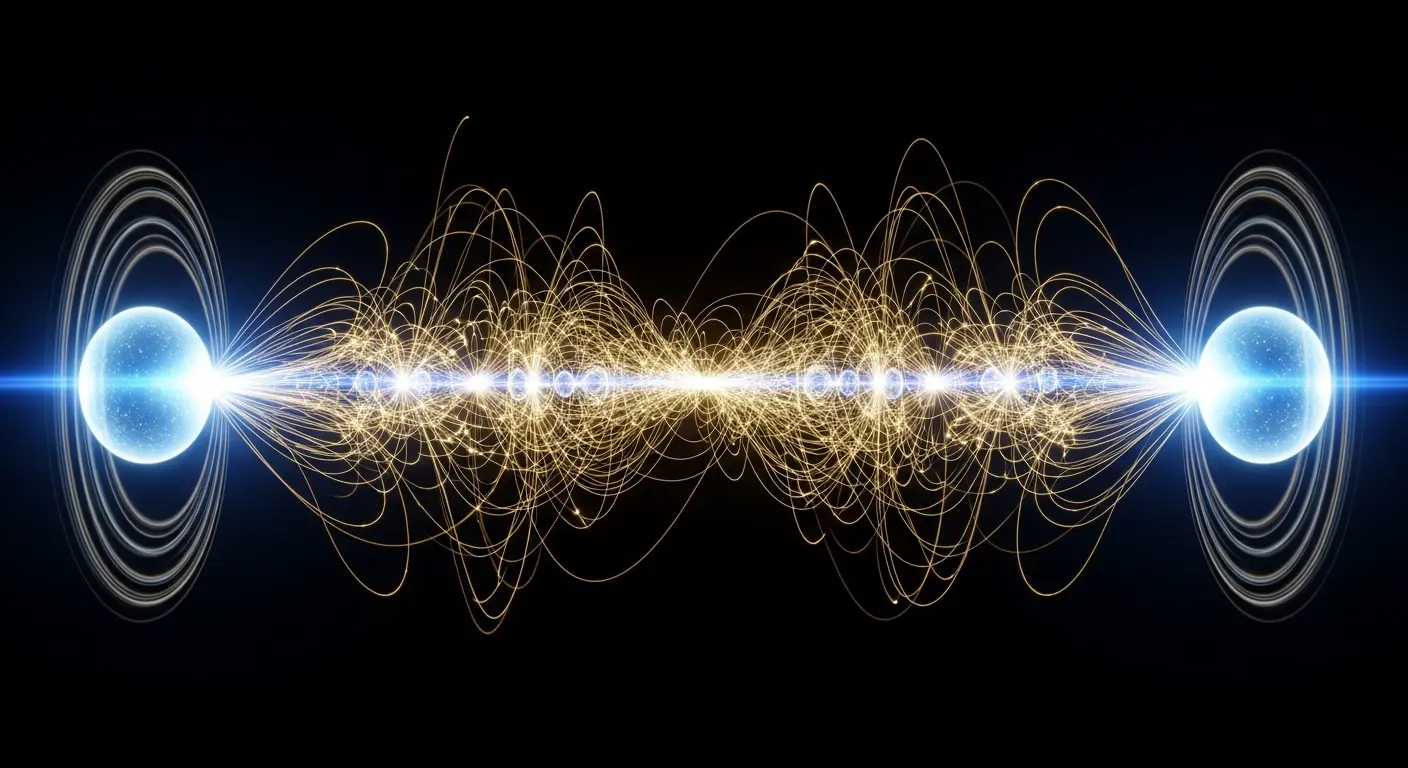
A new computational framework models complex interactions between multiple light-emitting quantum systems, overcoming limitations in previous research. Hyunwoo Choi and colleagues at Pohang University of Science present a Green’s function-based approach for understanding non-Markovian multi-emitter dynamics, sharply extending beyond the single-excitation limit. The advancement addresses the weakness of standard approximations when dealing with optical nonlinearities and errors accumulating in multi-photon processes. By explicitly retaining photonic amplitudes and preserving phase information, the framework offers a flexible set of tools for investigating a wide range of complex, non-Markovian phenomena in various electromagnetic environments and promises to improve the fidelity of multi-photon processes.
Enhanced modelling of photonic entanglement via Green’s function formalism and modified Langevin
A growing number of researchers are focusing on computationally efficient methods to better understand complex quantum systems. In this work, a Green’s function-based framework is developed that explicitly retains photonic amplitudes, preserving the phase information essential for accurately describing multi-photon interference and non-Markovian dynamics. As a result, both total probability and coherence are consistently maintained throughout the system’s evolution.
To validate the approach, numerical studies examine non-Markovian atom–field interactions in structured semi-infinite waveguide environments. A homogeneous waveguide is first used as a baseline, demonstrating improved Bell-state fidelity compared to traditional single-excitation models. The analysis is then extended to a waveguide containing a lossy dielectric slab, where the collective decay of symmetric Dicke states reveals selective stabilisation and delayed excitation transfer driven by the structured environment.
Further investigation of entanglement dynamics within this system uncovers non-Markovian features such as sudden entanglement generation and oscillatory revivals. By mapping the final-time population of dark states, resonance-like regions emerge in which radiative decay is suppressed, redirecting population into long-lived dark states. This behaviour can be controlled by adjusting parameters such as slab thickness and emitter spacing. Concurrence calculations show that coherence builds up before reaching population thresholds, ultimately triggering entanglement between asymmetrically positioned emitters.
Structured photonic platforms, including plasmonic nanostructures, optical cavities, and waveguides, have established photons as powerful carriers of quantum information, enabling light–matter interactions far beyond those in free space. However, these environments introduce additional complexities such as dispersion, dissipation, and feedback effects, making them active participants in the system’s dynamics rather than passive backgrounds.
A major challenge remains in bridging the gap between idealised theoretical models and realistic implementations of many-body quantum systems. While existing approaches, such as master equations and stochastic Schrödinger formalisms, provide valuable insights, they often rely on simplified environmental models that overlook detailed electromagnetic properties. In contrast, advances in computational electromagnetics now allow for high-fidelity simulations of complex, inhomogeneous, and lossy environments.
Building on these developments, the present framework integrates Green’s function techniques with a modified Langevin noise formalism to provide a first-principles description of open quantum systems. By incorporating both boundary-assisted and medium-assisted contributions, the method ensures theoretical consistency while accounting for radiative and material losses. Combined with an emitter-centred mode approach, this enables a computationally tractable description of multi-emitter dynamics within the two-excitation regime, opening new possibilities for studying correlated quantum phenomena in realistic photonic environments.
👉 More information
🗞 Computational framework for non-Markovian multi-emitter dynamics beyond the single-excitation limit
🧠 ArXiv: https://arxiv.org/abs/2604.02741



See today’s quantum computing news on Quantum Zeitgeist for the latest breakthroughs in qubits, hardware, algorithms, and industry deals.