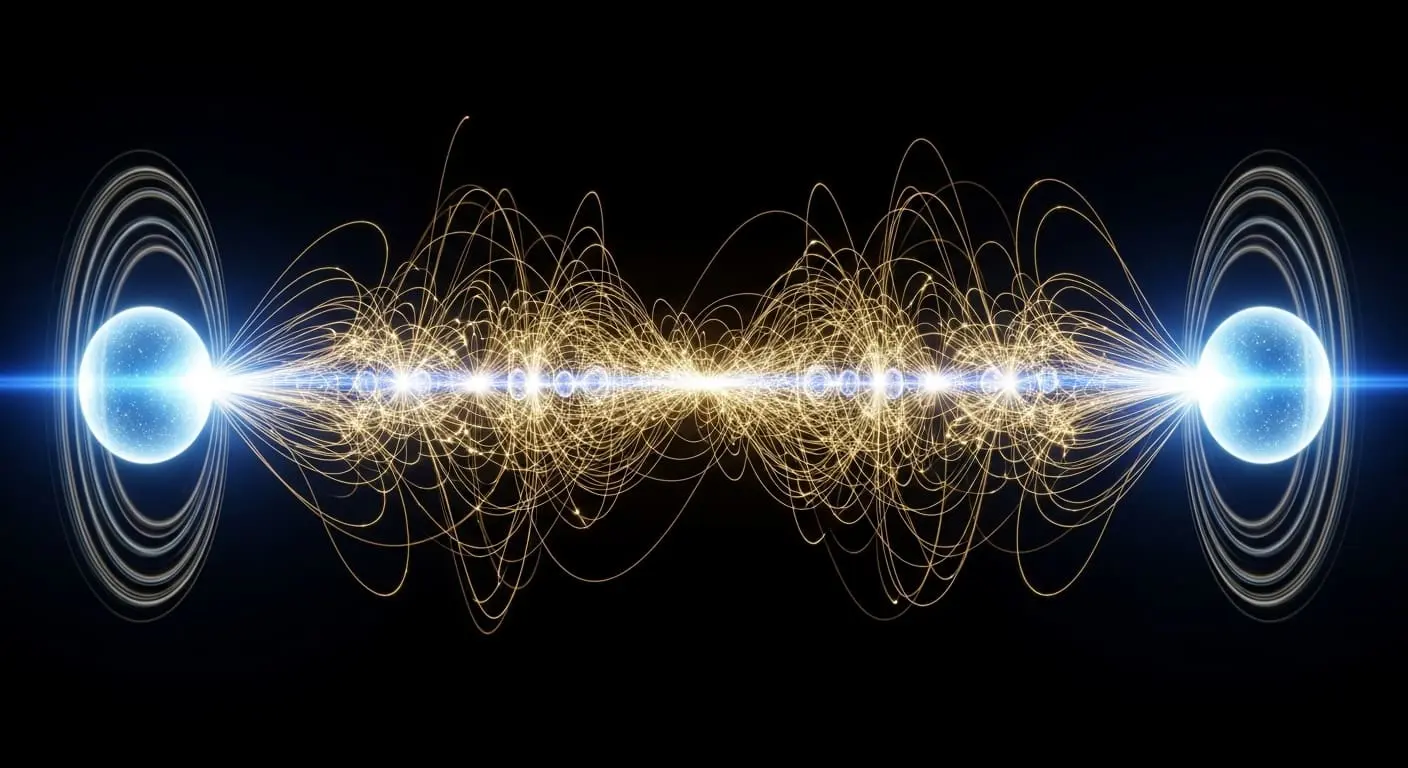
Scientists at the Hunter College of CUNY, led by Mark Heller, are investigating the nuanced conditions necessary for establishing genuine entanglement within systems comprising three or four particles. Determining whether multiple particles genuinely share this interconnectedness, rather than existing as separate, independently entangled pairs, presents a significant analytical challenge. Their research proposes novel, sufficient conditions for detecting genuine multi-partite entanglement, extending established criteria for bipartite entanglement, and constitutes a crucial contribution to our fundamental understanding of quantum mechanics.
Relaxed criteria reveal multipartite entanglement with single expectation value measurement
Criteria for detecting genuine multipartite entanglement have been refined, representing an improvement over existing methods by lowering the threshold required for confirmation. Previously, establishing genuine entanglement necessitated demonstrating that all three operator expectation values were non-zero; however, the new work demonstrates that confirmation can now be achieved with only a single non-zero value. This advancement broadens the range of quantum states that can be definitively identified as exhibiting entanglement, offering significant implications for the development of quantum technologies. The new conditions are derived from a set of inequalities applied to the density matrix, a mathematical object fully describing the quantum state of the system, and provide a more sensitive and efficient means of verifying interconnectedness between three or four quantum particles. The density matrix, represented as ρ, encapsulates all possible information about the system, and its properties are central to determining entanglement characteristics.
GHZ states, a specific class of multi-particle entangled states, are demonstrably genuinely entangled according to these refined criteria. Specifically, a state constructed as a superposition of |001⟩ and |110⟩ is confirmed to be genuinely entangled, irrespective of any arbitrary scaling factor applied to each component of the superposition. This means that even if the amplitudes of these states are modified, the entanglement persists. Furthermore, states incorporating |0uu⟩ and |u00⟩, where |u⟩ represents an arbitrary quantum state, also exhibit genuine entanglement under these conditions. The previous requirement of demonstrating non-zero values for multiple operator combinations has been successfully relaxed. These refined criteria expand the range of quantum states demonstrably exhibiting genuine entanglement, potentially enabling the analysis of more complex systems where subsets of particles may be entangled amongst themselves, but not necessarily entangled with other subsets within the larger system. This is a crucial distinction, as genuine entanglement requires a global interconnectedness, not merely localised correlations.
The significance of this relaxation lies in its practical implications for experimental verification. Measuring multiple operator expectation values introduces experimental complexity and potential for error. Reducing this requirement to a single measurement simplifies the process, making it more feasible to confirm genuine entanglement in real-world quantum systems. The inequalities used are based on the Peres-Horodecki criterion, a well-established method for detecting entanglement, but adapted to the multi-partite case. The mathematical formulation involves tracing over the degrees of freedom of certain particles to reveal correlations that would otherwise be hidden. This allows for a more efficient assessment of the system’s entanglement properties.
Refining criteria to detect fully connected quantum states in multipartite systems
The ability to verify genuine multipartite entanglement is steadily improving, representing a key step towards the realisation of future quantum technologies. Current methods can confirm the presence of entanglement, the peculiar quantum link between particles, but often struggle to definitively prove genuine entanglement, where every particle in a system is interconnected and contributes to the overall quantum state. This work offers additional criteria, building upon existing techniques developed for two-particle (bipartite) entanglement, to more easily identify these fully connected states. The distinction between entangled and genuinely entangled states is critical; a system can exhibit entanglement without being genuinely entangled if only subsets of particles are correlated.
Genuinely entangled states are vital because they offer advantages in quantum computing and quantum communication that surpass the capabilities of systems exhibiting only partial entanglement. For instance, in quantum computation, genuinely entangled states can enable algorithms with exponential speedups over classical algorithms. In quantum communication, they can facilitate secure key distribution protocols that are impervious to eavesdropping. The work focuses on inequalities derived from the density matrix, a complete description of a quantum system’s state, providing a rigorous mathematical framework for analysing entanglement. Violation of these inequalities now guarantees genuine entanglement in three and four-particle systems, simplifying the detection process. The inequalities are constructed such that their violation directly implies that the system cannot be described as a product of independent, entangled subsystems.
Despite this progress, verifying genuine entanglement remains computationally intensive, particularly as the number of particles increases. The complexity scales rapidly with the number of particles, requiring significant computational resources to evaluate the density matrix and test the relevant inequalities. Furthermore, imperfect real-world conditions introduce noise and decoherence, which can degrade the entanglement and make it more difficult to detect. These effects pose a continuing challenge in the field, necessitating the development of more robust and efficient methods for characterising and preserving entanglement in practical quantum devices. Future research will likely focus on developing techniques to mitigate the effects of noise and decoherence, as well as exploring new mathematical tools for analysing entanglement in larger and more complex systems. The development of scalable quantum technologies hinges on overcoming these challenges and achieving reliable generation and verification of genuine multipartite entanglement.
Genuine entanglement was confirmed in systems of three or four particles using newly derived inequalities based on the density matrix. This is important because genuinely entangled states offer potential benefits for quantum computing and communication beyond those achievable with partial entanglement. The research provides a more straightforward method for detecting this genuine entanglement by demonstrating that violation of the inequalities guarantees its presence. Authors suggest future work will concentrate on tackling noise and decoherence to improve entanglement characterisation in larger systems.
👉 More information
🗞 Conditions for 3-partite and 4-partite genuine entanglement
🧠 DOI: https://doi.org/10.1142/S0219477525400292