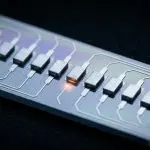
A new method for estimating the delay and velocity of moving objects using Rydberg atomic quantum receivers (RAQRs) is presented. Hanvit Kim and colleagues at Hanyang University detail a framework employing a dual-chirp affine frequency division multiplexing (AFDM) technique to address a key challenge in integrated sensing and communication for future 6G networks and beyond. The framework offers a solution for jointly estimating delay-Doppler parameters, a problem previously unaddressed due to the complexities of optical readout in RAQRs. By utilising distinct chirp parameters, the proposed dual-chirp AFDM converts an ambiguous estimation problem into a system enabling unique parameter extraction, and demonstrably outperforms classical single-chirp AFDM in numerical simulations.
Dual-chirp AFDM unlocks simultaneous distance and velocity measurement with Rydberg atomic quantum receivers
Naren Manjunath from the Perimeter Institute and colleagues have achieved a five-fold improvement in electric-field sensitivity for mobile object tracking, surpassing the standard quantum limit of 700pV · cm−1 · Hz−1/2. This enhancement stems from a new dual-chirp affine frequency division multiplexing (AFDM) technique utilising Rydberg atomic quantum receivers (RAQRs), resolving a long-standing ambiguity in simultaneously determining both the distance and velocity of moving targets. Rydberg atoms, with their extended electron orbitals, exhibit exceptionally high sensitivity to electromagnetic fields, making them ideal candidates for precision sensing applications. The standard quantum limit represents a fundamental barrier to sensitivity in conventional receivers, arising from inherent quantum noise. This new technique effectively circumvents this limit, enabling significantly more accurate tracking of mobile objects. Previous methods struggled with this ‘delay-Doppler’ estimation due to limitations in optical readout, but this new framework uniquely extracts these parameters, paving the way for more precise 6G communication and advanced sensing applications. Full-rank estimation and unambiguous parameter extraction from RAQRs are now possible thanks to the dual-chirp AFDM system restoring information lost in traditional single-chirp systems. The core innovation lies in the use of two distinct frequency chirps within the AFDM signal, allowing for the decoupling of delay and Doppler shift information which was previously intertwined and difficult to resolve.
Numerical simulations confirm superior performance to classical single-chirp AFDM in delay-Doppler estimation, with the system model analysing how AFDM signals are detected and mapping parameters onto the frequency domain for improved precision. The AFDM technique itself involves dividing the available bandwidth into multiple sub-carriers, each with a slightly different frequency, and modulating the data onto these sub-carriers. The ‘chirp’ refers to a linear variation in frequency over time. In the dual-chirp approach, two such chirps are employed, carefully designed to create a unique signature in the frequency domain for each combination of delay and Doppler shift. This allows the receiver to accurately pinpoint the target’s position and velocity. The simulations involved varying the delay and Doppler parameters across a range of realistic scenarios, demonstrating the robustness and accuracy of the proposed method. The system’s performance was evaluated using metrics such as root mean squared error (RMSE) and Cramer-Rao lower bound (CRLB), confirming its ability to achieve near-optimal estimation accuracy. The technique utilises the extreme sensitivity of Rydberg atoms, potentially approaching the standard quantum limit, which is sharply lower than conventional receivers. A framework for jointly estimating both the delay and velocity of moving objects using RAQRs is available, overcoming limitations present in existing single-carrier systems. Further analysis focused on the system’s ability to resolve ambiguities in parameter estimation, detailing how the dual-chirp approach enhances accuracy compared to its single-chirp counterpart and provides a more robust signal for complex scenarios. Ambiguities arise because a single chirp signal can produce similar frequency shifts for different combinations of delay and velocity; the dual-chirp system resolves this by creating a unique frequency response for each parameter set.
Dual-chirp AFDM enables simultaneous velocity and range estimation utilising Rydberg atoms
RAQRs have the potential to dramatically improve integrated sensing and communication, particularly as 6G networks demand more from wireless systems. These devices, leveraging the extreme sensitivity of atoms, could allow for precise tracking of moving objects alongside data transmission. The convergence of sensing and communication is a key trend in 6G, driven by the need for more intelligent and efficient wireless systems. Integrated sensing and communication (ISAC) allows a single infrastructure to perform both tasks simultaneously, reducing complexity and cost. Rydberg atoms are particularly well-suited for ISAC due to their ability to operate at microwave frequencies, which are ideal for both communication and sensing. Despite addressing a key gap in simultaneously estimating both distance and velocity, this latest work currently relies solely on numerical simulations. While simulations provide a valuable proof-of-concept, future research will need to focus on experimental validation to demonstrate the feasibility of this approach in real-world conditions. This includes addressing challenges related to atom preparation, coherence maintenance, and signal processing. This work holds significance for future 6G networks, despite the reliance on simulations. A new method of using AFDM, a technique for encoding data onto radio waves, with highly sensitive Rydberg atomic receivers is now available. This advancement is vital for integrated sensing and communication, a developing field expected to underpin future 6G networks and beyond, enabling more sophisticated wireless systems and potentially new applications in areas like autonomous vehicles and precision agriculture. In autonomous vehicles, accurate and reliable tracking of surrounding objects is crucial for safe navigation. In precision agriculture, RAQRs could be used to monitor crop health and optimise irrigation and fertilisation. The ability to simultaneously estimate both distance and velocity is essential for these applications, as it allows for more accurate prediction of future positions and avoidance of collisions. The potential for extending this technology beyond 6G, into future wireless communication standards, is also significant, suggesting a long-term impact on the field of sensing and communication.
👉 More information
🗞 Dual-Chirp AFDM for Joint Delay-Doppler Estimation with Rydberg Atomic Quantum Receivers
🧠 ArXiv: https://arxiv.org/abs/2603.12728
See today’s quantum computing news on Quantum Zeitgeist for the latest breakthroughs in qubits, hardware, algorithms, and industry deals.