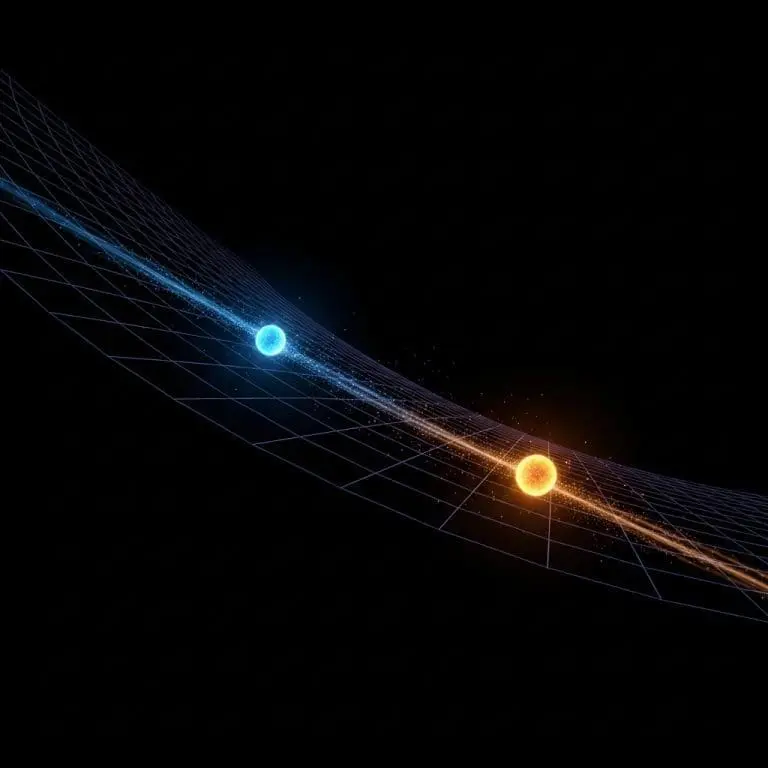
Scientists are increasingly interested in understanding how spacetime curvature can generate particle-antiparticle pairs, analogous to the Schwinger effect observed in strong electromagnetic fields. Mohammed Alkhateeb, James P. Edawards, and Yves Caudano, from the Research Unit Lasers and Spectroscopies at the University of Namur, have now developed a computational approach to study this gravitational pair creation in two-dimensional curved spacetimes. Their research extends Computational Field Theory to incorporate spin-½ fermions, enabling a numerical investigation of vacuum excitation following a “curvature quench”. This work represents a significant step towards modelling particle creation in more realistic, time-dependent gravitational scenarios and potentially alongside electromagnetic fields, offering new insights into fundamental physics at the intersection of quantum field theory and general relativity.
This work extends computational quantum field theory, previously successful in flat spacetime scenarios, to the realm of curved spacetime geometries, mirroring phenomena analogous to the Schwinger effect observed with strong electromagnetic fields.
Implementing CQFT in Curved Spacetime Backgrounds
Researchers achieved this by adapting the established CQFT methodology, which efficiently evolves quantum fields, to encompass spin-1/2 fermions within curved spacetime backgrounds. The study focuses on a “curvature quench,” evolving a fermionic vacuum within a 1+1-dimensional spacetime featuring a localized Gaussian deformation representing a “curvature bump”.
Vacuum excitation, indicative of particle-antiparticle pair creation, is quantified by meticulously calculating fermion-antifermion pair numbers relative to a flat-spacetime basis. This approach allows for a spacetime-resolved analysis of the excitation process, revealing how the number of created pairs depends on both the strength and spatial extent of the curvature deformation.
The numerical implementation of CQFT in curved backgrounds presented here overcomes challenges associated with lattice discretization and spurious fermion modes, employing a split-operator approach to ensure accurate time evolution. While the current investigation considers a static, post-quench geometry without electromagnetic fields, the findings lay a crucial foundation for future research.
Extending Simulations to Dynamic and Coupled Fields
This extended CQFT framework will enable investigations into particle creation within genuinely time-dependent curved spacetimes and, importantly, in the presence of combined electromagnetic and gravitational fields. The research employs a spacetime-resolved numerical approach within the interaction picture to study vacuum excitation induced by a curvature quench. This extended CQFT framework allows for efficient real-time evolution of fermionic fields, addressing a non-perturbative process analogous to particle/anti-particle pair production in strong electromagnetic fields.
Modeling Curvature via Localized Spacetime Deformations
A key methodological innovation involves evolving the fermionic Minkowski vacuum within a 1+1 dimensional curved spacetime characterised by a localised “curvature bump”. This bump is generated using a smooth, Gaussian deformation of flat spacetime, enabling precise control over the curvature profile. Vacuum excitation is quantified by calculating fermion, antifermion pair numbers relative to a flat-spacetime basis, representing the perspective of an observer at infinity.
The study meticulously analyses how pair production depends on both the strength and spatial extent of this curvature deformation. The numerical implementation utilises a split-operator approach on a discretised spacetime lattice to avoid spurious fermion modes arising from lattice discretisation. Unlike methods relying on asymptotic regions or adiabaticity, this CQFT framework directly evaluates time-dependent, spatially resolved observables at finite times.
Addressing the inherent ambiguity of particle number at transient times, calculations are performed in asymptotically flat backgrounds, ensuring a consistent interpretation. Importantly, the framework allows for the evaluation of charge densities and currents independently of any specific particle interpretation, offering a unique level of dynamical control.
This approach integrates the covariant Dirac equation, spin connection, and curvature-dependent Hamiltonian into a numerically stable scheme, establishing a complementary pathway for investigating nonperturbative quantum field-theoretical phenomena in curved spacetimes. This work investigates the non-perturbative process of gravitational pair creation, analogous to the Schwinger effect, using a spacetime-resolved numerical approach.
The research focuses on a one-plus-one-dimensional idealized curved spacetime generated by a smooth, localized Gaussian deformation of flat spacetime, evolving a fermionic Minkowski vacuum within this geometry. Vacuum excitation is quantified by computing fermion, antifermion pair numbers relative to a flat-spacetime basis, representing an observer at infinity.
Analysis reveals how excitation depends on the strength and spatial extent of the curvature deformation, establishing a foundation for future investigations of particle creation in genuinely time-dependent curved spacetimes and with electromagnetic backgrounds. The framework utilizes a Hermitian Hamiltonian and a unitary time-evolution operator derived for the curved background, allowing for efficient numerical time evolution of fields.
The Dirac equation is formulated in both relativistic quantum mechanics and quantum field theory, connecting the first-quantized and second-quantized approaches. Positive and negative frequency wavefunctions are expressed in position space, forming the basis for expanding the fermionic field operator.
The time evolution of the field operator is generated by an operator, mirroring the single-particle evolution equation, and the time-dependent creation and annihilation operators are defined through a transformation based on the evolved field operator. Number-density operators are defined to quantify the momentum spectrum of created fermions and anti-fermions, with ρp+(t, p) representing the number operator for particles with momentum p and ρp−(t, p) for anti-particles.
The charge-density operator, ρ(t, x), is expressed in terms of these number densities, revealing the contribution of both particle and anti-particle densities to the overall charge distribution. This approach allows for the identification of particle states according to the time-evolved operators, providing a means to study vacuum excitation and particle creation within the CQFT framework.
Fermion pair production rates in static curved spacetime geometries
Scientists have extended a computational framework to investigate particle creation originating from the curvature of spacetime. The study quantifies vacuum excitation by calculating fermion-antifermion pair numbers relative to a flat-spacetime reference frame. Analyses reveal how the strength and extent of the curvature deformation influence this excitation.
Numerical tests confirm the accuracy of the time evolution operator, with deviations remaining minimal throughout the simulation duration. While the current investigation focuses on a static, curved geometry without electromagnetic fields, it successfully establishes a robust foundation for future explorations of particle creation in more complex, time-dependent scenarios.
A key limitation acknowledged is that particle number is not an invariant quantity and depends on the chosen mode decomposition. The present work prioritises establishing the mathematical and numerical framework necessary for calculating asymptotic pair creation rates rather than defining a physical particle spectrum for a specific observational context.
Future research will explore alternative particle definitions based on instantaneous eigenstates of the Hamiltonian or charge-density operator, as well as incorporating spatially varying electromagnetic fields and addressing time ordering errors to enhance numerical precision. These extensions promise to enable investigations of more realistic physical scenarios where particle number becomes unambiguous and directly measurable.
🗞 Computational quantum field theory for fermion pair creation in 2-dimensional curved spacetimes
🧠 ArXiv: https://arxiv.org/abs/2602.07330