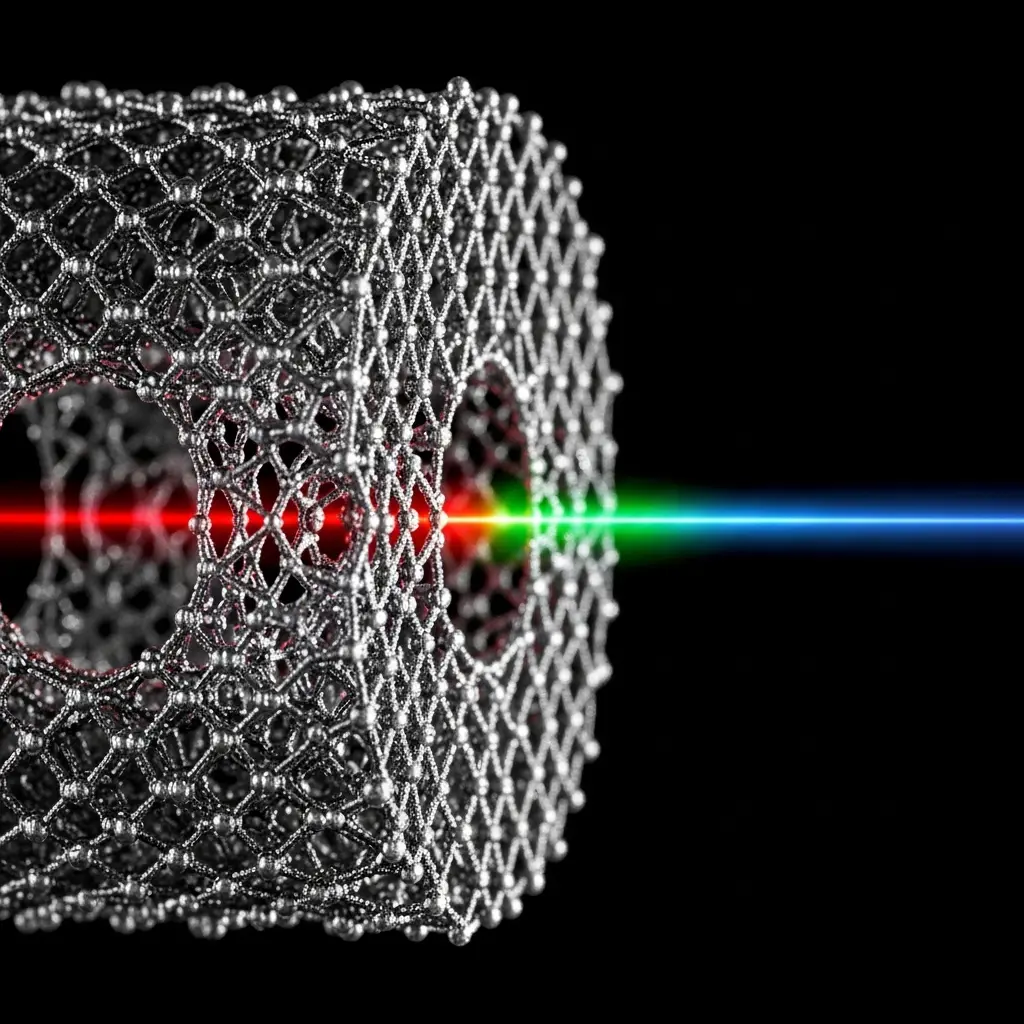
Researchers are increasingly focused on harnessing nanoscale nonlinear optical processes, such as second-harmonic generation (SHG), for applications spanning filtering to nonlinear spectroscopy. Yaping Hou from Xi’an Jiaotong University, Yigong Luan and Alfonso Nardi from Politecnico di Milano, et al., report a significant advance in this field by demonstrating a large-area lithium niobate metasurface capable of efficient and tunable narrowband SHG. Their work, enabled by scalable nanoimprint lithography and optimal coupling of quasi-bound state in the continuum modes, achieves a normalized SHG efficiency amongst the highest reported for lithium niobate metasurfaces, crucially at a low pump peak intensity suitable for integrated and portable devices. Furthermore, the ability to tune the SHG wavelength and control polarization via pump illumination expands the potential of this versatile platform for sensing, terahertz generation and detection, and ultrafast electro-optic modulation.
This breakthrough utilizes a novel etchless lithium niobate (LN) platform fabricated with scalable nanoimprint lithography, overcoming longstanding challenges in LN nanofabrication.
Harnessing q-BIC Modes for Light-Matter Interaction
The research centres on a titanium dioxide (TiO₂) nanograting patterned onto thin-film lithium niobate, designed to harness quasi-bound state in the continuum (q-BIC) modes for intensified light-matter interactions. By optimally coupling these q-BIC modes with a narrowband pulsed laser pump, the team achieved a normalized SHG efficiency of 0.15% cm²/GW, ranking among the highest reported values for LN metasurfaces.
This high efficiency stems from a design that avoids direct etching of the lithium niobate crystal, a process known to introduce defects and reduce nonlinear conversion efficiency. Instead, a low-refractive-index TiO₂ nanograting is imprinted onto the TFLN layer, enabling the support of delocalized photonic modes with extremely high quality factors.
The use of a picosecond pulsed laser, rather than conventional femtosecond oscillators, further optimizes the power coupling into the optical mode by matching the q-BIC resonance linewidth. This innovative approach allows for narrowband SHG while maintaining a low pump peak intensity of 3.64kW/cm², potentially enabling integrated and portable photonic applications, and even continuous-wave pumping.
Achieving Tunable and High-Precision Optical Output
Furthermore, the metasurface exhibits wavelength tuning of the SHG signal from 870 to 920nm with stable output power, alongside precise polarization control achieved through off-normal pump illumination. The fabricated device spans a substantial area of 1mm x 1mm, comprising 530nm-wide TiO₂ nanowires with a 910nm periodicity and a 5° slant angle, atop a 610nm-thick TFLN film.
Calculations of the photonic band structure reveal four resonant modes, TE10, TE20, TM20, and TM10, crucial for optimizing the device’s performance. This versatile platform promises new avenues for sensing, terahertz generation and detection, and ultrafast electro-optic modulation of nonlinear optical signals.
Computational Modeling and Band Structure Analysis
Photonic band structure calculations and quality factor analysis with varying grating slant angle are crucial for device optimization
A finite-element method implemented in COMSOL Multiphysics underpinned the photonic band structure calculations of the system with vertical sidewalls, identifying four resonant modes: TE10 and TE20 for TE-polarization, and TM20 and TM10 for TM-polarization. These optical modes were investigated to determine the impact of grating slanting angle α on their quality factors.
Mirror symmetry within the unit cell creates an avoided crossing point, splitting guided modes into a leaky mode and a symmetry-protected bound state in the continuum, or BIC. Evaluation of the Q-factor as a function of α revealed a steep dependence for TE10 and TM10 modes, diverging at α = 0°, indicative of BIC resonances.
Conversely, TE20 and TM20 modes exhibited a moderately high, largely angle-independent Q-factor, typical of leaky modes. Fabrication employed a 5° slanting angle α to disrupt mirror symmetry, converting the BIC into a quasi-BIC with a theoretical Q-factor of approximately 105. This angle was selected to maximize field enhancement within the lithium niobate film while maintaining efficient coupling to a collimated pump beam.
A narrowband picosecond laser, possessing an equivalent Q-factor exceeding 103, delivered energy to the sample. Spatial field distribution maps at α = 5° demonstrated strong localization of all four modes within the lithium niobate layer, with varying degrees of confinement. Simulated and experimental transmission spectra were then acquired, tilting the sample from −4° to +4° in 0.2° steps using a motorized rotation stage and a supercontinuum laser source.
Excellent agreement between simulations and experimental data confirmed the dispersion bands. The Q-factors of TE10 and TM10 modes exhibited a marked dependence on incidence angle, confirming quasi-BIC behaviour, while TE20 and TM20 modes displayed broader, angle-insensitive resonances. Notably, q-BICs and leaky modes exhibited dispersion with opposite slopes as a function of sample rotation angle.
High-efficiency narrowband second harmonic generation from titanium dioxide metasurfaces on lithium niobate enables compact nonlinear optical devices
Normalized second-harmonic generation (SHG) efficiency reached 1000, representing one of the highest values reported for lithium niobate (LN) metasurfaces. This performance was achieved using a large-area metasurface fabricated via scalable nanoimprint lithography, comprising a slanted titanium dioxide (TiO₂) nanograting on etchless TFLN.
Efficient narrowband SHG resulted from optimal coupling of quasi-bound state in the continuum (-BIC) modes with a narrowband pulsed laser pump. The fabricated sample measured 1mm × 1mm and consisted of an array of TiO₂ nanowires with a width of 530nm and periodicity of 910nm, exhibiting a slanting angle of 5°.
TiO₂ and TFLN layer thicknesses were 510nm and 610nm respectively, as confirmed by scanning electron microscopy. Calculations of the photonic band structure identified four resonant modes, TE10, TE20, TM20, and TM10, for both TE- and TM-polarized plane-wave illumination. Analysis of the Q-factor as a function of grating slanting angle revealed that the TE10 and TM10 modes exhibited a steep dependence, diverging at a slanting angle of 0°.
Conversely, TE20 and TM20 modes maintained a moderately high Q-factor, largely insensitive to the angle. The fabricated structure, with a 5° slanting angle, perturbed mirror symmetry, converting the BIC into a q-BIC with a theoretical Q-factor of approximately 105. A narrowband picosecond laser, possessing an equivalent Q-factor exceeding 103, was employed to maximize energy delivery to the sample.
Simulated and experimental transmission spectra closely matched, demonstrating excellent agreement with the dispersion bands. Q-factors for the TE10 and TM10 modes showed a marked dependence on the incidence angle, confirming q-BIC characteristics. At normal incidence, q-BIC resonances were narrower than the spectrometer resolution of 0.5nm, but became detectable at tilt angles of 0.2° and 0.4°, where Q-factors reduced to less than 103. Leaky modes (LMs) TE20 exhibited a Q-factor ranging from 250 to 450 in experiment and 350 to 650 in simulation, while LM TM20 maintained a nearly constant linewidth.
Efficient second harmonic generation via quasi-bound state in the continuum resonances offers new possibilities for nonlinear optics
Scientists have developed a large-area metasurface capable of efficient, narrowband second-harmonic generation (SHG), a nonlinear optical process with applications in sensing, terahertz generation and ultrafast electro-optic modulation. This platform integrates a titanium dioxide nanograting onto a thin film of lithium niobate using scalable nanoimprint lithography, enabling strong light-matter interactions through the excitation of quasi-bound state in the continuum (q-BIC) modes.
The achieved normalized SHG efficiency of 0.15% cm²/GW represents a significant result amongst lithium niobate nanoscale devices. The key innovation lies in the precise coupling of q-BIC resonances with a narrowband pulsed laser, maximizing light-matter interaction and achieving high conversion efficiency even with relatively low peak intensities of 3.64kW/cm².
Furthermore, the platform allows for dynamic wavelength tuning of the SHG signal from 870nm to 920nm via angular adjustments, maintaining stable output power throughout the range. Polarization control, including modulation from linear to circular polarization, is also demonstrated under specific excitation conditions.
The authors acknowledge a limitation in the current design relating to the dependence of performance on precise angular alignment to match the q-BIC linewidth with the laser bandwidth. Future research may focus on further optimizing the nanograting geometry and exploring alternative materials to broaden the tuning range and enhance the efficiency of the metasurface. The large-area scalability afforded by nanoimprint lithography positions this technology as a promising candidate for integrated photonic circuits and portable nonlinear optical applications, offering a versatile platform for compact frequency conversion and reconfigurable photonic systems.
🗞 Efficient and tunable narrowband second-harmonic generation by a large-area etchless lithium niobate metasurface
🧠 ArXiv: https://arxiv.org/abs/2602.00830




See today’s quantum computing news on Quantum Zeitgeist for the latest breakthroughs in qubits, hardware, algorithms, and industry deals.