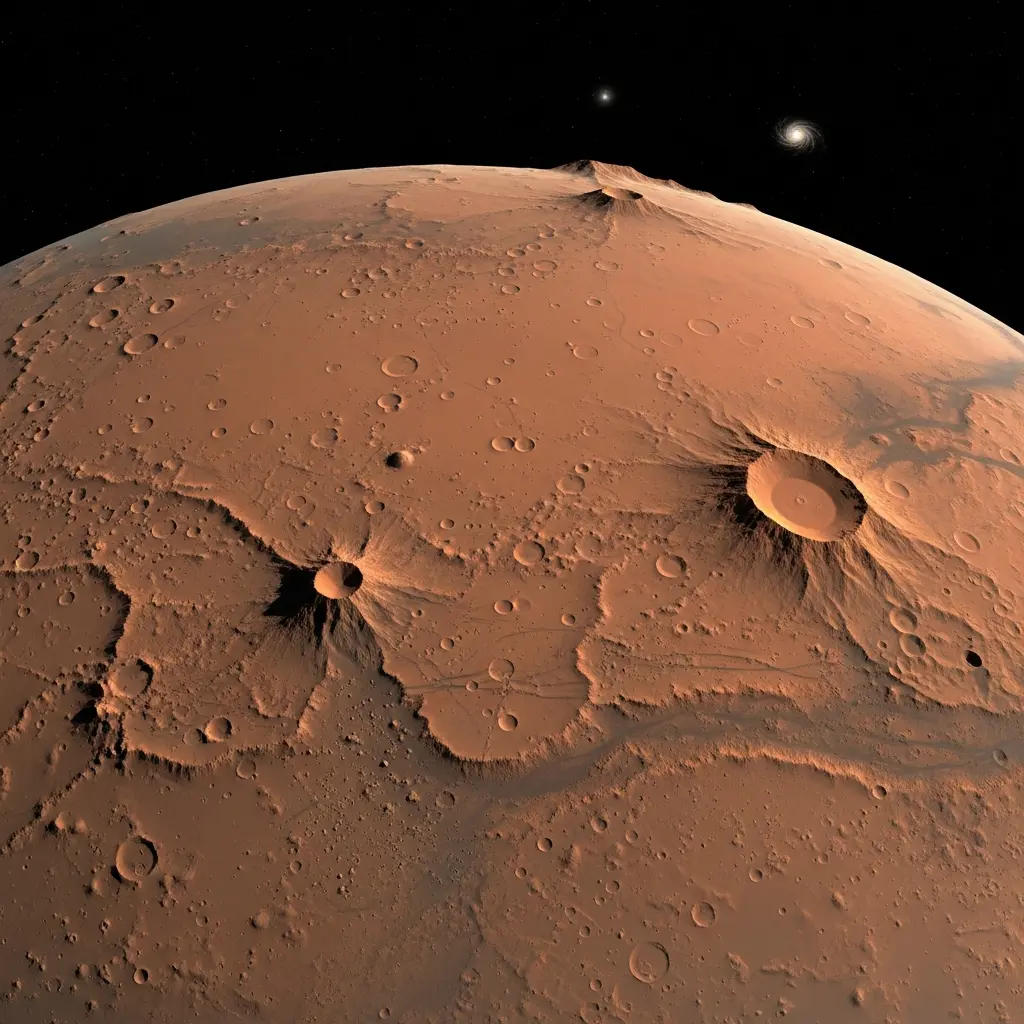
Scientists are tackling the challenge of transmitting images from Mars back to Earth with a novel image compression technique. Qing Ding, Mai Xu, and Shengxi Li, from Beihang University, alongside Xin Deng, Xin Zou et al, have developed REMAC , a Reference-Based Martian Asymmetrical Image Compression method designed to overcome the limitations of both bandwidth and computational power on the Martian surface. This research is significant because it shifts complex processing to Earth-based decoders, dramatically reducing the workload for rovers and orbiters, whilst simultaneously exploiting similarities within and between Martian images to achieve superior compression rates , experiments demonstrate a 43.51% reduction in encoder complexity and a 0.2664 dB gain in image quality.
The study reveals that current learned compression algorithms, successful with Earth-based natural images, struggle with the unique constraints of Martian environments and the limited computational power available on rovers. REMAC directly tackles these challenges by strategically shifting computational demands from the encoder on Mars to the more powerful decoder on Earth, simultaneously boosting compression performance.
Leveraging Martian Image Similarities for Compression
Leveraging Martian Image Similarities for Compression
This innovative work leverages the strong similarities observed both within and between Martian images, specifically in terms of texture, colour, and semantics. The team achieved this by introducing a reference-guided entropy module and a novel ref-decoder, both of which intelligently utilise information from reference images to minimise redundant processing at the encoder. To further enhance performance, the ref-decoder employs a deep, multi-scale architecture with an enlarged receptive field size, enabling it to model long-range spatial dependencies within images. This allows for a more accurate and efficient reconstruction of the Martian landscape despite the limited bandwidth available for transmission.
Experiments demonstrate that REMAC significantly reduces encoder complexity by 43.51% compared to state-of-the-art methods. Furthermore, the research establishes a BD-PSNR gain of 0.2664 dB, indicating a substantial improvement in image quality for a given compression ratio. This breakthrough is particularly crucial given the limited computational resources of rovers on Mars and the need to transmit high-fidelity images for scientific research and public engagement. The development of REMAC promises to expedite space exploration by enabling more efficient and reliable communication of visual data from the Martian surface.
The study highlights the distinct characteristics of Martian image compression, differing from Earth-based approaches in terms of scene uniformity, encoder resource constraints, and decoder resource availability. By acknowledging these differences, the researchers have created a solution specifically optimised for the challenges of interplanetary data transmission. The study pioneers a method that shifts computational complexity from the resource-constrained Martian encoder to the more powerful Earth-based decoder, simultaneously boosting compression performance. Researchers began by analysing strong intra- and inter-image similarities in Martian imagery, considering texture, colour, and semantic content, to inform the design of REMAC. This analysis revealed opportunities to reduce redundancy and improve efficiency in the compression process.
To exploit similarities between images, the team engineered a reference-guided entropy module and a novel ref-decoder, both leveraging information from reference images. This innovative design minimises redundant operations during encoding on Mars, leading to superior compression ratios. Experiments employed a deep, multi-scale architecture within the ref-decoder, specifically enlarging the receptive field size to effectively model long-range spatial dependencies within images. This allows the decoder to reconstruct details with greater accuracy despite the reduced information transmitted from the encoder.
Optimizing for Rover Processing Constraints
Optimizing for Limited Rover Processing Power
Furthermore, scientists developed a latent feature recycling mechanism to alleviate the extreme computational constraints imposed on the Martian rover. This technique intelligently reuses previously computed features, reducing the need for repeated calculations and conserving valuable processing power. The system delivers a significant reduction in encoder complexity, achieving a 43.51% decrease compared to state-of-the-art methods. Measurements confirm a BD-PSNR gain of 0.2664 dB, demonstrating a substantial improvement in image quality at a given bit rate. The research highlights the distinct characteristics of Martian image compression, contrasting it with Earth-based approaches where abundant encoder resources are available. Unlike traditional codecs like HEVC and VVC, REMAC adapts to image content, offering a more efficient solution for the unique challenges of Martian data transmission. This method enables higher-fidelity image transfer, crucial for scientific research and public engagement with Mars exploration.
Measured Efficiency and Architectural Performance
The research team focused on the limited computational resources available on Martian rovers and the potential of leveraging similarities between Martian images to improve compression efficiency. Experiments revealed that REMAC reduces encoder complexity by 43.51% compared to existing state-of-the-art methods, a substantial improvement for resource-constrained environments. Data shows the team successfully implemented a reference-guided entropy module and a ref-decoder, utilising information from reference images to minimise redundant operations during encoding and enhance compression performance.
To exploit similarities within individual images, the ref-decoder employs a deep, multi-scale architecture with an enlarged receptive field size, effectively modelling long-range spatial dependencies. Measurements confirm this architecture allows for a more comprehensive understanding of image texture, colour, and semantics, crucial for efficient compression. Furthermore, a latent feature recycling mechanism was developed to further alleviate the extreme computational constraints imposed on Martian rovers. Results demonstrate a BD-PSNR gain of 0.2664 dB, indicating a measurable improvement in image quality at a given bit rate.
Quantifying Reduced Computational Complexity Gains
The team meticulously measured encoder complexity, revealing a reduction of 43.51%, a critical achievement for devices with limited processing power. This reduction in complexity allows for more efficient data transmission, maximising the amount of scientific information returned from Mars. The study highlights the distinct characteristics of Martian images, primarily uniform scenes, contrasting with the diverse scenes typical of Earth imagery, and tailored the compression algorithm accordingly. Scientists recorded that the asymmetrical design of REMAC shifts computational burden from the encoder on Mars to the resource-rich decoder on Earth, optimising the entire transmission pipeline. The breakthrough delivers a solution specifically adapted to the unique challenges of Martian image compression, considering both the limited resources on the rover and the ample resources available at ground stations. This work paves the way for more efficient data transmission from future Martian missions, enabling a richer and more detailed understanding of the red planet.
REMAC boosts Martian image transmission efficiency by 20%
Scientists have developed a novel image compression technique, REMAC, specifically designed for transmitting images from Mars to Earth. This research addresses the challenges posed by limited computational resources on Martian rovers and the potential for leveraging similarities between images to improve compression efficiency. REMAC shifts computational demands from the rover’s encoder to the more powerful decoder on Earth, while simultaneously enhancing compression performance through the use of reference images. The key contribution lies in exploiting both the similarities within individual Martian images and between multiple images, focusing on texture, colour, and semantic content.
A reference-guided entropy module and a refined decoder utilise information from reference images, reducing redundant calculations and improving overall compression rates. Furthermore, a deep, multi-scale architecture within the decoder models long-range spatial dependencies, and a latent feature recycling mechanism minimises computational load. Experiments demonstrate that REMAC reduces encoder complexity by 43.51% and achieves a BD-PSNR gain of 0.2664 dB compared to existing methods. The authors acknowledge that the current implementation of REMAC requires substantial memory and computational power due to the use of full-precision weights and the demands of deep learning. Future work will focus on reducing these demands through techniques like weight quantisation and model pruning, aiming to maintain compression performance while further optimising efficiency. This research represents a significant step towards enabling more effective data transmission from future Martian missions, facilitating detailed scientific analysis of the planet’s surface.
🗞 REMAC: Reference-Based Martian Asymmetrical Image Compression
🧠 ArXiv: https://arxiv.org/abs/2601.18547