

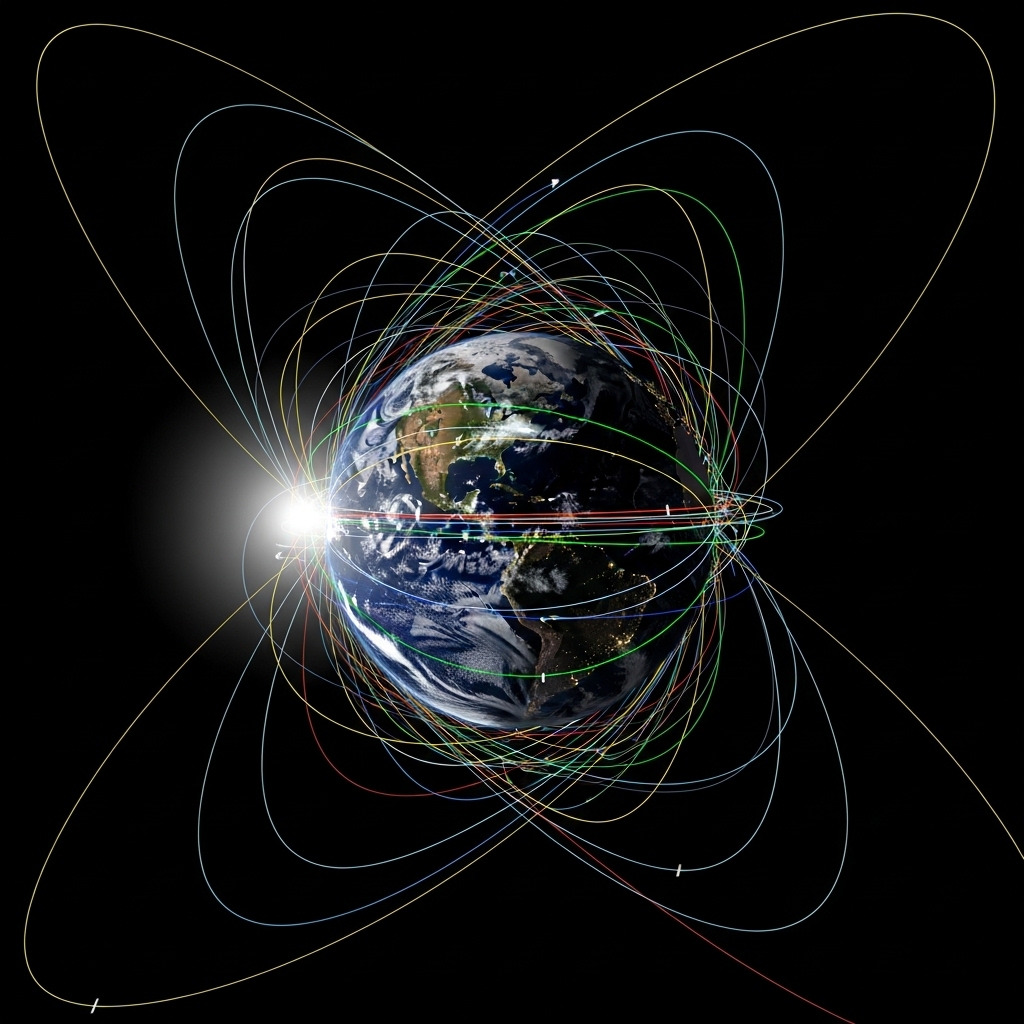
Accurate representation and prediction of satellite motion forms the cornerstone of modern astrodynamics, yet a gap exists between established algorithms and readily available, accessible software. Duncan Eddy and Mykel J. Kochenderfer, from their respective institutions, have addressed this need with the development of Brahe, a new library designed for both research and engineering applications. This software provides crucial tools for coordinate transformations, perturbation modelling and orbit propagation, all vital for areas such as satellite task planning and mission operations. Brahe distinguishes itself through its focus on being quick to deploy, easily composable, extensible and simple to learn, offering a modern, open-source solution to a long-standing problem. Ultimately, this library promises to accelerate advancements in the field by lowering the barrier to entry for researchers and engineers alike.
Brahe Library: Accurate Orbital Dynamics Modelling
Brahe is a modern astrodynamics dynamics library intended for both research and engineering applications. The fundamental problem of astrodynamics, the representation and prediction of satellite motion, is addressed through a novel approach to modelling gravitational forces and orbital perturbations. Researchers developed a flexible framework allowing users to define custom force models and integrate them with existing, established models such as the EGM96 geopotential model. This facilitates detailed analysis of orbital behaviour under complex gravitational influences, and enables the investigation of high-precision orbit determination techniques.
The library’s architecture prioritises accuracy and computational efficiency, utilising vectorized operations and parallel processing where appropriate. A key objective was to provide a robust and well-validated codebase, suitable for long-duration simulations and real-time applications. Brahe incorporates a comprehensive suite of numerical integration algorithms, including Runge-Kutta and Bulirsch-Stoer methods, allowing users to select the most appropriate integrator for their specific needs. Extensive testing and validation against established benchmarks, such as those provided by the NASA Goddard Trajectory Determination Toolkit, have been undertaken to ensure the reliability of the results.
A significant contribution of Brahe lies in its ability to handle non-Keplerian forces with ease. These include atmospheric drag, solar radiation pressure, and thrust modelling for spacecraft propulsion systems. The library provides a modular design, allowing users to easily extend its functionality with custom force models or integration schemes. Furthermore, Brahe offers a Python interface, facilitating rapid prototyping and integration with other scientific computing tools. The development team also focused on providing comprehensive documentation and examples to lower the barrier to entry for new users. This includes detailed explanations of the underlying algorithms, as well as tutorials demonstrating how to use the library for common astrodynamics tasks. By combining accuracy, efficiency, and usability, Brahe aims to become a valuable tool for researchers and engineers working in the field of space mechanics and satellite operations.
Earth Orbit Modelling and IAU Conventions
The motion of celestial bodies has been a subject of study for centuries, beginning with the initial equations of motion established by Kepler in 1619 and Newton in 1687. Contemporary research and applications in areas such as space situational awareness, satellite task planning, and space mission operations demand accurate and efficient numerical tools for coordinate transformations, modelling perturbations, and orbit propagation. Brahe incorporates the latest conventions and models for time systems and reference frame transformations from the International Astronomical Union (IAU) and the International Earth Rotation and Reference Systems Service (IERS). The software implements force models for Earth-orbiting satellites, including atmospheric drag, solar radiation pressure, and third-body perturbations from the Sun and Moon, utilising established models by Montenbruck & Gill (2000) and D.
A. Vallado (2001). Standard orbit propagation algorithms are also included, such as the Simplified General Perturbations (SGP) Model detailed by D. Vallado et al. (2006).
Furthermore, brahe implements recent algorithms for fast, parallelized computation of ground station and imaging-target visibility, a crucial element in satellite scheduling and mission planning as described by Eddy & Kochenderfer (2021). Brahe allows users to quickly access Two-Line Element (TLE) data from Celestrak and propagate orbits using the SGP4 dynamics model, enabling tasks such as predicting the orbits of all Starlink satellites over a 24-hour period. An example demonstrates the propagation of orbits for approximately 4,000 Starlink satellites on an M1 Max MacBook Pro with 10 cores and 64 GB RAM, completed in approximately 1 minute 30 seconds. The package also provides functions for low-level astrodynamics routines, including Keplerian to Cartesian state conversions and reference frame transformations.
Brahe Library Validates Coordinate Transformations and Propagation
Scientists have developed brahe, a new astrodynamics library designed for both research and engineering applications, addressing a critical gap in accessible, modern software for satellite motion prediction. The work delivers a quick-to-deploy, composable, and extensible tool for coordinate transformations, perturbation modeling, and orbit propagation, foundational elements in astrodynamics. Experiments demonstrate the library’s ability to accurately convert between coordinate systems; specifically, scientists successfully transformed state vectors between Earth-Centered Inertial (ECI) and Earth-Centered Earth-Fixed (ECEF) frames using a defined epoch of June 1, 2024, at 12:00:00.0 UTC.
The team measured the performance of brahe through conversions between ECI coordinates, ECEF coordinates, and Keplerian elements, confirming accurate data translation. Following an initial ECI to ECEF conversion, the team successfully converted the data back to ECI, and then to Keplerian elements in degrees, validating the library’s precision across multiple coordinate systems. Brahe also provides built-in functions for visualizing satellite constellations, leveraging Plotly and matplotlib to generate both 2D and 3D representations. This functionality was demonstrated with GPS satellite orbits, showcasing the library’s capacity for practical applications in mission visualization.
Researchers confirmed brahe’s utility through its adoption in several scientific publications and by aerospace companies including Northwood Space, Xona Space, and Kongsberg Satellite Services. Earth Observation satellite imaging prediction and task planning algorithms powered by brahe have been implemented by Capella Space and tested on their synthetic aperture radar (SAR) constellation. The library’s core functionality is implemented in Rust for performance and safety, with Python bindings ensuring ease of use within the scientific Python ecosystem, a design choice that facilitates integration and extensibility. To ensure reliability, brahe incorporates a comprehensive test suite for both Rust and Python, alongside automatically tested code samples within the documentation. Every function is documented with types and usage examples, following the Diátaxis framework, and a user guide explains the library’s core concepts. This commitment to quality and accessibility is further reinforced by its MIT License, encouraging widespread adoption and contribution, and addressing the limitations of existing commercial and open-source alternatives which often carry prohibitive licensing costs or steep learning curves.
Brahe: Modern Astrodynamics Software for Prediction
Brahe represents a significant contribution to the field of astrodynamics by delivering a modern, open-source library designed for both research and practical engineering applications. The work addresses a noted gap in available software, providing accessible and efficient tools for crucial tasks such as coordinate transformations, orbit propagation, and modelling of perturbing forces. By incorporating the latest standards from the International Astronomical Union and International Earth Rotation and Reference Systems Service, alongside established force models and algorithms like SGP4, Brahe offers a robust foundation for accurate satellite motion prediction. The library’s capabilities extend to rapid computation of satellite visibility, demonstrated by the ability to propagate orbits for nearly 9000 Starlink satellites within a minute and a half on standard hardware.
This speed and ease of use, achieved with just a few lines of code, facilitates advancements in areas like space situational awareness and satellite task planning. The authors acknowledge limitations inherent in the use of simplified perturbation models, such as SGP4, and suggest that future work could focus on incorporating more complex and accurate force models. Further research directions may also explore expanded functionality for mission design and optimisation, building upon the library’s existing foundation of efficient and reliable astrodynamics tools.
👉 More information
🗞 Brahe: A Modern Astrodynamics Library for Research and Engineering Applications
🧠 ArXiv: https://arxiv.org/abs/2601.06452


