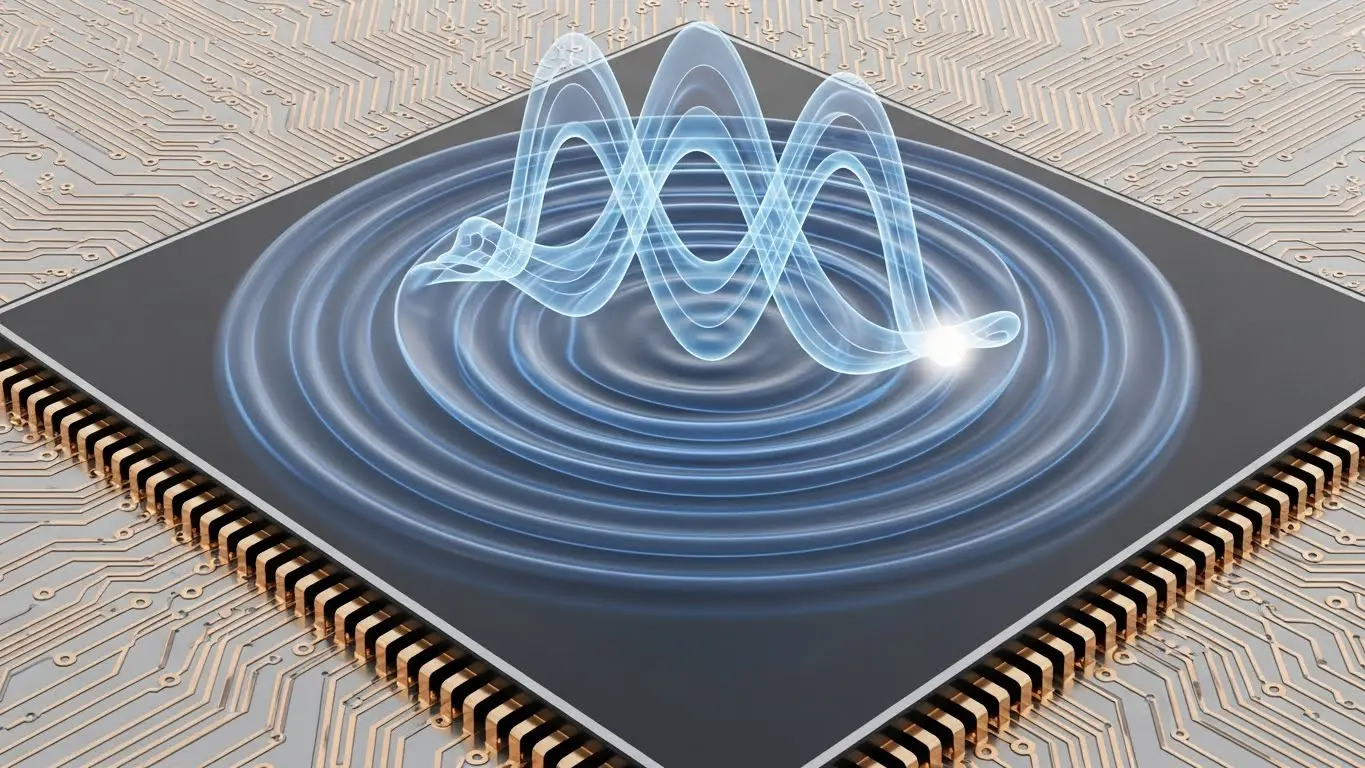
After years of false starts, the race for the Majorana fermion has a new frontrunner. If Microsoft‘s Majorana 1 chip works, it will prove that ‘half-particles’ can create the world’s first unshakeable qubit. The pursuit of stable quantum computation has been plagued by decoherence, the tendency of qubits to lose their quantum state due to environmental noise. Conventional approaches attempt to shield qubits, but Microsoft is taking a radically different tack: building qubits from particles inherently resistant to noise, leveraging the bizarre properties of the Majorana fermion. This isn’t just about better error correction; it’s about a fundamentally different kind of qubit, one that promises to rewrite the rules of quantum information processing.
The core of Microsoft’s billion-dollar gamble rests on the theoretical existence of the Majorana fermion, a particle that is its own antiparticle. Unlike most particles which have a distinct matter and antimatter counterpart, the Majorana fermion blurs this distinction. This peculiar property isn’t just a mathematical curiosity; it has profound implications for quantum stability. Microsoft Quantum believes they’ve engineered a system, the Majorana 1 chip, where these elusive particles emerge as quasiparticles within a specially designed semiconductor structure, forming the basis for topological qubits. The challenge, however, is proving their existence and controlling them with sufficient precision to perform meaningful computations.
The search for the Majorana fermion isn’t new, but Microsoft’s approach, spearheaded by a dedicated team of physicists and engineers, represents a significant escalation in both investment and ambition. The company’s strategy isn’t simply to find Majoranas, but to create and manipulate them in a controlled environment, paving the way for a scalable and fault-tolerant quantum computer. The stakes are immense, and the path is fraught with technical hurdles, but the potential reward, a quantum computer impervious to the errors that plague current designs, is driving this audacious endeavor.
The Ghostly Nature of Majorana’s Existence
The concept of a particle being its own antiparticle seems counterintuitive, violating our everyday understanding of matter and antimatter annihilation. The Majorana fermion, named after Italian physicist Ettore Majorana who first proposed its existence in 1937, isn’t a fundamental particle like the electron or quark. Instead, it’s predicted to emerge as a quasiparticle, a collective excitation within a material that behaves like a particle. This emergence is crucial because it allows for the possibility of creating and controlling Majoranas in a laboratory setting. The quasiparticle arises from complex interactions within a topological superconductor, a material exhibiting unique quantum properties. The quasiparticle’s wave function is spatially separated, meaning its quantum information isn’t localized in a single point, but rather distributed across the material. This distribution is key to its resilience against local disturbances.
Building a Home for Ghosts: The Topological Superconductor
Creating a topological superconductor is no easy feat. Microsoft’s approach involves growing a nanowire made of semiconductor material, specifically indium antimonide, coated with a superconducting material like aluminum. Applying a magnetic field and carefully controlling the electron density within the nanowire creates the conditions necessary for Majorana quasiparticles to emerge at the ends of the wire. These “Majorana bound states” are localized at the edges, protected from decoherence by the topological properties of the superconductor. The topological protection arises from the material’s unique band structure, which prevents scattering events that would normally disrupt a qubit’s quantum state. The nanowire acts as a ‘quantum waveguide’ confining the Majorana modes.
Braiding the Impossible: Encoding Qubits with Half-Particles
The true power of Majorana qubits lies in their ability to be encoded not by the presence or absence of a particle, but by the braiding of these quasiparticles around each other. Imagine two Majoranas existing at the ends of a nanowire. By physically moving them around each other, a process called braiding, the quantum state of the qubit is altered. This braiding operation is topologically protected; small imperfections or disturbances during the braiding process don’t affect the qubit’s state, making it incredibly robust against errors. The braiding operation effectively swaps the non-Abelian anyons, leading to a change in the quantum state. This is fundamentally different from traditional qubit manipulation, which relies on precise control of individual particles.
The Majorana 1 Chip: A Prototype in Progress
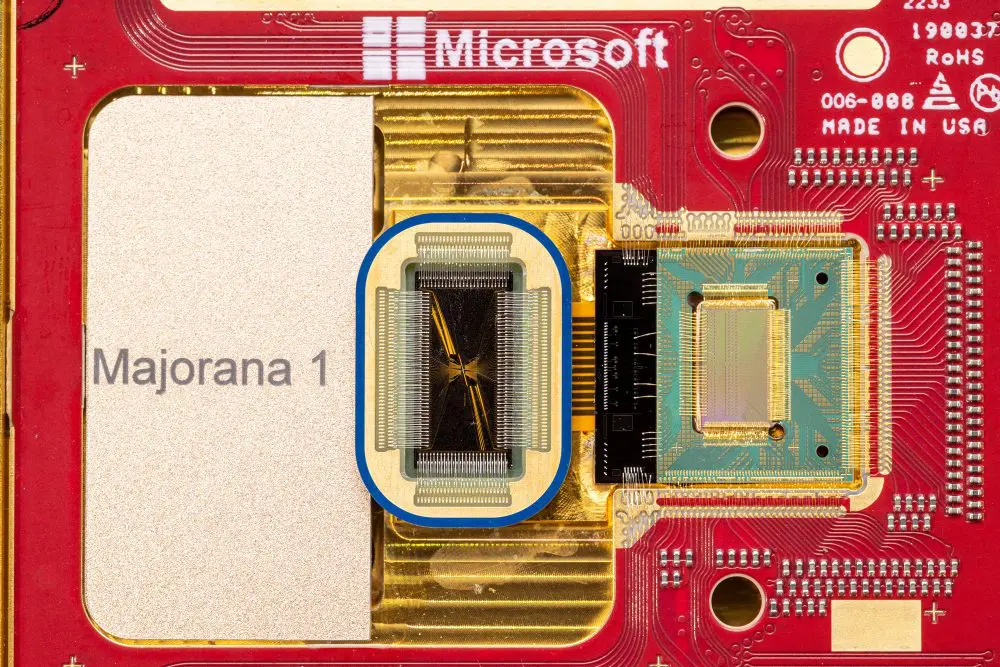
The Majorana 1 chip, the physical manifestation of Microsoft’s vision, is a complex device containing an array of nanowires designed to host Majorana bound states. While specific hardware specifications are not publicly detailed beyond the use of indium antimonide nanowires and aluminum superconducting layers, the chip represents a significant step towards realizing a scalable topological quantum computer. The chip is designed to allow for the creation and manipulation of multiple Majorana qubits, enabling complex quantum computations. The current focus is on demonstrating the coherent manipulation of these qubits and verifying the topological protection they offer. The chip’s architecture is designed to facilitate the braiding operations necessary for quantum gate implementation.
The Signal-to-Noise Ratio: Detecting the Elusive Majorana
One of the biggest challenges facing the Majorana program is definitively proving the existence of these quasiparticles. Because Majoranas are not fundamental particles, their detection relies on indirect measurements of their unique signatures. Researchers look for a specific zero-bias conductance peak in electrical measurements, indicating the presence of a Majorana bound state. However, these peaks can also be mimicked by other phenomena, leading to ongoing debate and scrutiny within the scientific community. Distinguishing a true Majorana signal from background noise requires extremely precise measurements and careful analysis. Microsoft has invested heavily in developing advanced characterization techniques to overcome this challenge.
Beyond the Zero-Bias Peak: Alternative Detection Methods
While the zero-bias conductance peak remains the primary method for detecting Majoranas, researchers are exploring alternative approaches. These include tunneling spectroscopy, which probes the electronic structure of the nanowire, and microwave spectroscopy, which looks for specific resonant frequencies associated with Majorana bound states. These alternative methods offer complementary information and can help to confirm the presence of Majoranas beyond the limitations of conductance measurements. Furthermore, advanced theoretical modeling is being used to predict the behavior of Majoranas in different materials and device configurations, guiding experimental efforts.
The Materials Science Bottleneck: Scaling Up Production
Even if the existence of Majoranas is definitively confirmed, scaling up the production of high-quality topological nanowires presents a significant materials science challenge. Growing nanowires with the precise dimensions and composition required for Majorana formation is a complex process. Variations in material quality and geometry can lead to inconsistencies in Majorana properties, hindering the development of a reliable quantum computer. Microsoft is actively researching new materials and fabrication techniques to improve the scalability and reproducibility of their nanowire devices. This includes exploring alternative semiconductor materials and refining the deposition processes used to create the superconducting layers.
The Control Problem: Orchestrating Quantum Braids
Manipulating Majorana qubits through braiding requires precise control over the position and movement of the quasiparticles. This is achieved using a network of gate electrodes fabricated on the Majorana 1 chip. Applying voltages to these electrodes creates electric fields that steer the Majoranas, allowing them to be braided around each other. However, achieving the necessary level of control is extremely challenging. The nanowires are incredibly small, and the Majorana quasiparticles are highly sensitive to external disturbances. Developing sophisticated control algorithms and feedback mechanisms is crucial for implementing complex quantum algorithms.
The Decoherence Dilemma: Is Topological Protection Enough?
While topological protection offers a significant advantage over conventional qubits, it’s not a perfect shield against decoherence. Even in a topological superconductor, imperfections in the material and interactions with the environment can still lead to qubit errors. Researchers are investigating various sources of decoherence and developing strategies to mitigate their effects. This includes optimizing the materials used in the nanowires, improving the shielding of the chip from external noise, and implementing error correction codes specifically designed for topological qubits. The goal is to achieve a level of qubit coherence that allows for the execution of complex quantum algorithms.
The Quantum Algorithm Landscape: What Can Majoranas Compute?
If Microsoft succeeds in building a scalable topological quantum computer, what types of problems will it be able to solve? The unique properties of Majorana qubits make them particularly well-suited for certain types of quantum algorithms, such as those involving quantum simulation and optimization. Quantum simulation could revolutionize fields like materials science and drug discovery by allowing researchers to model complex molecular systems with unprecedented accuracy. Quantum optimization algorithms could be used to solve challenging problems in areas like logistics, finance, and machine learning. The development of new quantum algorithms tailored to the capabilities of topological qubits is an active area of research.
The Future of Fault Tolerance: A New Era of Quantum Computing?
The pursuit of fault-tolerant quantum computing is arguably the most significant challenge facing the field. Conventional approaches rely on complex error correction codes that require a large number of physical qubits to encode a single logical qubit. Topological qubits, with their inherent resistance to noise, offer the potential to significantly reduce the overhead associated with error correction. If Microsoft can demonstrate that Majorana qubits can achieve sufficiently low error rates, it could pave the way for a new era of quantum computing, where complex computations can be performed reliably and efficiently. The success of the Majorana program could fundamentally alter the landscape of quantum technology, unlocking the full potential of this transformative field.
See today’s quantum computing news on Quantum Zeitgeist for the latest breakthroughs in qubits, hardware, algorithms, and industry deals.