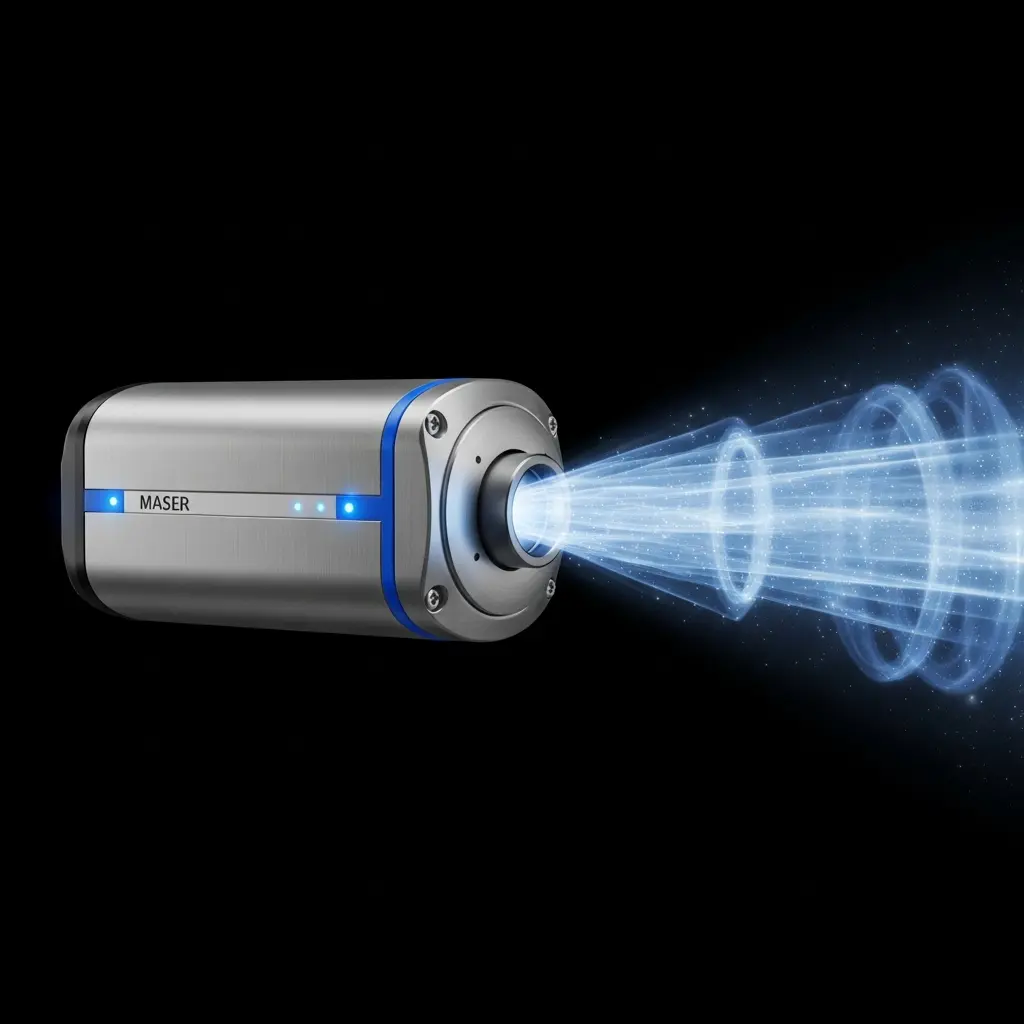
The pursuit of low-noise signal sources has led researchers to explore solid-state masers, devices that promise exceptional performance without the need for extreme cooling. Michael Newns, Shirley Xu, and Mingyang Liu, alongside colleagues from Imperial College London, have now achieved a significant breakthrough in this field, demonstrating maser oscillation at room temperature using a remarkably compact, single-LED pump. This innovative approach overcomes a key limitation of previous designs, where the size of the pump source often dictated the overall size of the maser system. By employing a waveguide to deliver light directly into the maser crystal, the team not only miniaturises the device but also enhances its efficiency, achieving a substantial improvement in performance compared to conventional excitation methods.
Their ability to achieve ‘cryogenic’ levels of noise performance while operating at room temperature means optically-pumped, solid-state (OPSS) masers show great promise as quantum sensors, oscillators, and amplifiers. This work demonstrates maser oscillation in a microwave cavity containing a crystal of pentacene-doped para-terphenyl (ptc:ptp) pumped by a single, chip-scale LED. Crucially, the size of the LED pump no longer dominates the overall maser system size, a substantial improvement over previous designs. This miniaturisation is achieved through an invasive pumping technique, embedding a waveguide directly into the maser crystal.
Invasive Pumping of Pentacene Maser Gain Medium
Focusing on Novel Materials for Maser Gain Medium
Novel Materials for Room-Temperature Gain Medium
This research details the development of a room-temperature solid-state maser, a significant advancement because traditional masers require cryogenic cooling. The team focuses on using pentacene (and more recently, diazapentacene) doped into para-terphenyl as the gain medium, employing invasive optical pumping to directly illuminate the gain medium with light. This approach allows for a more compact and potentially more efficient maser, operating at zero magnetic field and simplifying design.
Miniature LED Pumps High-Performance Maser Oscillation
This work demonstrates a significant advancement in maser technology, achieving miniaturisation of the optical pump source while maintaining high performance. Scientists successfully demonstrated maser oscillation within a microwave cavity containing a pentacene-doped para-terphenyl crystal, pumped by a single, chip-scale LED. The size of the LED pump no longer dominates the overall maser system size, a substantial improvement over previous designs. This miniaturisation is achieved through an invasive pumping technique, embedding a waveguide directly into the maser crystal, offering at least a two-fold enhancement in cooperativity compared to end-on excitation methods. Measurements reveal a magnetic quality factor, Qm, of approximately 3000, competitive with previously reported ptc:ptp masers.
Room-Temperature Maser Oscillation in Compact Device
Demonstrating Room-Temperature Operation in Compact Devices
Achieving Compact Maser Oscillation with Invasive Pumps
This research demonstrates a significant advance in solid-state maser technology, achieving maser oscillation at room temperature within a remarkably small device. By employing a novel invasive pumping technique, where an optical pump is embedded directly into the maser crystal, the team successfully created a system where the pump source does not limit the overall size or weight of the maser. This represents a substantial improvement over previous designs and opens possibilities for more compact and portable applications. The team’s maser, based on a pentacene-doped crystal, exhibits a cooperativity estimated to be around 2, enabling quasi-continuous wave operation. Focusing the pump light onto a smaller area of the crystal, near the region of maximal magnetic flux density, significantly enhances performance, particularly when the total available optical power is limited.
Validating Enhanced Performance Using Invasive Pumping
Quantifying Performance with Enhanced Cooperative Coupling
Simulations and experimental results align, confirming the effectiveness of this invasive pumping approach and demonstrating at least a two-fold improvement in cooperativity compared to conventional end-on excitation. Researchers acknowledge that the gain medium is not yet fully utilized, indicating potential for further optimization and performance gains. Future work will focus on developing more advanced optical pumping methods and incorporating more realistic three-dimensional simulations, with the goal of creating even more advantageous devices for a wide range of applications.
🗞 Single-LED-pumped, room-temperature, solid-state maser
🧠 ArXiv: https://arxiv.org/abs/2512.20611
The utilization of an integrated waveguide facilitates a strong coupling mechanism, significantly boosting the local electric field intensity within the gain medium. This enhanced coupling factor, which directly correlates with the cooperative gain, overcomes the typical limitations associated with surface-mounted excitation. By guiding the pump light directly into the active volume, the system effectively minimizes optical losses and concentrates the excitation energy, thereby reaching the required population inversion thresholds with substantially reduced pump power requirements.
The choice of pentacene, a highly luminescent organic semiconductor, as the dopant material is critical to the solid-state nature of the device. Its energy structure allows for efficient upconversion and subsequent stimulated emission within the para-terphenyl host matrix. This doping method enables the creation of robust, stable solid-state quantum emitters whose optical properties can be precisely tuned through chemical substitution, offering a pathway to tailor the gain spectrum for specific microwave frequency ranges.
From an industrial and quantum technology perspective, achieving room-temperature operation drastically expands the applicability of maser technology. Unlike superconducting quantum interference devices (SQUIDs) that require dilution refrigeration, solid-state OPSS masers can function in ambient environments. This capability makes them strong candidates for portable quantum sensors, next-generation microwave frequency standards, and field-deployable quantum communication links, broadening their market potential significantly.
See today’s quantum computing news on Quantum Zeitgeist for the latest breakthroughs in qubits, hardware, algorithms, and industry deals.