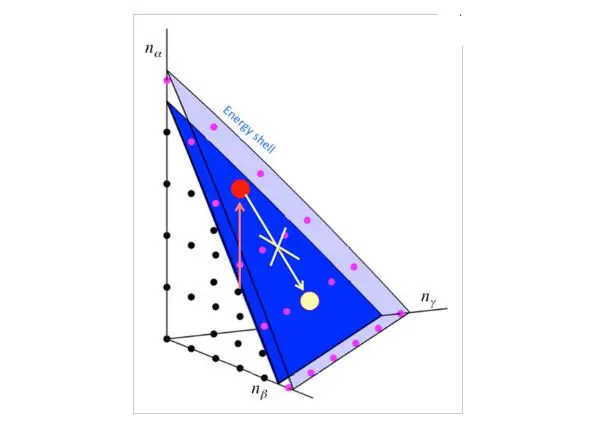
The question of how isolated quantum systems reach thermal equilibrium remains a central challenge in physics, and researchers continue to investigate the fundamental assumptions underlying the eigenstate thermalization hypothesis. Yucheng Wang from the Shenzhen Institute for Quantum Science and Engineering, Southern University of Science and Technology, and colleagues now present a unified framework that clarifies the origins of this behaviour, separating the inherent properties of quantum states from the dynamics governing their evolution. The team demonstrates that the characteristic structure of thermalization arises from a combination of fundamental principles, including the maximum entropy principle, the geometry of high-dimensional quantum spaces, and the locality of physical measurements. Crucially, they introduce the eigenstate typicality principle, which asserts that energy eigenstates in chaotic systems closely resemble typical states, and establish that this principle, combined with entropy and geometry, provides a robust foundation for understanding how complex quantum systems evolve towards predictable, thermal states, deepening our understanding of statistical mechanics.
This work establishes a unified approach that separates kinematic typicality from dynamical input, revealing the origin of ETH. The team demonstrates that the characteristic ETH structure emerges from the interplay between entropy, geometry, and locality, connecting seemingly disparate concepts. By rigorously deriving the ETH structure from first principles, the researchers bypass assumptions about specific Hamiltonians or microscopic details, revealing that typicality serves as a crucial bridge between initial conditions and the emergence of thermal behaviour. Consequently, this study establishes a robust foundation for understanding thermalization phenomena in complex quantum systems, offering insights beyond traditional approaches.
Determining local operator matrix elements relies on four key components: the maximum entropy principle, the geometry of high-dimensional Hilbert space, the locality of physical observables, and a minimal description. The methodology begins by imposing the maximum entropy principle, which selects the least biased probability distribution consistent with known constraints. These constraints arise from the symmetries of the system and the expectation values of local operators, effectively defining the information available about the quantum state. Subsequently, the geometry of the high-dimensional Hilbert space plays a crucial role, influencing the possible configurations and correlations within the system. This geometrical structure, combined with the principle of locality, restricts interactions to spatially proximate regions, simplifying calculations and ensuring physical realism. Finally, a minimal description is adopted, seeking the simplest possible model that accurately captures the essential physics, thereby reducing computational complexity and enhancing interpretability.
Eigenstate Thermalization From Fundamental Principles
This research establishes a foundational understanding of thermalization in isolated quantum systems by clarifying the origins of the eigenstate thermalization hypothesis (ETH). Scientists have demonstrated that ETH arises not from specific dynamical assumptions, but from a combination of fundamental principles: the maximum entropy principle, the geometry of high-dimensional quantum spaces, the locality of physical properties, and the principle that energy eigenstates in chaotic systems closely resemble typical states within a narrow energy range when considering local measurements. The team’s results show that the characteristic structure of ETH emerges naturally from these principles, without requiring assumptions about random matrix theory. Specifically, the predictable behavior of local properties arises from the concentration of probability in high-dimensional spaces, and the suppression of off-diagonal elements in energy matrices stems from entropic scaling and local dynamical correlations.
This work therefore positions ETH as a consequence of entropy, geometry, and the inherent properties of chaotic systems, deepening our understanding of how statistical mechanics emerges from the underlying quantum dynamics. The authors acknowledge that their analysis relies on the assumption of locality for the observable properties being measured. Furthermore, while the framework successfully explains the broad features of thermalization, it does not fully address the complexities of many-body interactions or the precise details of specific physical systems. Future research directions include exploring the implications of this framework for systems with long-range interactions and investigating the role of integrability in disrupting the established principles.
🗞 Eigenstate Typicality as the Dynamical Bridge to the Eigenstate Thermalization Hypothesis: A Derivation from Entropy, Geometry, and Locality
🧠 ArXiv: https://arxiv.org/abs/2512.13348




See today’s quantum computing news on Quantum Zeitgeist for the latest breakthroughs in qubits, hardware, algorithms, and industry deals.