Bilayer graphene presents exciting opportunities for manipulating electron flow, but understanding how electrons behave within these materials remains a significant challenge, particularly when confined to nanoscale spaces. Florian Schoeppl, Alina Mrenca-Kolasinska, and Ming-Hao Liu, alongside colleagues at the University of Regensburg and National Cheng Kung University, now demonstrate a clear link between theoretical predictions and expected electron behaviour in bilayer graphene cavities. The team investigates how electrons move within these confined spaces, revealing the existence of unique ‘triangular modes’ that dictate the direction of electron flow. This research not only confirms the validity of classical ray tracing calculations in describing electron behaviour, but also proposes a specific configuration for controlling and detecting these anisotropic transport properties, paving the way for novel electronic devices based on directional electron flow.
Electron jetting in bilayer graphene (BLG) forms the focus of this study, which investigates all-electronic, gate-defined BLG cavities using both tight-binding simulations and semiclassical equations of motion. These cavities provide a valuable platform for exploring anisotropic electron transport, a phenomenon arising from the trigonally warped Fermi surfaces characteristic of BLG. This work confirms the existence of triangular modes within these cavities, previously predicted by classical ray tracing calculations, and subsequently explores how these modes influence transport properties. The research demonstrates that the triangular symmetry directly translates into anisotropic transport behaviour, meaning electrons flow more readily in certain directions.
Quantum Scars in Bilayer Graphene Cavities
This research comprehensively investigates the quantum transport properties of bilayer graphene, specifically focusing on the presence and characterization of quantum scars within these materials. Quantum scars are long-lived wavefunctions that persist longer than expected, leading to unusual electron behaviour. The research draws a strong analogy between quantum particles in graphene cavities and classical billiards, where the shape of the cavity significantly influences quantum behaviour. The ultimate goal is to understand how electrons move through these graphene structures and how geometry and quantum scars affect conductance, the material’s ability to conduct electricity.
Researchers employ a combination of theoretical calculations and numerical simulations to study these phenomena, also considering the effects of connecting the graphene cavity to external circuits. The research establishes a firm understanding of bilayer graphene’s properties, utilizing tight-binding models to accurately represent its electronic structure. Understanding how electrons behave at the edges of the graphene cavity is crucial, and the research explores this extensively. The study also investigates how the geometry of the cavity affects the quantum behaviour and the properties of the quantum scars. The team uses advanced numerical simulations to model the quantum behaviour, including wave packet dynamics and transfer matrix methods, to calculate transmission and reflection of electrons. The research focuses on determining how easily electrons can flow through the graphene cavity, identifying resonant energy levels that enhance conductance, and understanding the impact of wavefunction localization on overall performance.
Triangular Fermi Surface Dictates Electron Transport
This work demonstrates a significant advancement in understanding electron transport within bilayer graphene (BLG) cavities, revealing how the unique triangular warping of the BLG Fermi surface dictates electron behaviour. Researchers verified the existence of triangular modes within these cavities, predicted by classical ray tracing calculations, and subsequently explored how these modes manifest in transport properties. Through detailed analysis using both tight-binding models and semiclassical equations of motion, the study reveals that whispering-gallery-type boundary modes are present unless the system features both a smooth cavity boundary and a trigonal distortion of the Fermi contour. The team meticulously tracked electron trajectories in both real and momentum space, demonstrating a transition from whispering-gallery-like behaviour to standard trajectories when encountering a smooth cavity boundary.
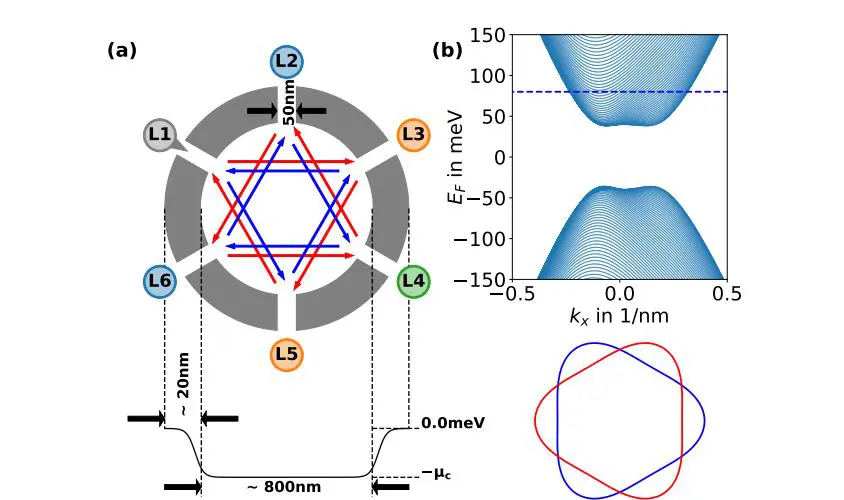
Crucially, the locally circular corners of the triangular Fermi contour stabilize whispering-gallery states, allowing electrons to skip flat sides of the warped contour. This detailed analysis confirms that the spatial structure of cavity eigenstates follows the dominant group velocities induced by the triangularly warped Fermi surface. To investigate transport, the researchers designed a BLG cavity connected to six leads, arranged with 60-degree separation to reflect the system’s D6 symmetry. Measurements of conductance through the cavity, varying displacement field from 0 to 150 meV and band offset from 0 to 100 meV, revealed a striking anisotropy.
The team observed substantially enhanced conductance between leads connected via the dominant group velocities, specifically between triangularly connected leads, with conductance values significantly higher than neighboring or opposing lead pairs. This anisotropic enhancement, robust against local scatterers and white noise, demonstrates that the triangular warping of the Fermi contour directly controls electron transport within the BLG cavity. The results provide a pathway for controlled modulation of transport in preferred directions, opening possibilities for novel electronic devices based on the unique properties of bilayer graphene.
Bilayer Graphene Enables Directional Electron Flow
This research demonstrates a clear link between the unique electronic properties of bilayer graphene and the behaviour of electrons within specifically designed cavities. The team successfully verified the existence of triangular modes within these cavities, predicted by theoretical models of electron behaviour, and importantly, showed these modes persist even when the cavity is connected to external electrical leads. This persistence results in anisotropic transport, meaning electrons flow more readily in certain directions within the cavity. The findings reveal that this directional flow isn’t caused by external factors like impurities or cavity shape, but arises directly from the inherent, trigonally warped band structure of bilayer graphene itself.
The researchers identified signatures of the material’s Lifshitz transition within the transport characteristics, and developed a cavity design that allows for detection of this anisotropy independent of the device’s orientation relative to the graphene lattice. This offers a pathway to control electron flow in preferred directions. The authors acknowledge that further work is needed to fully explore the potential of these cavities, particularly in observing exotic bound states and utilising them for advanced transport applications. They also note the limitations of the discretisation method used in their simulations. Future research may focus on refining these simulations and experimentally verifying the predicted behaviour in fabricated devices.
🗞 Anisotropic transport in ballistic bilayer graphene cavities
🧠 ArXiv: https://arxiv.org/abs/2512.08588


See today’s quantum computing news on Quantum Zeitgeist for the latest breakthroughs in qubits, hardware, algorithms, and industry deals.