
The pursuit of practical quantum computers demands qubits that function reliably and can be manufactured using industrial-scale processes, and a team led by Danqing Wang from Yale University, Yufeng Wu, and Naomi Pieczulewski from Cornell University now demonstrates a significant step forward in achieving this goal. They report the creation of superconducting qubits built entirely from nitride materials, fabricated using a technique called atomic layer deposition, an established method for creating precise thin films. By carefully controlling the deposition process, the researchers achieve exceptional control over the qubit’s properties, observing a vast range of electrical currents and, crucially, maintaining qubit coherence for microseconds even at relatively high temperatures. This achievement establishes atomic layer deposition as a powerful technique for building quantum circuits and paves the way for more scalable and practical quantum computers that can operate at warmer temperatures than currently possible.\n\n
Aluminum Nitride Barriers Enhance Qubit Coherence
\n\n
Integrating Aluminum Nitride for Enhanced Qubit Coherence
\n\nThis research details the development and characterization of superconducting qubits, termed ALDmons, incorporating aluminum nitride (AlN) as a key component to improve coherence times, crucial for advancing quantum computation. The team fabricated ALDmons, a type of transmon qubit, with a unique design featuring an AlN barrier within the Josephson junction. Researchers thoroughly characterized the AlN films, including their piezoelectric properties and resistivity, and investigated potential loss mechanisms limiting qubit coherence. The study meticulously investigates potential sources of decoherence, demonstrating that the AlN barrier itself does not significantly limit coherence, estimating a high quality factor for the barrier.\n\nWhile AlN is known to be piezoelectric, the research shows that piezoelectric losses are minimal in their devices, likely due to the material’s properties and device geometry. The fabrication process utilizes atomic layer deposition (ALD) to deposit the AlN barrier, allowing precise control over film thickness and quality. This research presents a promising new approach to superconducting qubit design using AlN barriers, demonstrating the potential for achieving high coherence times and laying the groundwork for future advancements in quantum computing.\n\n
ALD Fabricates Uniform Superconducting Josephson Junctions
\n\n
Pioneering Superconducting Circuits via Atomic Layer Deposition
\n\n
ALD for Creating Superconducting Josephson Junctions
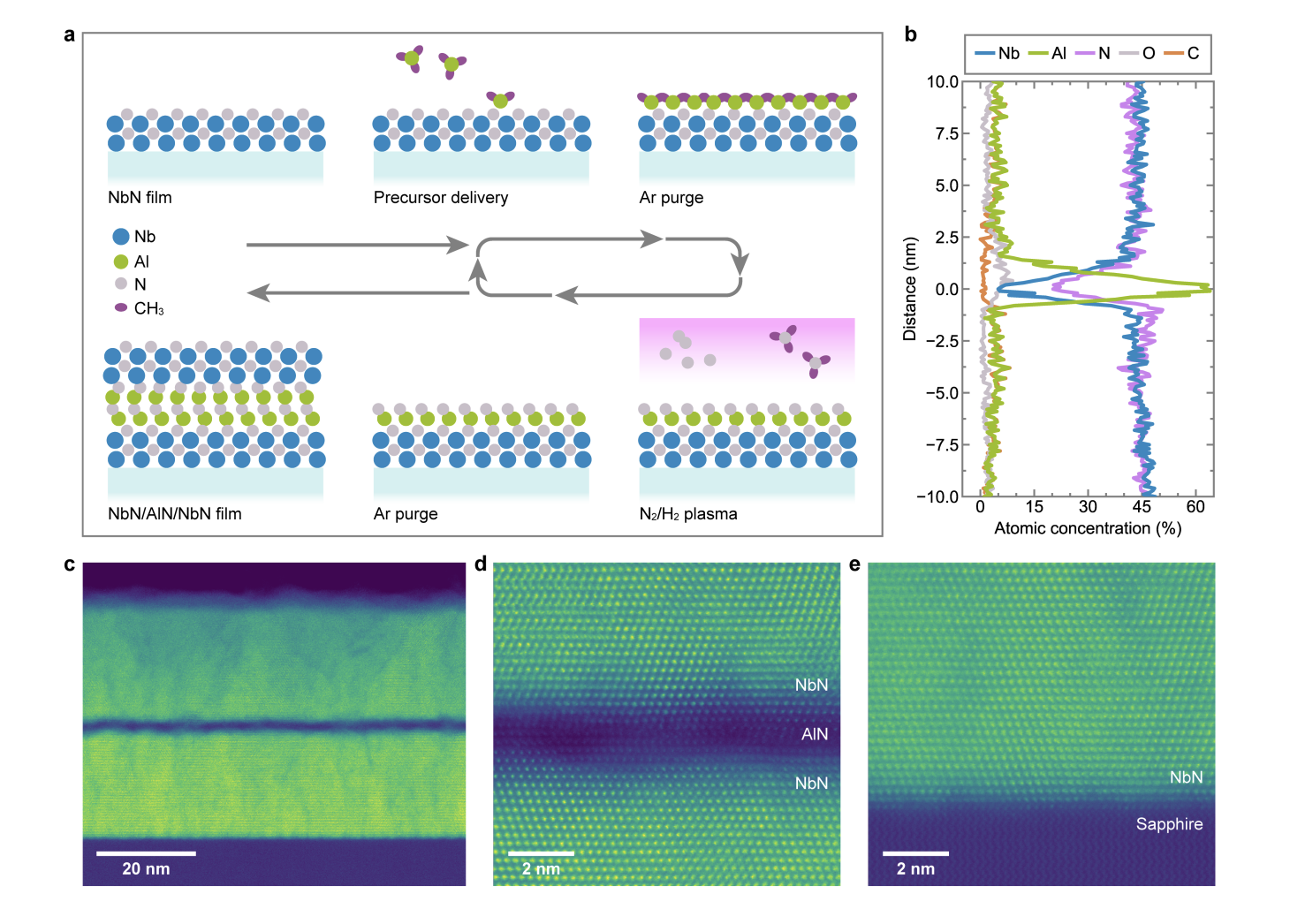
\n\nThe team pioneered a novel approach to fabricating superconducting quantum circuits using atomic layer deposition (ALD), a technique increasingly adopted for precise thin-film growth. This work centers on creating Josephson junctions, essential components of superconducting qubits, from NbN/AlN/NbN trilayers deposited entirely by ALD, enabling operation at elevated temperatures. Researchers systematically varied the number of ALD cycles used to form the aluminum nitride barrier layer, achieving critical current densities spanning seven orders of magnitude, demonstrating the uniformity and versatility of the deposition process. Prior to deposition, substrates received nitrogen and hydrogen plasma surface activation.\n\nTert-butylimido tris(diethylamido)niobium and trimethylaluminum served as precursors for depositing niobium nitride and aluminum nitride, respectively, utilizing nitrogen and hydrogen as reactive gases. Importantly, the two niobium nitride layers within the trilayer structure were maintained at equal thicknesses across all wafers, crucial for consistent junction performance. Researchers employed a suite of advanced techniques to characterize the resulting materials, including cross-sectional lamellae prepared using a focused ion beam and aberration-corrected STEM measurements. These combined characterization methods provide a comprehensive understanding of the material’s composition and structure, validating the effectiveness of the ALD process and paving the way for scalable, industry-compatible quantum technologies.\n\n
Atomic Layer Deposition Controls Superconducting Qubit Properties
\n\nScientists have demonstrated a new approach to fabricating superconducting qubits using atomic layer deposition (ALD), achieving precise control over material layers at the atomic scale. This work centers on the creation of NbN/AlN/NbN trilayer structures, deposited entirely using ALD, which promises a pathway towards scalable quantum processors operating at elevated temperatures. The team successfully tuned the critical current density, a key parameter for qubit performance, across an impressive seven orders of magnitude simply by varying the number of ALD cycles used to form the AlN barrier layer, demonstrating the uniformity and versatility of the ALD process for creating Josephson junctions with tailored properties. The resulting trilayer structures exhibit exceptional structural integrity, with clear boundaries between the NbN and AlN layers.\n\n
Maintaining Coherence at Elevated Operating Temperatures
\n\n
Achieving High Coherence Times at Elevated Operating Temperatures
\n\nMeasurements reveal that transmon qubits fabricated from these all-nitride trilayers maintain microsecond-scale relaxation times, even when tested at temperatures exceeding 300 millikelvin. This is a significant achievement, as it indicates the potential for operating qubits at higher temperatures, reducing the demands on cryogenic cooling systems. By precisely controlling the thickness of the AlN barrier at the atomic level, they achieved tunable Josephson junctions, a crucial component for building complex quantum circuits. The ability to control layer thickness with such precision, coupled with the scalability of the ALD process, positions this approach as a promising platform for developing superconducting qubits capable of operating at elevated temperatures and supporting large-scale quantum computation.\n\n
ALDmons Demonstrate Extended Temperature Operation
\n\nThis research demonstrates a new platform for superconducting qubits based on thin films grown using atomic layer deposition, specifically NbN/AlN/NbN trilayers. By precisely controlling the thickness of the AlN barrier layer during deposition, scientists achieved a wide range of critical current densities, spanning seven orders of magnitude, and confirmed the uniformity and quality of the resulting material. These qubits, termed ALDmons, exhibit microsecond-scale relaxation times even at temperatures above 300 millikelvin, significantly expanding the operational temperature window for superconducting quantum devices compared to existing aluminum-based technologies. While current devices exhibit relaxation times in the range of 1.\n\n4 microseconds, detailed analysis suggests that the dominant sources of loss remain unresolved, with potential contributions from substrate quality, etching processes, and device packaging. Future work focuses on optimizing these aspects, alongside exploring alternative nitride combinations, to further enhance qubit coherence and potentially enable high-frequency operation in the millimeter wave regime. These advancements establish a scalable and industry-compatible foundation for next-generation superconducting quantum technologies.\n\n
\n🗞 All-nitride superconducting qubits based on atomic layer deposition
\n🧠 ArXiv: https://arxiv.org/abs/2511.08931\n