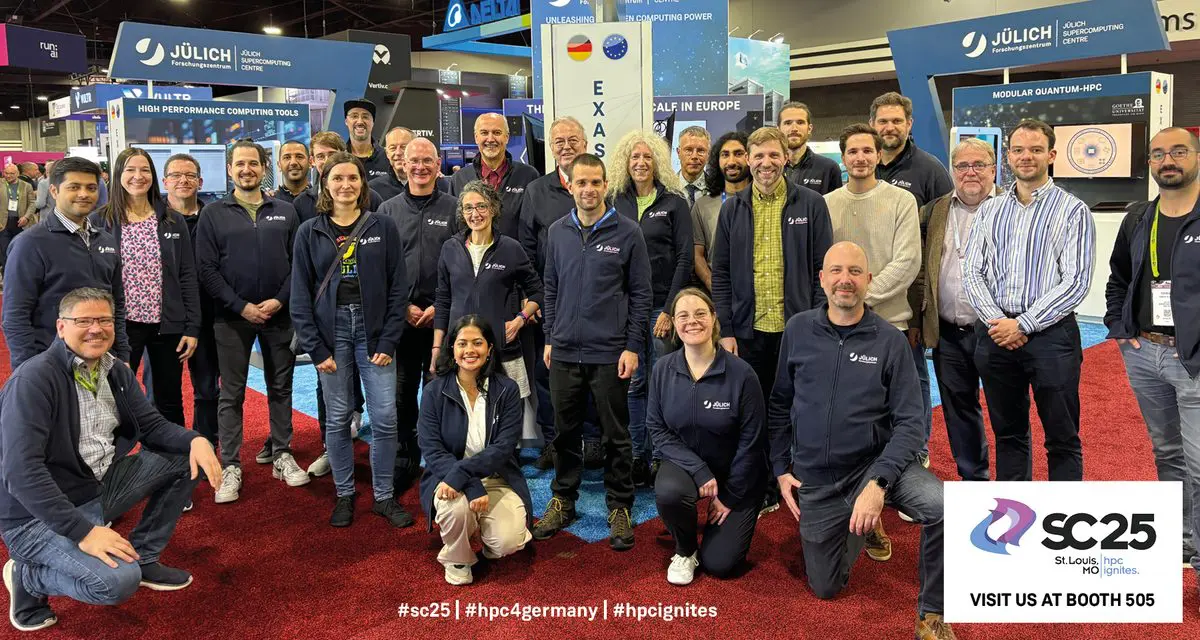
The relentless pursuit of faster, more powerful computing is set to take center stage this November at SC25, and the Jülich Supercomputing Centre (JSC) will be there leading the charge. As the world grapples with increasingly complex challenges – from climate modeling to artificial intelligence – the need for high-performance computing has never been greater. At this year’s conference in St. Louis, JSC will showcase its groundbreaking work, including Europe’s first exascale system, JUPITER, and innovative advancements in quantum computing, offering a glimpse into the future of scientific discovery and technological innovation. Visitors to booth #505 will even have the opportunity to directly interact with JSC’s quantum systems and explore the tools driving the next generation of HPC.
SC25 Conference Overview & Participation
The Supercomputing Conference (SC25), taking place November 16-21, 2025, in St. Louis, Missouri, will showcase the Jülich Supercomputing Centre’s (JSC) advancements in high-performance computing and quantum technologies. JSC, alongside partners from Goethe-University Frankfurt, will exhibit at booth #505 under the theme “Unleashing Next-Gen Computing Power,” with a strong focus on Europe’s first exascale system, JUPITER, recently listed on the Top500. Attendees can expect demonstrations of in-house HPC tools like LLview and Scalasca, as well as the opportunity to live code on the D-Wave Advantage™ System JUPSI via JUNIQ. Beyond the exhibit, JSC participation extends to a diverse program including a plenary talk by Kristel Michielsen on quantum computing, a Gordon Bell finalist presentation on climate modeling, and involvement in eight workshops, seven Birds of Feather sessions, and more – notably, the successful “Super(computing)heroes” BoF session. A complete schedule of JSC’s activities and event times is available for those planning to attend.
JSC’s Featured Research & Technologies
At the Supercomputing Conference SC25, the Jülich Supercomputing Centre (JSC) will showcase its cutting-edge research and technologies focused on “Unleashing Next-Gen Computing Power.” A central highlight will be Europe’s first exascale system, JUPITER, recently added to the Top500 list, alongside demonstrations of in-house HPC tools like LLview, JUBE, and Scalasca. Visitors to booth #505 will have the unique opportunity to live code on JSC’s D-Wave Advantage™ System, JUPSI, via the JUNIQ infrastructure, and explore advancements in hybrid algorithms developed with partners from Goethe-University Frankfurt. Beyond hardware, JSC will present its contributions to EU-funded projects with a particular emphasis on artificial intelligence applications within HPC. Key events include a plenary talk by Kristel Michielsen on the potential of quantum computing and a presentation on high-resolution Earth system modeling as a finalist in the ACM Gordon Bell Climate Modeling competition, alongside participation in eight workshops and several Birds of Feather sessions.
Key Events & Scheduled Presentations
SC25, taking place November 16-21 in St. Louis, Missouri, will showcase a robust schedule of events and presentations led by the Jülich Supercomputing Centre (JSC) and its partners. JSC’s booth (#505) will highlight “Unleashing Next-Gen Computing Power,” with a focus on the newly ranked exascale system, JUPITER, and advancements in HPC tools like LLview and Scalasca. Attendees can even interact with the D-Wave Advantage™ System JUPSI via JUNIQ. Keynote talks include Kristel Michielsen’s “Why Should I Care About Quantum Computing?” on November 17th, and a presentation by Andreas Herten and Mathis Bode detailing climate modeling advancements as finalists in the ACM Gordon Bell competition on November 18th. Beyond these highlights, JSC participation extends to eight workshops, seven Birds of a Feather sessions – including a returning “Super(computing)heroes” BoF co-organized by Cristina Manzano and Anna Lührs – one panel, one tutorial, and additional talks at the Exhibitor Forum, offering a comprehensive look at their work in supercomputing and quantum computing.



See today’s quantum computing news on Quantum Zeitgeist for the latest breakthroughs in qubits, hardware, algorithms, and industry deals.