Protecting qubits from errors is fundamental to realising the potential of quantum computers, but physical qubits are vulnerable to leakage into unintended energy states, a problem that corrupts calculations and hinders progress. Chaithanya Naik Mude and Swamit Tannu, both from the University of Wisconsin-Madison, and their colleagues have developed a new framework, called gladiator, that accurately predicts and mitigates this leakage. Unlike previous methods that rely on fixed assumptions, gladiator builds a detailed understanding of how errors propagate within a quantum code, allowing it to classify error patterns with exceptional precision. This precise approach eliminates unnecessary error-correction steps, significantly speeds up quantum computations, and reduces the overall error rate, representing a substantial advance towards practical, fault-tolerant quantum computing.
Leakage Detection Method for Quantum Systems
This document details an artifact submission for the MICRO ’25 conference, providing reviewers with the necessary information and code to verify research claims. The submission focuses on a new method for detecting leakage in quantum error correction codes, a critical step in building reliable quantum computers. Leakage refers to the loss of quantum information, a major source of errors that must be addressed for successful computation. The team developed a method to predict and detect these leakage events more effectively, improving the overall stability of quantum systems. The core of the method involves identifying specific patterns in detector outputs that correlate with leakage events, expressed as Boolean equations. This technique has been tested and documented for three types of quantum error correction codes: Balanced Product Cyclic (BPC) codes, Standard Color Codes, and Color Codes with Gladiator-d, an augmented code incorporating a new speculation method. The submission includes executable code and data, along with detailed instructions for installation, execution, and result verification.
Leakage Prediction with Code-Aware Propagation Graphs
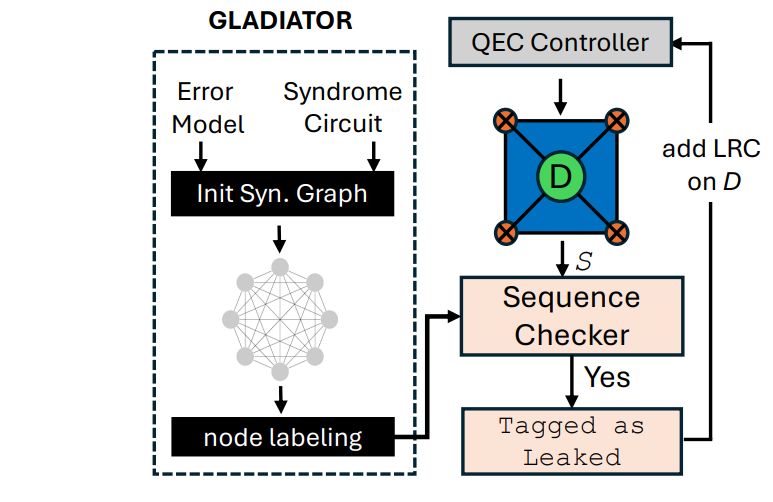
Scientists have developed gladiator, a novel leakage speculation framework that enhances quantum error correction (QEC) across diverse code architectures, including surface, color, and quantum LDPC codes. The work addresses the critical issue of qubit leakage, where qubits transition to higher energy levels, corrupting syndrome measurements and propagating errors. Gladiator accurately identifies and mitigates leakage events without introducing excessive overhead by precisely predicting leakage-dominated syndrome patterns. Unlike previous approaches relying on fixed heuristics, gladiator employs a code-aware propagation graph, built offline and calibrated to specific device data.
This innovative method enables online classification of syndromes in a few nanoseconds, scheduling Leakage Reduction Circuits (LRCs) only when a pattern is demonstrably leakage-driven. Characterizing IBM hardware, the team observed that leakage induces random bit flips during CNOT gate operations, while non-leakage errors produce consistent flips, informing gladiator’s ability to distinguish between error sources. By analyzing syndrome patterns, gladiator minimizes false positives, a significant limitation of previous techniques. Evaluations on fault-tolerant benchmarks demonstrate substantial performance gains, achieving speedups of 1.
7x to 3. 9x and a 16% reduction in logical error rate. The study reveals that gladiator eliminates up to three times more unnecessary LRCs, shortening QEC cycles and suppressing false positives. Furthermore, gladiator stabilizes or even reduces leakage levels over time, unlike other methods that exhibit a continuous rise in leakage population.
Gladiator Framework Corrects Leakage Errors Efficiently
Scientists have developed a new leakage speculation framework, named gladiator, that significantly improves the efficiency of quantum error correction. The research addresses a critical challenge in quantum computing: leakage errors, where qubits transition to unintended higher energy levels, disrupting computations and evading standard error correction techniques. Experiments demonstrate that gladiator accurately identifies leakage events and minimizes unnecessary interventions, leading to substantial performance gains. The team constructed a code-aware propagation graph, calibrated using device data, to predict how syndrome patterns transform due to leakage.
This graph allows gladiator to classify syndromes and schedule leakage reduction circuits (LRCs) only when leakage is highly probable, eliminating up to three times more unnecessary LRCs compared to previous methods. Measurements show an average reduction of two times in unnecessary LRCs, shortening quantum error correction cycles and suppressing false positives. Evaluated on standard fault-tolerant benchmarks, gladiator delivers speedups ranging from 1. 7 to 3. 9x and achieves a 16% reduction in logical error rate.
Specifically, gladiator+, an enhanced version incorporating multi-level readout, produces 1. 73x less data leakage compared to the prior state-of-the-art after 100 quantum error correction cycles. Furthermore, gladiator+ reduces the combined count of false positives and false negatives by around 3. 11x. Resource utilization is remarkably efficient, with gladiator requiring less than 0. 1% of lookup tables even at a code distance of 25, representing at least a 17-fold reduction in FPGA resource usage. The team’s work, conducted using IBM systems, confirms the disruptive impact of leakage on gate operations and highlights the necessity of specialized techniques to maintain the integrity of quantum computations.
Leakage Error Prediction With Code-Aware Graphs
Gladiator represents a significant advance in mitigating leakage errors, a fundamental challenge to building practical quantum computers. Researchers developed a framework that accurately predicts leakage events by analyzing patterns in quantum error correction syndromes, using a code-aware error graph calibrated to specific hardware characteristics. This approach generalizes across multiple quantum error correction codes, including surface, color, and qLDPC codes, adapting to diverse noise profiles without relying on pre-defined rules. The results demonstrate that gladiator substantially reduces false positives and unnecessary insertions of leakage reduction circuits, achieving up to three times fewer circuits compared to existing methods.
This reduction translates to a 16% decrease in logical error rates and a 1. 7 to 3. 9x improvement in the speed of quantum error correction cycles, ultimately accelerating application runtimes. The team also demonstrated the framework’s ability to classify leakage mobility regimes, informing the selection of optimal mitigation strategies.
🗞 Accurate Leakage Speculation for Quantum Error Correction
🧠 ArXiv: https://arxiv.org/abs/2510.25661


See today’s quantum computing news on Quantum Zeitgeist for the latest breakthroughs in qubits, hardware, algorithms, and industry deals.