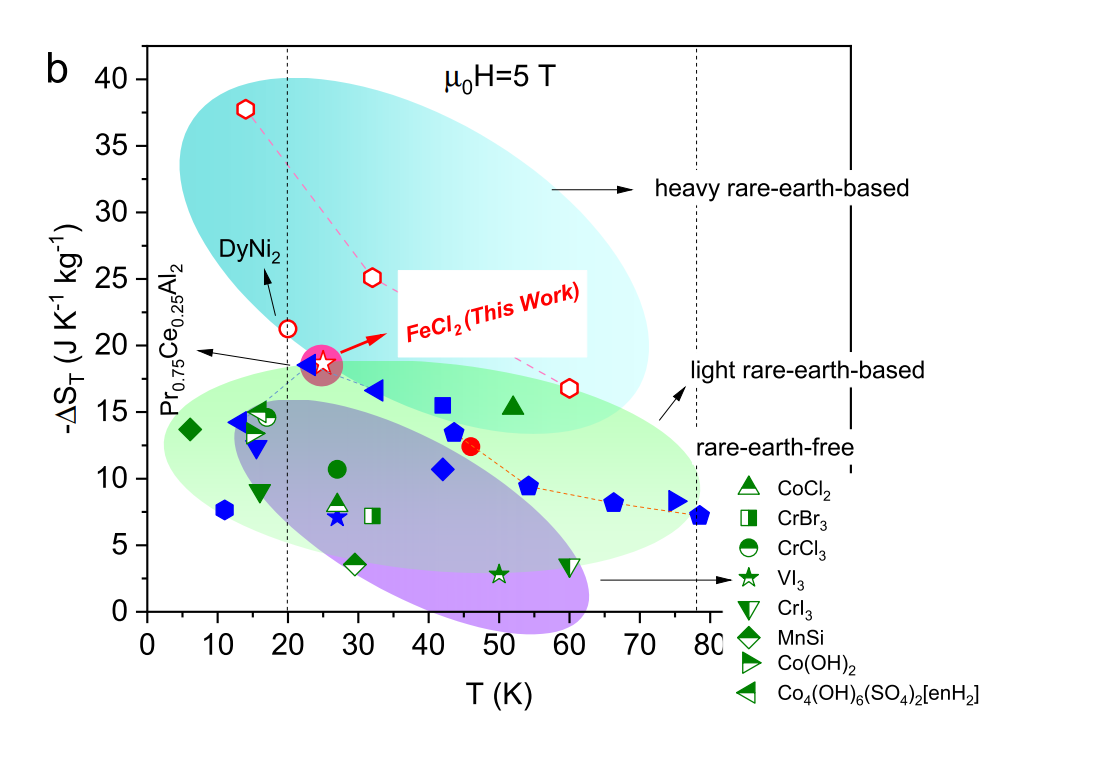
The pursuit of efficient and affordable methods for cooling gases drives innovation in numerous fields, and hydrogen liquefaction represents a significant challenge with substantial potential benefits. Wei Liu, Benjamin Theisel, and Yulia Klunnikova, alongside colleagues at TU Darmstadt’s Institute of Materials Science, now present research on a novel material poised to dramatically reduce the cost of cryogenic cooling. Their work focuses on iron chloride, an ionic compound built from exceptionally inexpensive elements, and demonstrates its remarkable magnetocaloric properties. The team reveals that iron chloride exhibits a substantial cooling effect, achieving a temperature change of approximately 3. 6 K in a 5 Tesla magnetic field, and importantly, its performance rivals that of more costly rare-earth materials, paving the way for practical and scalable hydrogen liquefaction technologies within the 20 to 77 Kelvin temperature range.
Magnetocaloric Materials for Sustainable Cooling
Scientists are actively researching materials that respond to magnetic fields with temperature changes, a phenomenon known as the magnetocaloric effect, with the goal of developing more efficient and environmentally friendly cooling technologies. This research focuses on identifying materials that are not only effective but also cost-effective and sustainable, avoiding reliance on scarce resources. Investigations encompass a wide range of materials, including traditional rare-earth alloys, Heusler alloys, layered materials, oxides, and coordination polymers, each offering unique properties and potential for application in magnetic refrigeration. A key area of exploration involves layered materials, such as chromium chloride, chromium bromide, and iron chloride, which exhibit significant magnetocaloric effects and offer potential for miniaturization.
Researchers are also investigating complex oxides and coordination polymers, tuning their composition and structure to maximize their performance. The drive towards sustainability necessitates a shift away from materials relying on scarce and expensive rare-earth elements, prompting a focus on abundant and cost-effective alternatives. Combining multiple caloric effects, such as magnetocaloric, electrocaloric, and barocaloric effects, is also being explored to enhance cooling performance.
Iron Chloride Shows Strong Magnetocaloric Performance
Researchers have demonstrated a substantial magnetocaloric effect in iron chloride, a compound composed of abundant and inexpensive elements, positioning it as a promising material for hydrogen liquefaction. Experiments reveal that FeCl₂ exhibits both inverse and conventional magnetocaloric behavior, meaning its temperature changes in response to magnetic fields in different ways. Measurements of magnetic entropy change show a value of 18. 6 J/kg/K near 20 K in magnetic fields of 5 T, exceeding the performance of many light rare-earth-based compounds and approaching that of heavier rare-earth materials.
The material undergoes an antiferromagnetic transition around 24 K and exhibits a large magnetization above 2 T, reaching approximately 160A m²/kg at 2 K in a 5 T field. Importantly, the material exhibits a hysteresis-free magnetic transition, returning to its original state after the magnetic field is removed. This combination of a large magnetocaloric effect and the low cost of its constituent elements makes FeCl₂ a compelling candidate for efficient magnetic refrigeration and hydrogen liquefaction within the 20-77 K temperature range.
Iron Chloride Shows Strong Magnetocaloric Potential
This research demonstrates that iron chloride, FeCl₂, exhibits a substantial magnetocaloric effect, achieving an adiabatic temperature change of approximately 3. 6 K and a magnetic entropy change reaching 18. 6 J/kg/K near 20 K in a 5 Tesla magnetic field. These values are comparable to those of many heavy rare-earth-based materials currently investigated for cryogenic applications, yet FeCl₂ benefits from being composed of abundant and inexpensive elements. The findings suggest a pathway toward significantly reducing the cost of magnetocaloric hydrogen liquefaction, a process with the potential to improve the efficiency of liquid hydrogen production.
Researchers acknowledge that further work is needed to optimize the performance of FeCl₂ and to assess its long-term stability and suitability for large-scale industrial applications. Future investigations will likely explore methods for enhancing its performance and integrating it into a complete hydrogen liquefaction system. This work represents a significant step toward developing cost-effective and sustainable technologies for hydrogen energy storage and transportation, offering a viable alternative to materials relying on scarce and expensive resources.
🗞 Ultralow-Cost magnetocaloric compound for Cryogenic Cooling
🧠 ArXiv: https://arxiv.org/abs/2510.20458




See today’s quantum computing news on Quantum Zeitgeist for the latest breakthroughs in qubits, hardware, algorithms, and industry deals.