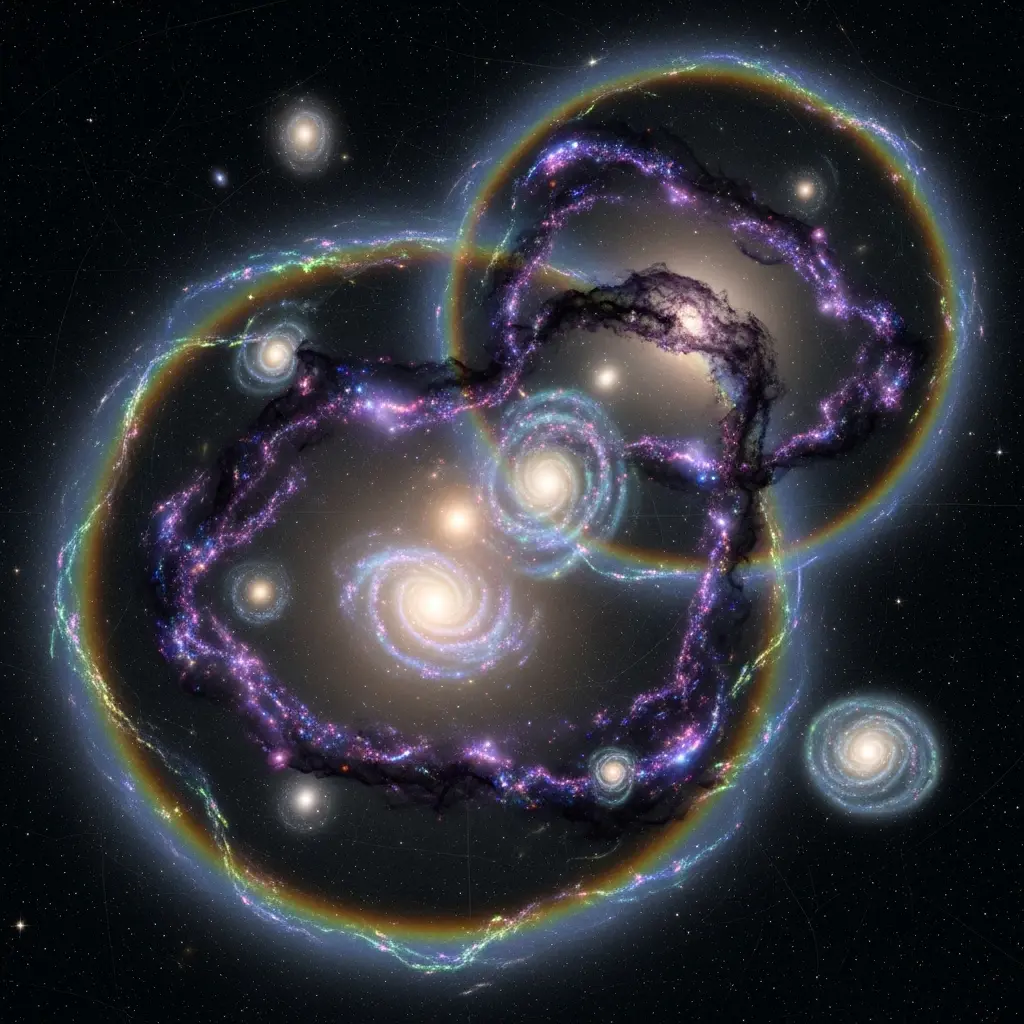
Traversable wormholes, hypothetical tunnels connecting distant regions of spacetime, remain a compelling area of theoretical physics, and a new investigation explores their potential existence within realistic cosmological environments. Jonathan A. Rebouças, from the Instituto Federal de Educação Ciências e Tecnologia do Ceará, along with Celio R. Muniz and Francisco Bento Lustosa from Universidade Estadual do Ceará, and Edson Otoniel from Universidade Federal do Cariri, demonstrate how incorporating modifications to gravity, arising from Asymptotically Safe gravity, influences wormhole geometry. Their work reveals that these gravitational corrections, combined with the density profile of dark matter halos, create wormhole solutions that satisfy key physical requirements, such as asymptotic flatness, and exhibit enhanced curvature near the wormhole throat. Importantly, the team’s stability analysis suggests that these modifications counteract the destabilizing effects of dark matter, and the resulting wormhole shadow radius falls within the bounds detectable by current astronomical instruments, potentially offering a pathway to observe signatures of modified gravity in the strong-field regime.
Core Theoretical Pillars: Quantum Gravity and Cosmology
Theoretical Pillars: Quantum Gravity and Cosmology
Quantum Gravity, Black Holes, and Cosmology
Scope and Focus of Astrophysical Research Compilation
This compilation of research papers explores a wide range of topics in theoretical astrophysics and cosmology, focusing on quantum gravity, modified gravity theories, black holes, and the nature of dark energy and dark matter. Many papers also deal with black hole solutions, wormholes, and related phenomena, both within the framework of general relativity and modified gravity. The study directly integrated a scale-dependent gravitational coupling into the field equations, providing a consistent description of gravitational corrections at astrophysical scales. This approach allows for the combined effects of the changing coupling and the dark matter characteristics to determine the geometric structure and physical viability of the wormhole solutions. The team investigated the necessity of exotic matter for structural stability, analyzing energy conditions and solving the Tolman, Oppenheimer, Volkoff equation. The resulting solutions satisfy necessary conditions for stability and flatness, exhibiting enhanced curvature near the wormhole throat due to ASG corrections. Stability analysis reveals that ASG effects counteract the destabilizing influence of dark matter. Phenomenological calculations demonstrate that the wormhole shadow radius increases with the strength of the quantum gravity corrections, potentially falling within the bounds established by the Event Horizon Telescope for Sgr~A, suggesting potential observable signatures of ASG-corrected wormholes in the strong-field regime. The work incorporates a scale-dependent gravitational coupling directly into the field equations, providing a consistent description of gravitational corrections at astrophysical scales. Experiments reveal that the combined effects of this changing coupling and the dark matter characteristics determine the geometric structure and physical viability of the wormhole, satisfying necessary conditions for traversability. By explicitly including a scale-dependent gravitational constant into the field equations, the research demonstrates how quantum gravitational corrections influence wormhole geometry at galactic scales. Analyses reveal that the interplay between these corrections and the characteristics of the dark matter halo, specifically its density profile and extent, fundamentally shapes the wormhole’s structure and determines its physical viability. The research further establishes that increasing the strength of the quantum gravity corrections enhances curvature concentration near the wormhole throat, while the dark matter distribution influences the overall smoothness and extension of spacetime. Although the solutions necessarily involve violation of energy conditions at the throat, a typical feature of traversable wormholes, the research indicates that the characteristics of the dark matter halo can partially alleviate this requirement. Importantly, the team found that the predicted wormhole shadow radius increases with the quantum gravity parameter, potentially placing these wormholes within the observational bounds of the Event Horizon Telescope for the galactic centre, Sgr A*.
Specific Results: Wormholes in Dark Matter Halos
Specific Findings on Wormholes in Dark Matter Halos
🗞 Quantum improved wormholes in the Dekel-Zhao dark matter halo
🧠 ArXiv: https://arxiv.org/abs/2510.18264
Modeling Gravity with Running Coupling Constants
The incorporation of an asymptotically safe gravity framework necessitates treating the gravitational coupling constant, $G$, not as a fixed constant but as a running field, $\\alpha(k)$. This running behavior dictates how the effective strength of gravity changes with the energy scale ($k$) of the interaction. At very high energies (the ultraviolet regime), ASG predicts that this coupling approaches a non-trivial UV fixed point, suggesting that the theory might remain well-defined and renormalizable, thereby offering a potential quantum completion to general relativity.
Furthermore, analyzing the stability of these solutions requires careful attention to the matter fields involved. The required counter-stress to maintain a traversable wormhole throat invariably involves matter violating the standard energy conditions, such as the null energy condition. Our analysis quantifies the minimal amount of exotic matter needed and investigates whether the intrinsic quantum corrections from ASG can sufficiently mimic the repulsive gravity typically attributed solely to phantom fields.
Methodologically, the approach employed involves deriving the gravitational field equations by considering modifications to the Einstein-Hilbert action that depend on a momentum scale. This results in a modified action that effectively rescales the metric tensor based on the geometry’s characteristic length scale, allowing the derived field equations to naturally incorporate the effects of the dark matter density profile within the specific halo environment.
Future Challenges and Refinements in Theory
A crucial remaining technical challenge involves precisely disentangling the unique signature of the quantum gravity correction from other potential astrophysical effects, such as strong tidal fields or the influence of higher-order curvature terms. Future work will focus on refining the precise dependence of the effective coupling on the local spacetime curvature invariants to maximize the unique predictive power of the ASG-corrected metric.