The search for quantum gravity, a theory uniting general relativity with quantum mechanics, receives a novel approach through the study of ultra-high-energy cosmic ray collisions. Manuel Ettengruber from Université Paris, Saclay, and Gonzalo Herrera from Massachusetts Institute of Technology, alongside their colleagues, investigate how these collisions might produce observable signals of quantum gravity effects. Their work proposes three new tests utilising cosmic ray interactions within active galactic nuclei and around supermassive black holes, potentially probing fundamental scales far beyond current capabilities, up to the PeV range. By analysing expected neutrino and gamma-ray emissions, including those arising from Hawking evaporation and potential graviton propagation, this research offers a unique pathway to test theories of low-scale quantum gravity and explore the universe at its most extreme energies.
Multi-Messenger Studies of High-Energy Sources
Leveraging Multi-Messenger Astronomy for Cosmic Phenomena
Multi-Messenger Astronomy for Understanding Cosmic Phenomena
This collection of research focuses on multi-messenger astronomy, a field that combines observations from different sources, photons, neutrinos, cosmic rays, and gravitational waves, to create a more complete understanding of energetic cosmic phenomena. A central theme is the study of high-energy astrophysical sources like active galactic nuclei (AGN) and blazars, with investigations into the mechanisms driving their powerful emissions. Researchers are particularly interested in understanding how these sources produce high-energy neutrinos and gamma-rays. A significant portion of the research explores the debate between hadronic and leptonic models for emission from these sources.
Hadronic models propose that emission arises from interactions involving protons, while leptonic models attribute it to electrons and positrons. By comparing theoretical predictions with multi-messenger observations, scientists aim to determine which model best explains the observed data and refine our understanding of particle acceleration processes. Understanding the formation and behavior of relativistic jets, powerful outflows of material ejected from these sources, is also a key focus. The research also considers binary supermassive black holes as potential sources of gravitational waves and multi-messenger signals. By studying the dynamics of these systems, scientists hope to predict their observational signatures and potentially detect them with current or future telescopes. This body of work highlights the potential for multi-messenger astronomy to unlock new insights into the most energetic phenomena in the universe.
Cosmic Ray Interactions Constrain Quantum Gravity Scales
Testing Quantum Gravity Using Cosmic Ray Collision Products
Testing Quantum Gravity Using Ultra-High Energy Cosmic Rays
This research pioneers new methods for testing theories of quantum gravity, which attempt to reconcile quantum mechanics with general relativity. Scientists investigate high-energy cosmic ray interactions within active galactic nuclei (AGN) to probe energy scales beyond the reach of terrestrial particle colliders. By analyzing collisions between cosmic rays and ambient particles within AGN, researchers aim to constrain the fundamental scale of gravity to levels as high as a TeV, with potential for future observations to further refine these limits. The study calculates the probabilities for various interactions, including Gravi-Compton scattering, Gravi-Primakoff scattering, and Gravi-Bremsstrahlung, where cosmic rays interact with photons and produce gravitons.
Researchers also investigate collisions between cosmic rays themselves, which can reach extraordinarily high energies within the extreme environments of AGN. By calculating the cross sections for graviton and black hole production in these collisions, scientists can assess the potential for observing signatures of quantum gravity. The team explores the potential for unique observational signatures, such as thermal neutrino emission from Hawking evaporation of black holes, which would differ from the spectra expected from standard particle decays. This research demonstrates the potential for using astrophysical observations to test fundamental physics theories and explore the nature of gravity at the smallest scales.
TeV Scale Gravity from Cosmic Ray Collisions
Constraints on Low-Scale Gravity from High-Energy Neutrinos
Low-Scale Quantum Gravity Constraints Using High-Energy Neutrinos
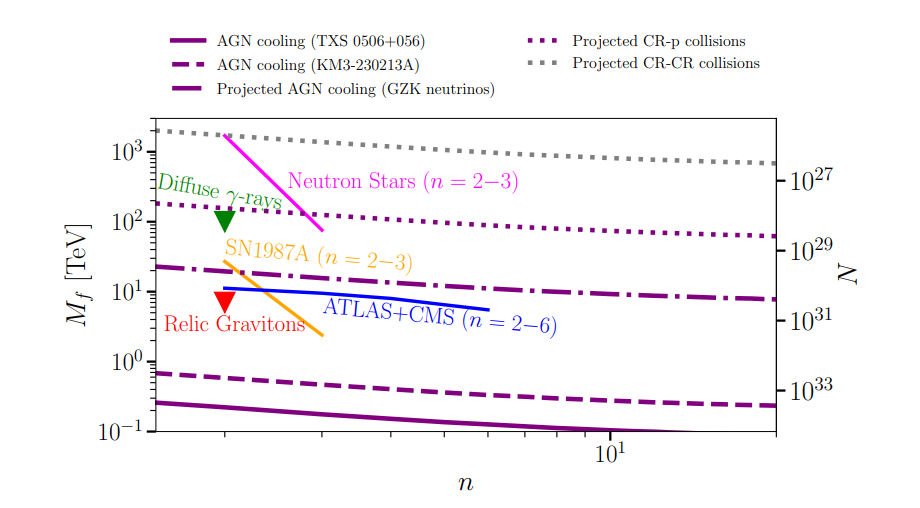
This research presents new methods for testing theories of low-scale quantum gravity by examining high-energy cosmic ray collisions within active galactic nuclei (AGN). Scientists demonstrate that observations of high-energy neutrinos from blazars already constrain the fundamental scale of these theories to around a TeV, with future data potentially raising this bound. Furthermore, the study highlights the potential for cosmic ray-cosmic ray collisions in dual or binary AGN to probe even larger fundamental scales, reaching up to the PeV range. The team also computes the expected neutrino emission from the Hawking evaporation of black holes created in these collisions, revealing a distinct spectral signature that differs from that produced by standard particle decays.
This provides a potential avenue for identifying evidence of low-scale gravity through multi-messenger astronomy, combining neutrino and gamma-ray observations. Researchers acknowledge that probing fundamental scales above 2 PeV is currently beyond reach, as the production timescales for collisions at these energies exceed the age of the universe. Future work should focus on refining predictions for these spectral signatures and exploring the sensitivity of current and upcoming telescopes to these subtle effects. This research demonstrates the potential for using astrophysical observations to test fundamental physics theories and explore the nature of gravity at the smallest scales.
🗞 New Tests of Low-Scale Quantum Gravity with Cosmic-Ray Collisions
🧠 ArXiv: https://arxiv.org/abs/2510.11879
A key signature sought in these high-energy astrophysical processes is the potential violation of Lorentz invariance (LIV). Quantum gravity models often predict that the speed of light or the propagation speed of high-energy particles, such as gamma rays, could become energy-dependent. By measuring the arrival time delay of photons with vastly different energies originating from a single distant source, researchers aim to place stringent limits on the underlying quantum structure of spacetime, providing a novel complement to terrestrial particle accelerator bounds.
The practical realization of these studies relies heavily on next-generation observatory capabilities, such as IceCube Gen2 and CTA. To isolate faint quantum gravity signals from overwhelming astrophysical backgrounds, detectors must employ sophisticated machine learning algorithms and directional reconstruction techniques. Identifying true point-source signatures from diffuse cosmic flux requires modeling the galactic foreground and accurately accounting for atmospheric hadronic showers, representing a significant computational and physical challenge.
Furthermore, the theoretical framework often involves considering physics beyond the Standard Model, such as the existence of extra spatial dimensions or non-minimal couplings between matter and gravity. If high-energy collisions within AGN jets are mediated by interactions sensitive to these extra dimensions, the resulting effective cross-section for certain processes, like pair production, could deviate significantly from established predictions, yielding distinct, measurable signals.



See today’s quantum computing news on Quantum Zeitgeist for the latest breakthroughs in qubits, hardware, algorithms, and industry deals.