

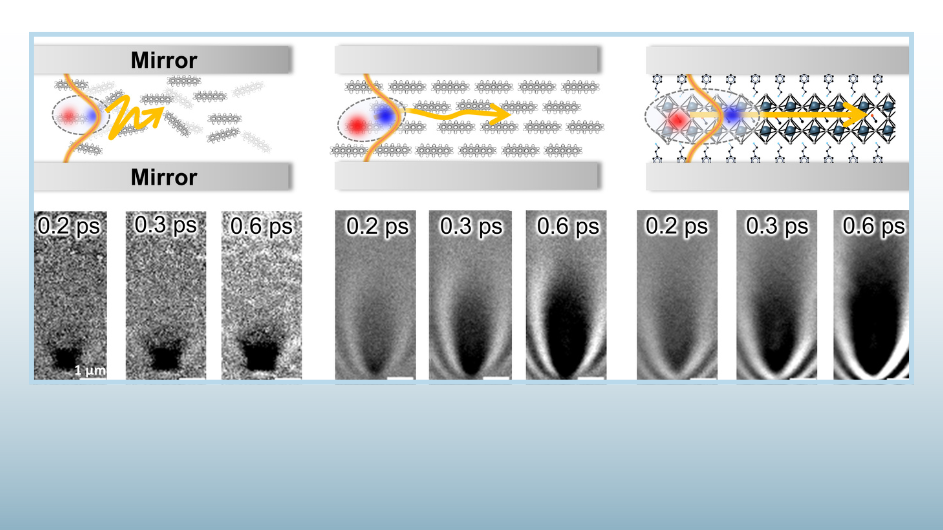
Columbia chemists have developed a groundbreaking playbook for creating “perfect” polaritons, quasiparticles that combine light and matter to form strong interactions and fast, wavelike flow. The team’s findings were published today in Chem by Milan Delor, associate professor of chemistry at Columbia, along with postdoctoral researcher Yongseok Hong and PhD student Ding Xu.
Polaritons are hybrid quasiparticles that can be used to power optical computers and other light-based quantum devices. To create the perfect polariton, Delor’s team tested materials ranging from films with randomly arranged molecules to more organized molecular crystals to fixed lattices of different 2D materials. They identified three guiding rules for creating ideal exciton-polaritons: the chosen material should have (1) large optical absorption, (2) low disorder, and (3) a little bit of inherent exciton delocalization.
The Three Rules for Creating Ideal Exciton-Polaritons
The team’s research revealed that the key to creating ideal polaritons lies in balancing three crucial properties: large optical absorption, low disorder, and inherent exciton delocalization. Large optical absorption allows a material to take in more light, while low disorder minimizes defects or impurities that can disrupt coherence. However, delocalization is often overlooked as an essential ingredient.
In 2023, Delor’s team developed an ultrafast imaging technique capable of capturing exciton-polaritons in motion. They observed waves indicating coherence but noticed a significant drop in coherence when the hybrid particles became more “matter-like.” The increased sensitivity to noise due to disorder led them to conclude that delocalization is the missing ingredient.
Why Light-Based Computers Need Stronger Photon Interactions
Light-based computers rely on polaritons to transmit information at near-light speeds. However, traditional photonic materials fail to provide strong interactions required for effective data transmission. Polaritons overcome this limitation by combining the properties of light and matter, resulting in long-range coherence and enhanced interaction.
Delor’s team identified that 2D halide perovskites, minerals used in solar panels and LEDs, and transition-metal dichalcogenides (TMDs) are promising candidates meeting all three criteria. They demonstrated how these materials can enhance nonlinear optical interactions in waveguides, structures that confine and direct light within a material.
From Disordered Films to 2D Lattices: Testing Polariton Materials
To test their hypothesis, Delor’s team designed and tested various materials, from films with randomly arranged molecules to fixed lattices of different 2D materials. Their experiments revealed that delocalization is the key factor in preserving polariton coherence despite strong interactions and inherent disorder.
By optimizing these properties, the researchers aim to create scalable approaches for realizing light-based quantum computing architectures. They plan to enhance optical interactions to achieve single-photon nonlinearities, a critical step towards unlocking countless applications in quantum information and sensing.
Delor’s work represents a significant breakthrough in the field of light-matter interactions and holds the potential to revolutionize optical computing. As researchers continue to refine these materials and techniques, we can expect to see even more advanced and efficient light-based devices on the horizon.


