The behaviour of atoms interacting with light often reveals ‘dark states’, where atoms become effectively invisible to certain wavelengths, a phenomenon with significant implications for quantum technologies and atomic physics. Xuan Zhao, Le-Man Kuang, and Jie-Qiao Liao from Hunan Normal University now present a comprehensive theory to predict and understand these dark states in complex, multi-level quantum systems. Their work establishes a general method, utilising a novel ‘arrowhead-matrix’ approach, to determine the number and form of dark states regardless of the system’s complexity. This achievement overcomes previous limitations in analysing these states and provides a powerful tool for manipulating and harnessing them in future scientific and technological applications, potentially leading to advances in areas such as quantum computing and precision sensing.
A general dark-state theory for arbitrary multilevel quantum systems Researchers have developed a comprehensive theory to explain and predict the behaviour of quantum systems with multiple energy levels when subjected to external fields. This work addresses a longstanding challenge in quantum physics, namely understanding how these systems evolve and remain stable under specific conditions. The team constructs a general framework applicable to any multilevel quantum system, moving beyond the limitations of previous approaches which often focused on simplified scenarios. This theoretical advancement provides a powerful tool for analysing and controlling complex quantum phenomena, with potential implications for quantum technologies and fundamental studies of quantum mechanics. The researchers demonstrate that specific combinations of external fields can create ‘dark states’, which are immune to certain types of decay and thus exhibit enhanced stability, a crucial property for maintaining quantum information.
Adiabatic Passage and Dark State Control
Research in quantum optics, atomic physics, and quantum information has extensively explored adiabatic passage and dark states. A significant body of work focuses on extending adiabatic passage and stimulated Raman adiabatic passage to multi-level systems, improving their robustness, and applying them to areas like quantum memory, interferometry, and molecule formation. The Morris-Shore transformation frequently appears as a valuable tool for simplifying the analysis of these complex systems. Dark states themselves are a central theme, with investigations covering multi-level atoms, cavity quantum electrodynamics, and multi-mode systems, all with the aim of creating robust quantum systems and protecting quantum information.
Several studies focus on using dark states, specifically dark-state polaritons, for storing quantum information carried by photons. Research also explores strong coupling between atoms and cavities, investigating multi-atom interactions within cavities and the creation of collective states. Quantum information and computation are also addressed, with investigations into quantum gates, quantum algorithms, and the use of quantum systems for information processing. Atomic interferometry using adiabatic passage represents another area of active research. Theoretical foundations underpin much of this research, drawing on linear algebra and foundational principles of quantum mechanics and optics.
The Morris-Shore transformation is a key mathematical technique for simplifying the analysis of multi-level systems, while dark state theory continues to evolve through ongoing theoretical development. Studies of cavity quantum electrodynamics explore strong coupling between atoms and cavities, leading to the creation of collective states and the investigation of multi-mode cavities. Quantum memory research focuses on using dark states, particularly dark-state polaritons, for storing quantum information. Emerging topics include the application of these concepts to superconducting qubits, diamond NV centers, Fock state lattices, and the development of quantum networks.
Notable researchers contributing to this field include N. V. Vitanov, known for his prolific work in adiabatic passage and robust quantum control, and B. W. Shore, recognized for the Morris-Shore transformation and his contributions to multi-level systems.
M. Fleischhauer and M. D. Lukin are key researchers in quantum memory and dark-state polaritons, while C. K. Law has made significant contributions to the understanding of dark states of moving mirrors. This comprehensive body of research represents a valuable resource for anyone working in quantum optics, atomic physics, and quantum information, with a strong emphasis on adiabatic passage, dark states, and their applications to quantum technologies.
Arrowhead Matrices Reveal Dark State Structure
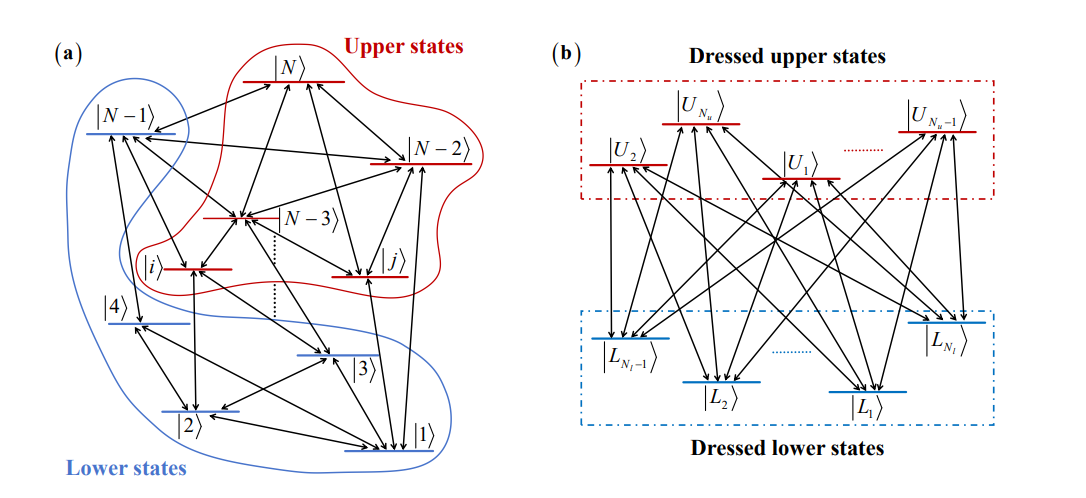
Researchers have developed a novel method for understanding dark states in multilevel quantum systems, employing an arrowhead-matrix approach. The team developed a technique to analyze the Hamiltonian within defined upper and lower state subspaces, transforming it into an arrowhead matrix. This allows them to determine the number of dark states by examining the ranks of associated coupling submatrices, and then solve for the null space of these submatrices to find the form of these dark states. The team systematically applied this method to three-, four-, and five-level systems, classifying them based on the number of upper and lower states to provide a comprehensive analysis.
They extended the framework to N-level systems, demonstrating its applicability to various configurations including multipod, Λ-chain, and V-chain systems. They found specific conditions under which dark states exist or do not exist within these systems, such as the requirement for degeneracy in certain configurations to support a dark state subspace. The researchers successfully reproduced previously established results concerning dark-state polaritons in driven three-level systems, validating the effectiveness of their approach. They acknowledge that their method relies on the accurate definition of upper and lower state subspaces, and the complexity of analysis increases with the number of levels in the system. They suggest future research should focus on preparing, manipulating, and applying these dark states, potentially leading to advancements in quantum technologies. This work provides a powerful tool for investigating dark state effects in any multilevel quantum system and is expected to stimulate further exploration in this field.
🗞 A general dark-state theory for arbitrary multilevel quantum systems
🧠 ArXiv: https://arxiv.org/abs/2510.05561
See today’s quantum computing news on Quantum Zeitgeist for the latest breakthroughs in qubits, hardware, algorithms, and industry deals.