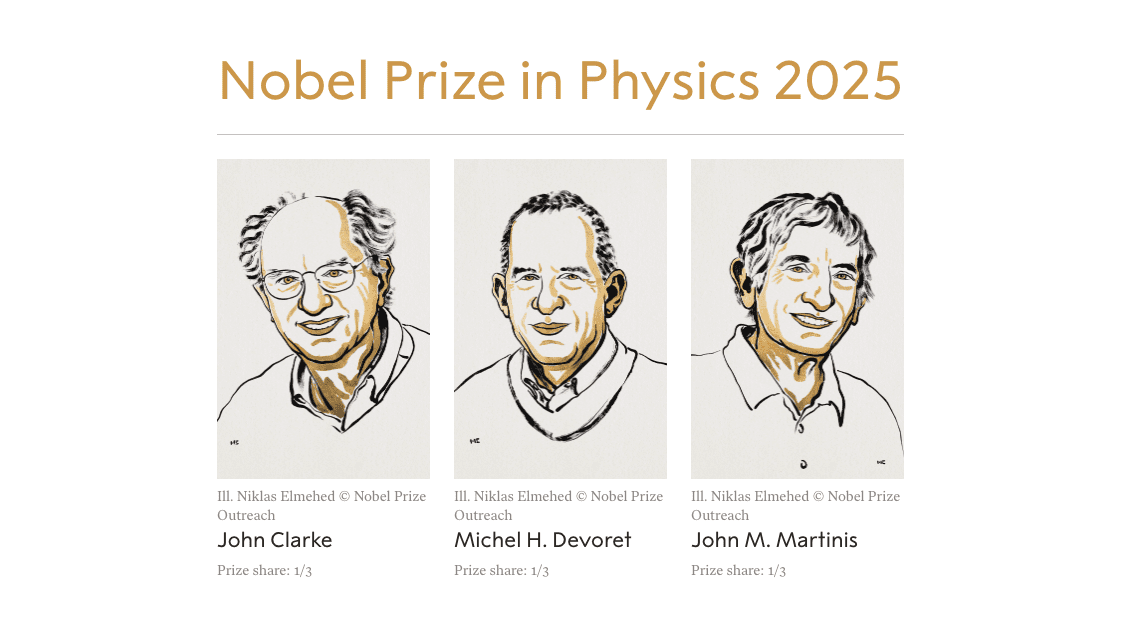
Quantum physics has long been the invisible engine behind the microchips that power smartphones and data centres. Yet the boundary between the quantum and the everyday has always seemed impenetrable. That barrier was broken in the mid‑1980s by a trio of physicists, and the Royal Swedish Academy of Sciences has now recognised their work with the 2025 Nobel Prize in Physics.
John Clarke of the University of California, Berkeley, Michel H. Devoret of Yale University and the University of California, Santa Barbara, and John M. Martinis of Santa Barbara together demonstrated that a macroscopic electrical circuit could exhibit the same tunnelling and energy‑quantisation phenomena that were once thought to belong only to subatomic particles. Their experiments, carried out in 1984 and 1985, showed that a superconducting loop interrupted by a thin insulating barrier, the Josephson junction, could behave as a single quantum particle. When a current was driven through the loop, the system remained trapped in a zero-voltage state; however, it would occasionally “tunnel” through the barrier, producing a measurable voltage spike. By measuring the voltage steps, the researchers confirmed that the system’s energy was quantised, absorbing or emitting only discrete packets of energy.
From Tiny Superconductors to Hand‑Size Circuits
The key to the breakthrough was the use of superconductors, materials that carry electrical current without resistance at cryogenic temperatures. In the Josephson junction, two superconducting electrodes are separated by a nanometre‑thick insulator. When a current is applied, the Cooper pairs of electrons, pairs that move together through the superconductor, can tunnel through the insulator. This tunnelling is a purely quantum effect, yet the entire circuit, a few millimetres across, behaved as if it were a single particle.
Clarke, Devoret and Martinis refined the fabrication of these junctions to an unprecedented precision. By carefully controlling the thickness of the insulating layer and the purity of the superconducting films, they suppressed noise and decoherence, allowing the quantum state to persist long enough for measurement. Their meticulous calibration revealed that the energy levels of the circuit were evenly spaced, a hallmark of a quantum harmonic oscillator. The observation that a macroscopic object could be forced into a coherent quantum state was startling; it suggested that the size limit of quantum phenomena was far larger than previously imagined.
The Quantum Leap That Breaks the Size Barrier
The implications of this work extend beyond a laboratory curiosity. Quantum mechanics is the foundation of all digital technology, yet most practical devices rely on classical physics. By demonstrating that quantum tunnelling and quantisation can persist in a hand-sized circuit, the laureates paved the way for scalable quantum hardware. Modern quantum processors, whether based on superconducting qubits or trapped ions, now rely on precisely the same principles: coherent control of macroscopic systems and the ability to read out quantum states without destroying them.
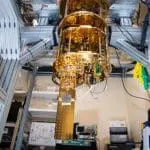
Moreover, the experiment provided a prototype for the first quantum bits, or qubits, that would later become the building blocks of quantum computers. The same Josephson junctions that enabled the tunnelling experiments are now standard in leading quantum processors, such as those developed by IBM, Google and Rigetti. The ability to create, manipulate and measure superpositions of current states has become the cornerstone of superconducting quantum technology.
Beyond computation, the discovery fuels advances in quantum sensing and cryptography. Devices that exploit macroscopic quantum tunnelling can detect minute changes in magnetic fields or temperature with unprecedented sensitivity, promising new medical imaging techniques and environmental monitoring tools. In cryptography, the same principles underpin quantum key distribution systems that guarantee unbreakable encryption by exploiting the fundamental impossibility of measuring a quantum state without disturbing it.
Why the Prize Matters for Tomorrow’s Tech
The Nobel Committee’s decision underscores the long‑term relevance of foundational physics. While the experiments were performed over three decades ago, the technology they inspired is still in its infancy. Quantum computers are now approaching the point where they can solve problems that are beyond the reach of classical machines, and quantum sensors are transitioning from laboratory prototypes to commercial products. The award to Clarke, Devoret and Martinis signals that the scientific community recognises the value of basic research as a springboard for transformative technology.
It also highlights the collaborative nature of modern science. The trio’s work spanned institutions in California, Connecticut, and New York, and their results were disseminated through a series of papers that drew on expertise from both experimental and theoretical physics. This interdisciplinary approach mirrors the structure of today’s quantum‑technology companies, which blend materials science, engineering, computer science and mathematics.
In a world where the next generation of digital infrastructure will increasingly depend on quantum principles, the Nobel Prize serves as a reminder that the most revolutionary advances often arise from curiosity‑driven investigations into the very fabric of reality. The experiments that have transformed a superconducting circuit into a macroscopic quantum particle have already reshaped the landscape of computing, communication, and measurement, and they will continue to influence the trajectory of technology for years to come.
Frequently Asked Questions
What is macroscopic quantum mechanical tunnelling?
Macroscopic quantum mechanical tunnelling is a phenomenon where quantum mechanical effects, such as particles moving through barriers, are observed in systems large enough to be held in the hand. The 2025 Nobel Prize laureates demonstrated this in an electrical circuit, showing that quantum properties can manifest on a macroscopic scale.
How did the laureates demonstrate quantum mechanical effects on a large scale?
The laureates conducted experiments with an electrical circuit where they observed quantum mechanical tunnelling and quantised energy levels. These experiments revealed that quantum effects can be significant even in systems large enough to be held, challenging the notion that such effects are limited to microscopic scales.
Why is the discovery of quantum mechanical tunnelling in an electric circuit significant?
The discovery is significant because it shows that quantum mechanical properties can be observed in macroscopic systems. This challenges the traditional view that quantum effects are only relevant at microscopic scales, opening new avenues for understanding and applying quantum mechanics in larger systems.