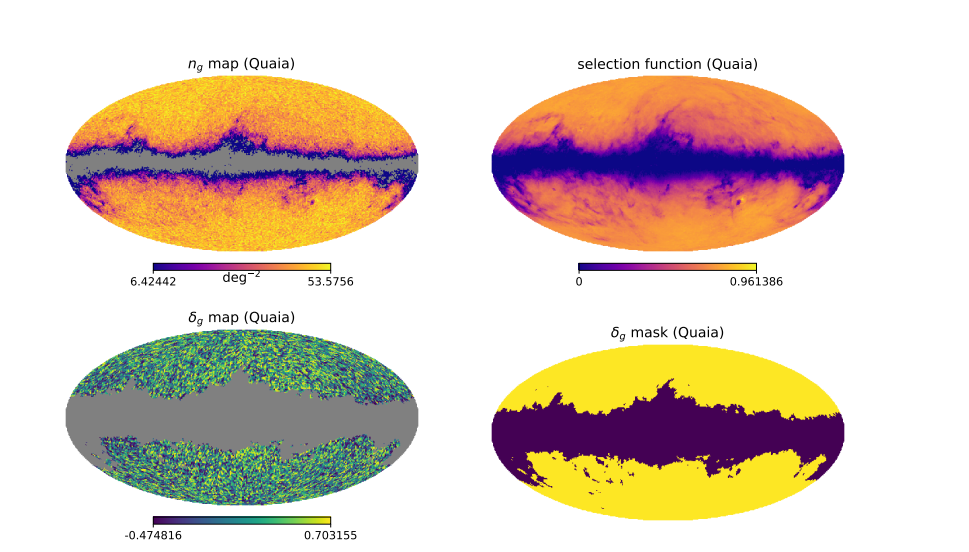
The subtle twisting of light as it travels across vast cosmic distances now offers a new avenue for searching for axions, hypothetical particles considered leading candidates for dark matter. Scientists, led by S. Arcari, N. Bartolo, and G. Fabbian, have performed the first measurement correlating this twisting, known as anisotropic birefringence, with the distribution of galaxies, utilising data from the Planck NPIPE mission and the Quaia quasar catalogue. This innovative approach establishes an unprecedented upper limit on the strength of the interaction between axions and ordinary matter, pushing down to extremely low masses and opening a previously unexplored region of the possible parameter space for these elusive particles. The team’s findings represent a significant step forward in the search for dark matter, offering a novel method to constrain the properties of axions and potentially reveal their role in the universe.
CMB Polarization Reveals Cosmic Birefringence Search
Scientists are investigating cosmic birefringence, a subtle rotation of light polarization as it travels across the universe, which could reveal new physics beyond our current understanding. This research focuses on analyzing the polarization of the Cosmic Microwave Background (CMB), the afterglow of the Big Bang, and connecting it to the distribution of matter in the universe. The team explores the possibility that this birefringence is caused by axions, hypothetical particles proposed as a component of dark matter, or other undiscovered phenomena. They utilize advanced computational tools, including the Cosmic Linear Anisotropy Solving System (CLASS), to model the evolution of the universe and predict the expected signals.
By combining observations of the CMB with maps of large-scale structure created from galaxy surveys and quasar observations, researchers aim to detect or constrain the properties of these exotic particles. They employ sophisticated statistical methods to analyze the data and account for potential sources of error. This work builds upon existing data repositories and resources which compile existing constraints on axion properties. The research represents a comprehensive effort to explore the fundamental nature of the universe and search for evidence of new physics.
Cross-Correlation of Galaxy Distribution and Polarization Rotation
For the first time, scientists have measured the relationship between the rotation of light polarization and the distribution of galaxies across the sky. This breakthrough utilizes data from the Planck satellite, which mapped the polarization of the CMB, combined with a comprehensive catalog of quasars, distant objects used as background light sources. By analyzing how the polarization of light changes as it passes through the distribution of galaxies, the team seeks to understand the underlying physics and explore potential connections to new particles. The analysis reveals that the observed relationship is consistent with random chance, with a probability exceeding 37 percent, indicating no strong evidence for a connection between birefringence and galaxy distribution.
However, this work establishes a crucial baseline for future investigations and allows researchers to place unprecedented constraints on the properties of axions, hypothetical particles proposed as components of dark matter. Specifically, the team derived a new upper limit on the coupling strength between axions and photons, extending constraints down to an ultra-light mass regime previously unexplored. This work opens a new window into the nature of dark matter and the fundamental constituents of the universe.
Cosmic Birefringence And Galaxy Distribution Uncorrelated
Scientists have investigated the relationship between variations in cosmic birefringence and the distribution of galaxies across the sky, combining polarization data from the Planck satellite with a comprehensive catalog of quasars. This analysis seeks to understand early universe phenomena and potential new physics. The results demonstrate that the observed relationship is consistent with no connection between birefringence and galaxy distribution, with a probability of 37 percent. While no definitive signal was detected, this work establishes a crucial baseline for future investigations and allows researchers to place unprecedented constraints on the properties of axions, hypothetical particles proposed as components of dark matter. Specifically, the team derived a new upper limit on the coupling strength between axions and photons, extending constraints down to an ultra-light mass regime previously unexplored. Future research will benefit from improved data quality and more refined theoretical models, potentially revealing subtle connections between birefringence, galaxy distribution, and the fundamental properties of the universe.
🗞 Stairway to Axions: the cross-correlation of birefringence and galaxies from NPIPE and Quaia
🧠 ArXiv: https://arxiv.org/abs/2509.22273
See today’s quantum computing news on Quantum Zeitgeist for the latest breakthroughs in qubits, hardware, algorithms, and industry deals.