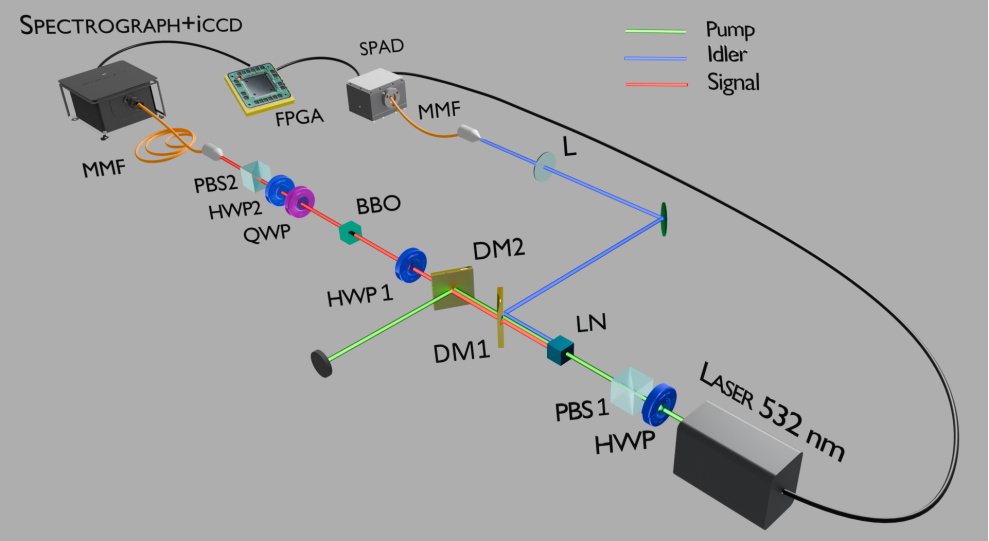
Polarimetry and optical imaging struggle when light is scarce, forcing a compromise between image clarity, measurement duration, and the ability to detect faint signals. Matteo Rosati, Miranda Parisi, and colleagues from Universit`a degli Studi Roma Tre and ENEA now present a new technique, functional classical shadows, that overcomes these limitations and accurately reconstructs polarization profiles even with extremely low photon counts. The team’s method cleverly exploits the relationships between adjacent data points, building on the recent discovery that multiple physical properties can be estimated from a limited number of measurements. This innovative approach allows for detailed polarization analysis across different wavelengths, offering a significant advance for applications ranging from remote sensing to biomedical imaging, and works effectively regardless of light intensity.
Low-Light Polarization Estimation via Shadows
Researchers are developing innovative polarimetry techniques for extremely low-light conditions, crucial for applications like remote sensing and astronomy. The team has created a method based on functional classical shadows, which efficiently estimates polarization properties from very few detected photons. This technique significantly improves upon traditional polarimetry, which typically requires substantial illumination for accurate measurements. By representing the unknown polarization state as a random variable and approximating its properties using a carefully chosen set of measurement bases, researchers can reconstruct the polarization state with minimal statistical error. This approach effectively balances computational complexity with sensitivity, enabling accurate measurements even with limited photon counts. The key advancement lies in a functional representation of classical shadows, allowing for a more compact and efficient estimation of the polarization state.
Efficient Quantum State and Process Learning
Researchers are investigating a method called classical shadows for efficiently learning about quantum states and processes using a limited number of measurements. This research focuses on reconstructing quantum states and characterizing how quantum systems evolve, but aims to do so with significantly fewer measurements than traditional methods. The goal is to apply these techniques to areas like quantum imaging, polarimetric sensing, and improving the efficiency of quantum technologies. Classical shadows involve making a small number of measurements on a quantum system and then using those measurements to estimate the full quantum state or process. The idea is to create a set of shadows that capture enough information to reconstruct the original quantum object. This research has potential applications in improving the resolution and sensitivity of quantum imaging techniques, more efficient and accurate polarimetric remote sensing, enhanced biomedical imaging, and developing more efficient quantum technologies.
Functional Shadows Reconstruct Light Polarization Accurately
Researchers have developed a method called functional classical shadows, which accurately reconstructs the polarization properties of light even when detecting only a limited number of photons. By combining classical shadows with a functional parametrization of quantum states and a global optimization routine, the team created a system that accounts for correlations between data points. This approach allows for accurate reconstruction of polarization phase as a function of wavelength, demonstrating improved data regularization compared to standard fitting methods. The team demonstrated the method’s effectiveness in a polarimetry experiment, successfully reconstructing polarization profiles with limited data. While the theoretical framework outlines specific guarantees regarding variance and unbiasedness, the practical implementation relies on a classical optimization process following data acquisition.
🗞 Photon-starved polarimetry via functional classical shadows
🧠 ArXiv: https://arxiv.org/abs/2509.19547


See today’s quantum computing news on Quantum Zeitgeist for the latest breakthroughs in qubits, hardware, algorithms, and industry deals.