Estimating global properties across spatially separated systems, known as distributed metrology, presents a significant challenge to achieving the highest possible precision, and until now, optimal strategies for this task have remained elusive. Zhiyao Hu, Allen Zang from the University of Chicago, and Jianwei Wang, alongside colleagues, now demonstrate a complete optimal scheme for distributed metrology, establishing fundamental limits to precision in networked systems. The team derives the ideal preparation of quantum probes, the most effective control protocols, and the best measurement strategies for estimating multiple independent, unknown parameters. Crucially, this research proves that achieving optimal performance requires only local control operations on each individual node, dramatically simplifying the practical implementation of high-precision distributed sensing and opening new avenues for applications ranging from gravitational wave detection to distributed imaging.
Optimal strategies for local quantum metrology, including the preparation of optimal probe states and implementation of optimal control and measurement strategies, are well established. However, for distributed quantum metrology, where the goal is to estimate global properties of multiple spatially distributed parameters, the optimal scheme, particularly the role of optimal control, remained poorly understood. In this work, researchers address this challenge by developing optimal schemes for distributed quantum metrology that characterise the ultimate precision limits in distributed systems.
Achieving Cramer-Rao Limit in Quantum Sensing
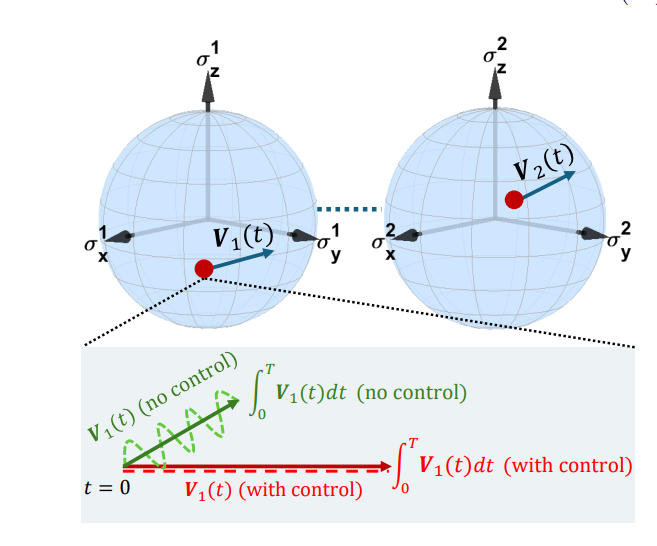
This research demonstrates that, given optimal preparation and control, the Cramer-Rao Lower Bound, the theoretical limit on the precision of parameter estimation, can be achieved in a multi-node quantum sensing system. The team proves this by maximizing the information gained from a quantum system to estimate parameters with the highest possible accuracy, focusing on a system where multiple nodes each contain qubits. Scientists established that using a global GHZ state as the initial probe state is optimal, maximizing the system’s sensitivity to changes in the parameters being estimated. The research further demonstrates that applying local control, manipulating each node independently, is sufficient to reach the maximum achievable quantum Fisher Information, eliminating the need for complex global control schemes.
Theoretical analysis confirms that carefully designed control pulses align operations and maximize the signal, enhancing sensitivity to the parameters. The team also proves that performing local projective measurements, measuring each qubit individually in a specific basis, is the optimal measurement strategy, utilizing an optimal observable derived through the Heisenberg uncertainty relation to maximize information gained from each measurement. This work has direct implications for quantum sensing applications, where the goal is to use quantum systems to measure physical quantities with high precision. It provides a theoretical framework for achieving the ultimate limits of precision in measurement and could also be relevant to other areas of quantum information processing, such as quantum communication and quantum computation. In essence, this research provides a recipe for building a highly sensitive quantum sensor by carefully choosing the initial state, control operations, and measurement strategy.
Localized Control Yields Optimal Quantum Precision
This work presents a breakthrough in distributed quantum metrology, establishing optimal strategies for estimating global properties across multiple spatially separated parameters. Scientists derived the optimal probe state, control protocols, and measurement strategies necessary to achieve precision limits in distributed systems, a significant advancement over existing methods. The research demonstrates that optimal control operations can be implemented locally on each individual sensor, eliminating the need for complex, non-local control across distant nodes and greatly simplifying practical implementation. The team proved that this localized control does not compromise performance, delivering the same precision as more complex, networked control schemes.
This achievement is particularly important because it reduces the complexity and cost associated with building and operating distributed quantum sensor networks. Experiments and theoretical analysis confirm that the developed framework maximizes the information gained from each sensor, leading to enhanced estimation accuracy. Furthermore, the research establishes a fundamental understanding of how to optimally combine measurements from multiple sensors to estimate a linear combination of unknown parameters. The results demonstrate that the proposed strategies outperform conventional approaches, offering a pathway to significantly improve the sensitivity and resolution of distributed sensing applications. This breakthrough has implications for a wide range of fields, including precision navigation, environmental monitoring, and materials science, where accurate estimation of distributed parameters is crucial.
Optimal Distributed Quantum Sensing Protocols
This research presents a comprehensive framework for designing optimal quantum sensing protocols within distributed sensor networks, addressing a significant challenge in the field of metrology. Scientists have successfully derived the optimal probe states, control strategies, and measurement techniques to estimate global parameters across multiple networked sensors. Crucially, the team demonstrated that effective control operations can be implemented locally at each sensor, simplifying the practical implementation of these advanced sensing schemes and removing the need for complex, non-local control. The findings establish a saturable upper bound for the effective quantum Fisher information, a key metric for precision in parameter estimation, and provide systematic control strategies to achieve this bound.
In specific scenarios tested, the application of carefully timed pulses on individual sensors yielded a super-Heisenberg scaling of precision with measurement time, significantly exceeding the limits achievable without active control. This advancement promises enhanced sensitivity and accuracy in distributed sensing applications. Future work will extend this framework to handle multi-parameter estimation and investigate the impact of realistic noise on protocol performance, exploring the potential of noise-resilient probe states to maintain precision in practical sensing environments.
🗞 Optimal scheme for distributed quantum metrology
🧠 ArXiv: https://arxiv.org/abs/2509.18334


See today’s quantum computing news on Quantum Zeitgeist for the latest breakthroughs in qubits, hardware, algorithms, and industry deals.