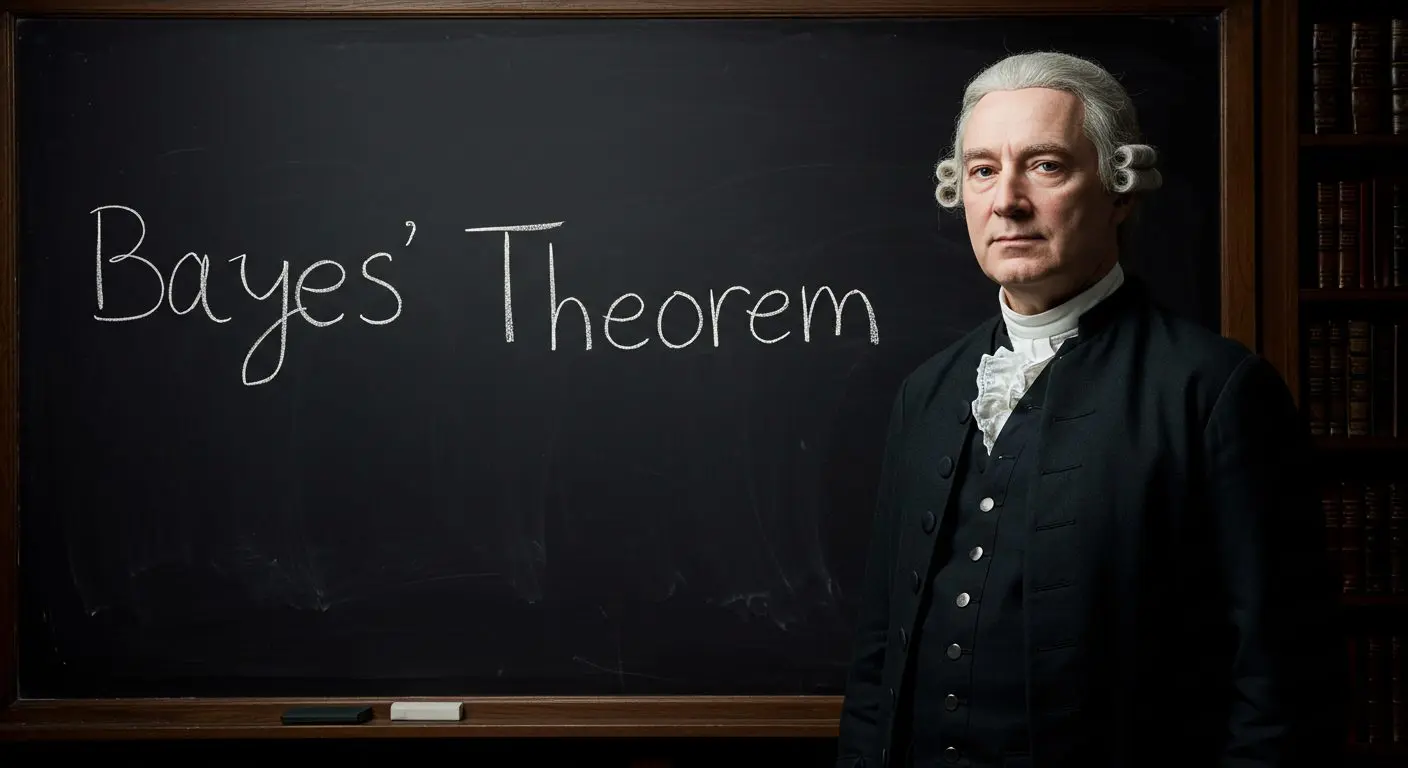
Professor Valerio Scarani from the Centre for Quantum Technologies at the National University of Singapore has derived a quantum analogue of Bayes’ rule by maximising quantum fidelity between forward and reverse processes, a method that aligns with the Petz recovery map. The new rule, published in Physical Review Letters on 28 August 2025, formalises how quantum states update in light of measurement outcomes, offering a principled foundation for quantum inference that could inform error correction and machine learning. The work, co‑authored with Assistant Professor Ge Bai of the Hong Kong University of Science and Technology and Professor Francesco Buscemi of Nagoya University, marks the first derivation of a quantum Bayes rule from a fundamental principle.
Quantum Bayes Rule and the Petz Recovery Map
Professor Valerio Scarani, deputy director and principal investigator at the Centre for Quantum Technologies, together with Assistant Professor Ge Bai of the Hong Kong University of Science and Technology and Professor Francesco Buscemi of Nagoya University, published a paper on 28 August 2025 in Physical Review Letters that derives a quantum analogue of Bayes’ rule from a fundamental optimisation principle. The authors refer to this as the “quantum Bayes rule” and demonstrate that it can be derived by maximising the quantum fidelity between two states representing the forward and reverse processes, in direct analogy with the classical joint-probability formulation of Bayes’ theorem.
In classical probability theory, Bayes’ rule updates a prior belief in light of new evidence by minimising the change between the prior and posterior joint distributions, a principle known as the principle of minimum change. Scarani, Bai and Buscemi translate this idea into the quantum domain by measuring change with quantum fidelity, a metric that quantifies the closeness of two density operators. By maximising fidelity between the state before and after a measurement, they effectively minimise the disturbance to the quantum state that is compatible with the new data. This optimisation yields a rule that updates a quantum state in response to measurement outcomes, mirroring how a positive flu test would alter a person’s belief about their health.
The resulting quantum Bayes rule coincides, in many cases, with the Petz recovery map, a construction introduced by D. Petz in the 1980s and later recognised as a promising candidate for a quantum Bayes rule. Scarani notes that this is the first derivation of the rule from a higher‑level principle, thereby providing theoretical validation for the Petz map. The Petz map is already of interest in quantum information science, where it underpins protocols for quantum error correction and has been proposed for use in quantum machine‑learning algorithms.
The authors demonstrate that the Petz recovery map satisfies the conditions required of a quantum analogue of Bayes rule, confirming its role as a quantum Bayes rule. Looking ahead, the team intends to investigate whether applying the minimum‑change principle to other quantum distance measures could reveal further candidate rules for updating quantum states. Such work could broaden the toolkit available for quantum computing, particularly in tasks that require reliable state reconstruction after partial or noisy measurements.
In addition to the theoretical advance, the Petz map has attracted attention in quantum computing, particularly for error‑correction protocols that recover lost information from corrupted states, and in quantum machine learning, where it offers a principled method for updating beliefs about quantum data in the presence of noise or incomplete observations. Professor Scarani remarked, “I would say it is a breakthrough in mathematical physics,” underscoring the rule’s significance for these emerging fields.
The work marks the 250th anniversary of Thomas Bayes’ original formulation of conditional probability in 1763, underscoring how the century‑old statistical framework now acquires a quantum edge. The team plans to investigate whether applying the minimum‑change principle to other quantum distance measures could yield alternative updating rules, potentially expanding the toolkit available for state estimation on next‑generation quantum platforms.
Original News Report
Source: National University of Singapore (news.nus.edu.sg)
View Original Source



See today’s quantum computing news on Quantum Zeitgeist for the latest breakthroughs in qubits, hardware, algorithms, and industry deals.