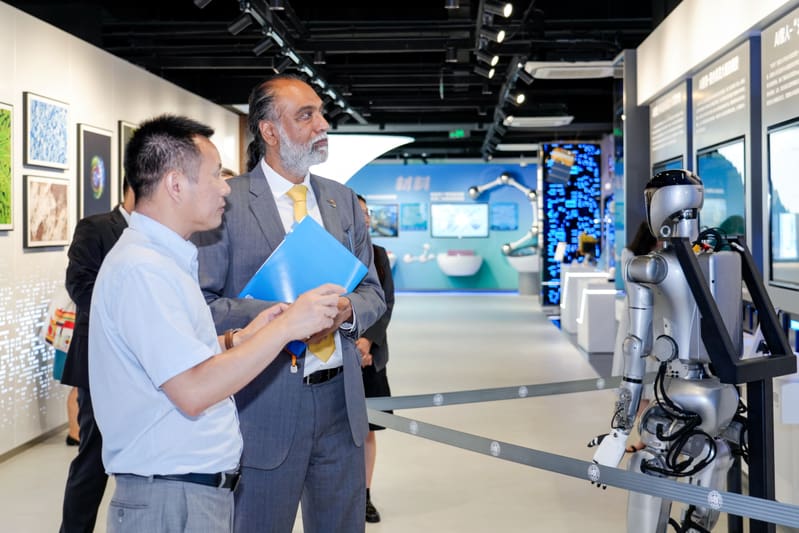
Fudan University, led by President Jin Li and with Vice President Chen Zhimin serving as Executive Director, launched the Center for Global AI Innovative Governance at the opening ceremony of the 2025 World Artificial Intelligence Conference (WAIC) in Shanghai on July 26th. Established with support from the Shanghai Municipal Government, the centre’s mandate focuses on capacity building, governance coordination, and the provision of international public goods, particularly targeting nations within the Global South, to facilitate a globally accepted framework for ethical artificial intelligence governance. A delegation led by UN officials, including Amandeep Singh Gill, conducted a fact-finding visit to Fudan University to assess its advancements in artificial intelligence and the development progress of the newly established centre, signalling a collaborative intent in the pursuit of responsible AI development.
Fudan University, a leading Chinese institution, inaugurated the Centre for Global AI Innovative Governance at the opening ceremony of the 2025 World Artificial Intelligence Conference (WAIC) held in Shanghai on July 26th. This initiative, supported by the Shanghai Municipal Government, signifies a concerted effort to address the escalating need for responsible artificial intelligence development through enhanced international cooperation. The centre’s establishment reflects a growing recognition of the complex ethical, legal, and societal challenges posed by rapidly advancing AI technologies and the necessity for globally harmonised governance frameworks.
The centre is spearheaded by Fudan University President Jin Li, who will provide overall strategic direction, with Vice President Chen Zhimin appointed as Executive Director, responsible for day-to-day operations and programme implementation. This leadership structure aims to ensure a blend of academic vision and practical administrative expertise. The centre’s core mandate encompasses three principal areas: capacity building, governance coordination, and the provision of international public goods. Capacity building will focus on training programmes designed to equip policymakers, regulators, and civil society actors with the knowledge and skills required to navigate the complexities of AI governance. Governance coordination will involve facilitating dialogue and collaboration amongst diverse stakeholders, including governments, industry representatives, and academic institutions, to forge consensus on key policy issues. The provision of international public goods will prioritise assistance to nations in the Global South, acknowledging the potential for AI to exacerbate existing inequalities and the importance of ensuring equitable access to its benefits.
A central tenet of the centre’s approach is the integration of China’s own experiences in AI development with a distinctly global outlook. This reflects a commitment to sharing lessons learned from domestic initiatives – including advancements in areas such as computer vision, natural language processing, and machine learning algorithms – while simultaneously adopting a broad perspective informed by international best practices. The centre intends to contribute towards the development of a widely accepted framework for ethical AI governance, encompassing principles such as fairness, accountability, transparency, and human oversight. This framework will aim to mitigate potential risks associated with AI, including bias, discrimination, privacy violations, and the erosion of trust.
The centre’s establishment has already garnered attention from
The centre’s establishment has already garnered attention from international bodies, with a delegation of United Nations officials, led by Amandeep Singh Gill, conducting a fact-finding visit to Fudan University. The delegation sought a comprehensive understanding of the university’s advancements in artificial intelligence research and the developmental progress of the Centre for Global AI Innovative Governance. This visit underscores the increasing international recognition of the importance of collaborative efforts in addressing the challenges and opportunities presented by AI. Mr. Gill, a prominent figure in the discourse on digital cooperation and AI governance, expressed particular interest in the centre’s approach to capacity building in the Global South.
The focus on supporting nations in the Global South is particularly noteworthy, as these countries often lack the resources and expertise necessary to effectively regulate and harness the potential of AI. The centre intends to provide tailored assistance, including technical training, policy advice, and access to cutting-edge research. This initiative aligns with broader efforts to promote digital inclusion and ensure that the benefits of AI are shared equitably across the globe. The centre’s work will also contribute to the ongoing dialogue surrounding Global AI governance, a critical area of international cooperation in the 21st century. The institution’s commitment to fostering responsible AI development through international collaboration positions it as a key player in shaping the future of this transformative technology. The centre’s success will depend on its ability to forge strong partnerships with stakeholders across the globe and to translate its research into practical, impactful solutions.
External Link: Click Here For More
See today’s quantum computing news on Quantum Zeitgeist for the latest breakthroughs in qubits, hardware, algorithms, and industry deals.