The behaviour of quantum vortices, topological defects in superfluids, reveals much about the fundamental properties of matter at extremely low temperatures. Understanding these structures is particularly pertinent in dipolar Bose-Einstein condensates, where long-range interactions between atoms introduce anisotropy and complexity to vortex dynamics. Ryan Doran, from Mathematical Physics at Lund University, and Thomas Bland, of the Joint Quantum Centre Durham-Newcastle at Newcastle University, alongside their colleagues, present a new analytic solution for the phase of a vortex within such a condensate in their article, ‘Analytic Phase Solution and Point Vortex Model for Dipolar Quantum Vortices’. This work delivers a simplified, yet accurate, model – a dipolar point vortex model – capable of reproducing observed vortex pair behaviours, and provides a platform for further investigation into vortex dynamics and potential turbulence in dipolar quantum systems.
Quantum physicists accurately model vortex phase behaviour within anisotropic two-dimensional systems, specifically dipolar Bose-Einstein condensates, and successfully incorporate the effects of long-range dipole-dipole interactions into a dipolar point vortex model (DPVM). This model captures the phase behaviour surrounding vortices, surpassing limitations previously imposed by constant anisotropy parameters and providing a tractable analytical framework for exploring parameter regimes and interactions previously inaccessible through purely numerical methods. A Bose-Einstein condensate is a state of matter formed when bosons are cooled to temperatures very close to absolute zero, exhibiting quantum mechanical phenomena on a macroscopic scale.
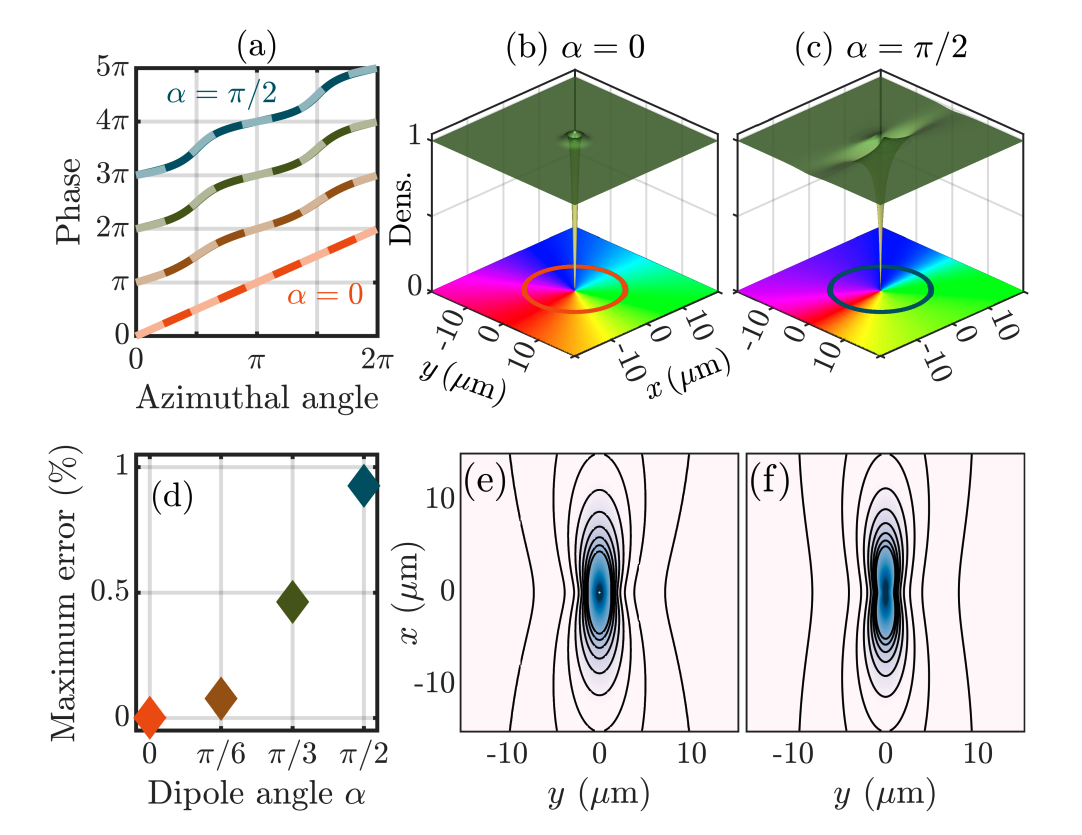
Scientists investigate vortex dynamics within dipolar Bose-Einstein condensates, establishing a DPVM that incorporates both phase-driven flow and dipolar forces, offering a simplified yet accurate representation of vortex behaviour. They derive this model by demonstrating that a spatially varying parameter, λ(ρ), is essential for correctly describing the phase around the vortex core, as a constant value inadequately represents the observed ellipticity. The parameter λ(ρ) represents the anisotropy, or direction-dependent properties, of the condensate, and its radial dependence, meaning it changes with distance (ρ) from the vortex centre, is crucial for accurate modelling.
Researchers present an analytic expression for the phase
Researchers present an analytic expression for the phase structure surrounding a vortex within a dipolar Bose-Einstein condensate, accurately capturing the anisotropic effects arising from long-range dipole-dipole interactions. They detail the analytic solution for the phase structure, relying on complete and incomplete elliptic integrals to account for the influence of dipolar interactions, and highlight that employing a spatially varying λ(ρ) significantly improves the accuracy of the velocity field modelling, particularly near the vortex core. Elliptic integrals are special functions used to calculate arc lengths of ellipses and are essential for solving problems involving periodic or quasi-periodic phenomena.
Physicists utilize imaginary time evolution to solve the Gross-Pitaevskii equation and employ absorbing boundaries to manage reflections within the simulation domain, establishing a minimal and accurate model for dipolar vortex dynamics. The Gross-Pitaevskii equation is a fundamental equation in the study of Bose-Einstein condensates, describing the evolution of the condensate’s wavefunction. Imaginary time evolution is a numerical technique used to find the ground state of a quantum system. Absorbing boundaries prevent spurious reflections from the edges of the simulation, ensuring accurate results.
The DPVM’s ability to reproduce key features observed in simulations of vortex pair dynamics, including anisotropic velocities, deformed orbital paths, and directional motion, has been validated, stemming from the accurate modelling of anisotropic interactions. This development opens avenues for further investigation into vortex dynamics and turbulence in dipolar matter, allowing researchers to explore parameter regimes and interactions previously inaccessible through purely numerical methods.
Researchers establish a framework for understanding these complex
Researchers establish a framework for understanding these complex phenomena and potentially designing experiments to explore them further. They propose future work to investigate the effects of varying the parameters within the DPVM, exploring the potential for creating novel quantum states and devices.
🗞 Analytic Phase Solution and Point Vortex Model for Dipolar Quantum Vortices
🧠 DOI: https://doi.org/10.48550/arXiv.2507.02779




See today’s quantum computing news on Quantum Zeitgeist for the latest breakthroughs in qubits, hardware, algorithms, and industry deals.