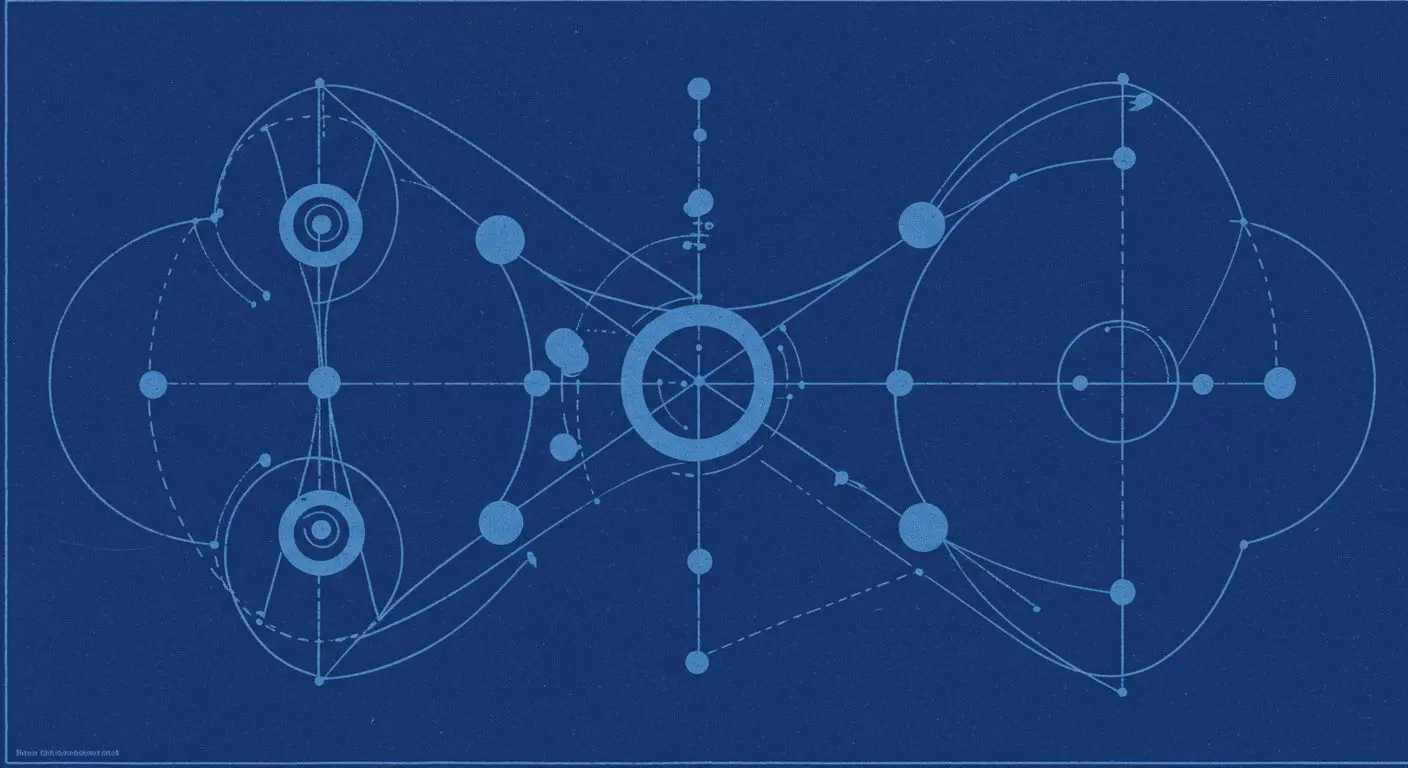
Researchers demonstrate entanglement between distant qubits using a metasurface, a structured material manipulating electromagnetic waves. Spatial and temporal modulation engineers controllable qubit coupling, achieving over 98% entanglement fidelity across centimetre scales. This approach circumvents limitations of decaying near-field interactions, enabling robust remote qubit connectivity.
Quantum entanglement, a phenomenon where two or more particles become linked and share the same fate, no matter how far apart, underpins many proposed quantum technologies. Maintaining this delicate connection over significant distances remains a substantial challenge, typically limited by signal degradation and the exponential decay of interactions. New research addresses this limitation by demonstrating a method for performing entanglement operations between qubits separated by centimetre scales, utilising a carefully engineered metasurface. Mustafa Bakr, from the Clarendon Laboratory, Department of Physics, University of Oxford, and colleagues, detail their approach in the article, “Long-Range Entangling Operations via Josephson Junction Metasurfaces”, presenting a framework where a space-time modulated metasurface acts as a reconfigurable medium to selectively couple qubits and facilitate entanglement via iSWAP gates and controlled phase gates, achieving simulated fidelities exceeding 98%.
Quantum computation currently faces substantial challenges in scaling due to the limited range of direct qubit interactions, impeding the creation of large, interconnected quantum processors. Researchers detail a novel approach utilising dynamically modulated Josephson junction metasurfaces to mediate long-range interactions between superconducting qubits, potentially resolving this scalability issue and enabling more complex quantum algorithms. The core principle involves engineering a metasurface, an artificial material exhibiting properties not found in nature, comprising an array of Josephson junctions, and dynamically modulating these junctions in both space and time to create tailored electromagnetic modes that selectively couple distant qubits.
This innovative method circumvents the exponential decay characteristic
This innovative method circumvents the exponential decay characteristic of near-field coupling, enabling strong interactions over centimetre scales and opening new avenues for quantum circuit design. Simulations reveal that high-fidelity entangling operations, exceeding 98%, are achievable between qubits separated by up to five centimetres, representing a substantial improvement over existing methods for long-range qubit control. The researchers address the challenge of dispersive shifts, which can degrade gate fidelity, by proposing dynamical decoupling protocols to maintain high-performance entangling operations. Dispersive shifts arise from the interaction between the qubits and the mediating electromagnetic field, altering the qubit frequencies and introducing errors. Dynamical decoupling involves applying a series of carefully timed pulses to suppress these unwanted interactions.
Researchers demonstrate a pathway to extend qubit connectivity in superconducting circuits through the application of dynamically modulated Josephson junction metasurfaces, addressing a fundamental limitation of current architectures. The rapid decay of interactions with increasing physical distance between qubits hinders the creation of large, interconnected quantum processors. By engineering electromagnetic interactions via a metasurface, the authors achieve sustained coupling strengths over centimetre scales, significantly exceeding the range achievable with conventional near-field coupling. A Josephson junction is a superconducting device exhibiting a non-linear current-voltage relationship, crucial for creating qubits and controlling their interactions.
The proposed system functions by dynamically modulating the
The proposed system functions by dynamically modulating the properties of Josephson junctions within the metasurface, effectively tailoring the electromagnetic wavevector and enabling selective coupling between distant qubits. Researchers demonstrate the feasibility of implementing two key quantum gates: the iSWAP gate, which exchanges the quantum states of two qubits, and the controlled-phase gate, which applies a phase shift based on qubit states.
🗞 Long-Range Entangling Operations via Josephson Junction Metasurfaces
🧠 DOI: https://doi.org/10.48550/arXiv.2506.14958



See today’s quantum computing news on Quantum Zeitgeist for the latest breakthroughs in qubits, hardware, algorithms, and industry deals.