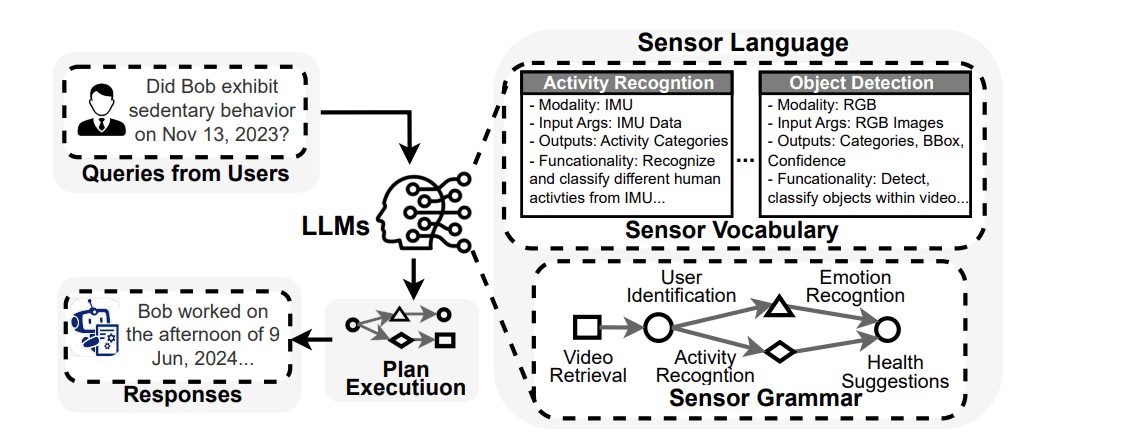
The use of sensors has become ubiquitous in various applications, but despite their extensive deployment, the potential of coexisting sensor systems is often not fully utilized. To overcome this limitation, researchers have been exploring innovative solutions that can effectively coordinate heterogeneous sensor systems. One such approach involves leveraging Large Language Models (LLMs) to task sensor systems for handling complex user queries.
This novel solution has the potential to unlock sensor systems’ full capabilities and enable them to address more advanced applications. By utilizing LLMs, researchers have introduced a groundbreaking approach that defines a sensor language comprising vocabulary sets and grammar rules analogous to natural language components. This enables LLMs to translate user intentions into sensor coordination plans.
The preliminary results of this research demonstrate that the proposed approach significantly outperforms existing solutions at plan generation, execution, and response generation stages. This achievement showcases the potential of LLMs in unlocking the full capabilities of heterogeneous sensor systems and enabling them to address more complex user requirements.
Sensors have become ubiquitous in various applications, enabling intelligent and complex functionalities. However, despite their extensive deployment, the full potential of coexisting sensor systems is often not fully utilized, limiting more advanced applications. This paper introduces a novel solution that leverages large language models (LLMs) to coordinate sensor systems for handling complex user queries.
The existing tasking techniques for sensor systems rely on rule-based approaches or end-to-end algorithms, which are highly specialized and require significant manual effort to accommodate new tasks. These fragmented operations limit sensor systems from reaching their full potential in addressing complex and dynamic user requirements. In contrast, the proposed solution utilizes LLMs to translate user intentions into sensor coordination plans, enabling more efficient and effective tasking of heterogeneous sensor systems.
The preliminary results show that this approach significantly outperforms existing solutions at plan generation, execution, and response generation stages. This breakthrough has far-reaching implications for various applications, including healthcare monitoring, human activity recognition, and emotion recognition. By harnessing the power of LLMs to coordinate sensor systems, developers can create more sophisticated and user-centric applications that fully leverage the capabilities of coexisting sensors.
Current sensor system tasking techniques are highly specialized and require significant manual effort to accommodate new tasks. These rule-based approaches or end-to-end algorithms are often tailored to specific use cases, limiting their flexibility and adaptability. As a result, sensor systems are not able to reach their full potential in addressing complex and dynamic user requirements.
The existing solutions are also prone to errors, such as out-of-scope queries, select format errors, and incorrect output. These limitations highlight the need for more efficient and effective tasking techniques that can handle complex user queries and adapt to changing requirements. The proposed solution using LLMs addresses these limitations by providing a more flexible and adaptable approach to sensor system tasking.
The use of LLMs enables the translation of
The use of LLMs enables the translation of user intentions into sensor coordination plans, allowing developers to create more sophisticated and user-centric applications. This breakthrough has far-reaching implications for various applications, including healthcare monitoring, human activity recognition, and emotion recognition. By harnessing the power of LLMs to coordinate sensor systems, developers can create more effective and efficient solutions that fully leverage the capabilities of coexisting sensors.
Large Language Models (LLMs) have revolutionized various fields by enabling machines to understand and generate human-like language. In the context of sensor system tasking, LLMs can be leveraged to translate user intentions into sensor coordination plans. This approach enables more efficient and effective tasking of heterogeneous sensor systems, allowing developers to create more sophisticated and user-centric applications.
The proposed solution utilizes a novel sensor language that includes vocabulary sets and grammar rules analogous to natural language components. This sensor language enables LLMs to understand user queries and generate corresponding sensor coordination plans. The preliminary results show that this approach significantly outperforms existing solutions at plan generation, execution, and response generation stages.
The use of LLMs in sensor system tasking has far-reaching implications for various applications, including healthcare monitoring, human activity recognition, and emotion recognition. By harnessing the power of LLMs to coordinate sensor systems, developers can create more effective and efficient solutions that fully leverage the capabilities of coexisting sensors.
The proposed solution introduces a novel sensor language that includes vocabulary sets and grammar rules analogous to natural language components. This sensor language enables LLMs to understand user queries and generate corresponding sensor coordination plans. The sensor language is designed to be flexible and adaptable, allowing developers to create more sophisticated and user-centric applications.
The sensor language includes various components, such as video retrieval, user identification, activity recognition, emotion recognition, health suggestions, and object detection. These components enable LLMs to understand complex user queries and generate corresponding sensor coordination plans. The preliminary results show that this approach significantly outperforms existing solutions at plan generation, execution, and response generation stages.
The use of a novel sensor language has far-reaching implications for various applications, including healthcare monitoring, human activity recognition, and emotion recognition. By harnessing the power of LLMs to coordinate sensor systems using a novel sensor language, developers can create more effective and efficient solutions that fully leverage the capabilities of coexisting sensors.
The proposed solution using LLMs has far-reaching implications for various applications, including healthcare monitoring, human activity recognition, and emotion recognition. By harnessing the power of LLMs to coordinate sensor systems, developers can create more effective and efficient solutions that fully leverage the capabilities of coexisting sensors.
The use of LLMs in sensor system tasking
The use of LLMs in sensor system tasking enables more efficient and effective tasking of heterogeneous sensor systems, allowing developers to create more sophisticated and user-centric applications. The proposed solution introduces a novel sensor language that includes vocabulary sets and grammar rules analogous to natural language components, enabling LLMs to understand complex user queries and generate corresponding sensor coordination plans.
The preliminary results show that this approach significantly outperforms existing solutions at plan generation, execution, and response generation stages. This breakthrough has far-reaching implications for various applications, including healthcare monitoring, human activity recognition, and emotion recognition. By harnessing the power of LLMs to coordinate sensor systems, developers can create more effective and efficient solutions that fully leverage the capabilities of coexisting sensors.
The proposed solution using LLMs has revolutionized the field of sensor system tasking by enabling more efficient and effective tasking of heterogeneous sensor systems. The use of a novel sensor language enables LLMs to understand complex user queries and generate corresponding sensor coordination plans, allowing developers to create more sophisticated and user-centric applications.
The preliminary results show that this approach significantly outperforms existing solutions at plan generation, execution, and response generation stages. This breakthrough has far-reaching implications for various applications, including healthcare monitoring, human activity recognition, and emotion recognition. By harnessing the power of LLMs to coordinate sensor systems, developers can create more effective and efficient solutions that fully leverage the capabilities of coexisting sensors.
The future of sensor systems tasking with LLMs is bright, with far-reaching implications for various applications. The proposed solution has shown significant promise in addressing complex user queries and adapting to changing requirements. As the field continues to evolve, it is likely that we will see even more innovative applications of LLMs in sensor system tasking, leading to more effective and efficient solutions that fully leverage the capabilities of coexisting sensors.
Publication Date: 2024-11-04
Authors: K.H. Liu, Bufang Yang, Lilin Xu, Yunqi Guo, et al.
Source:
DOI: https://doi.org/10.1145/3666025.3699428




See today’s quantum computing news on Quantum Zeitgeist for the latest breakthroughs in qubits, hardware, algorithms, and industry deals.