A research team led by Dr. Yongsoo Yang from the Department of Physics at KAIST has solved a 20-year-old puzzle about the behavior of ferroelectrics when reduced to nano sizes. The team used atomic electron tomography to reveal a three-dimensional, vortex-shaped polarization distribution inside ferroelectric nanoparticles. This discovery, which was theoretically predicted by Prof. Laurent Bellaiche from the University of Arkansas two decades ago, could lead to ultra-high-density memory devices with capacities over 10,000 times greater than existing ones. The research was published in Nature Communications and was supported by the National Research Foundation of Korea.
Unraveling the Mystery of Zero-Dimensional Ferroelectrics
Ferroelectrics, the electric counterparts to ferromagnets, are materials that maintain a polarized state without an external electric field. The behavior of these materials when reduced to nano sizes, specifically into a zero-dimensional structure such as nanoparticles, has been a subject of debate for many years. A team of researchers led by Dr. Yongsoo Yang from the Department of Physics at KAIST has recently made a significant breakthrough in this area.
The Three-Dimensional Vortex of Ferroelectric Nanoparticles
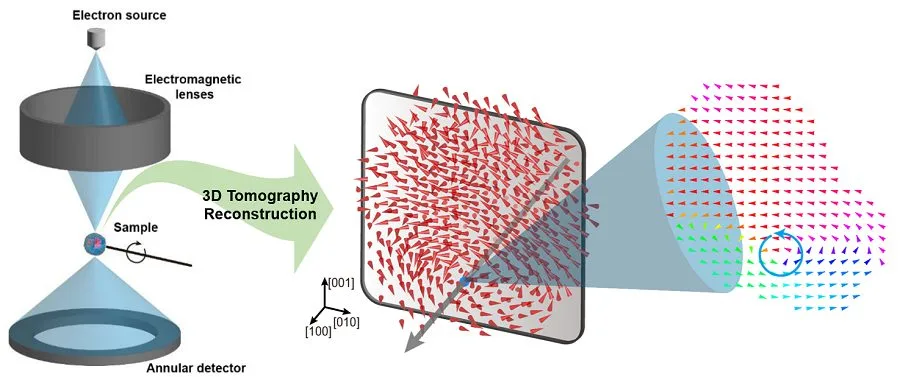
The team, in collaboration with researchers from POSTECH, SNU, KBSI, LBNL, and the University of Arkansas, has experimentally clarified the three-dimensional, vortex-shaped polarization distribution inside ferroelectric nanoparticles. This discovery was made possible through the use of atomic electron tomography, a technique that involves acquiring atomic-resolution transmission electron microscope images of the nanomaterials from multiple tilt angles, and then reconstructing them back into three-dimensional structures using advanced reconstruction algorithms.
The 20-Year-Old Prediction and its Experimental Verification
Two decades ago, Prof. Laurent Bellaiche and his colleagues at the University of Arkansas theorized that a unique form of polarization distribution, arranged in a toroidal vortex shape, could occur inside ferroelectric nanodots. They also proposed that if this vortex distribution could be properly controlled, it could be applied to ultra-high-density memory devices with capacities over 10,000 times greater than existing ones. However, due to the difficulty of measuring the three-dimensional polarization distribution within ferroelectric nanostructures, this theory remained unverified until now.
The Role of Atomic Electron Tomography
The KAIST team successfully implemented atomic electron tomography to solve this long-standing challenge. This technique, similar to the CT scans used in hospitals to view internal organs in three dimensions, was uniquely adapted for nanomaterials, utilizing an electron microscope at the single-atom level. The team completely measured the positions of cation atoms inside barium titanate (BaTiO3) nanoparticles, a well-known ferroelectric material, in three dimensions. From the precisely determined 3D atomic arrangements, they were able to further calculate the internal three-dimensional polarization distribution at the single-atom level.
The Future of High-Density Memory Devices
The analysis of the polarization distribution revealed, for the first time experimentally, that topological polarization orderings including vortices, anti-vortices, skyrmions, and a Bloch point occur inside the 0-dimensional ferroelectrics, as theoretically predicted 20 years ago. Furthermore, it was also found that the number of internal vortices can be controlled depending on their sizes. This discovery opens up the possibility of next-generation high-density memory devices that can store more than 10,000 times the amount of information in the same-sized device compared to existing ones. This research suggests that controlling the size and shape of ferroelectrics alone, without needing to tune the substrate or surrounding environmental effects such as epitaxial strain, can manipulate ferroelectric vortices or other topological orderings at the nano-scale.
External Link: Click Here For More



See today’s quantum computing news on Quantum Zeitgeist for the latest breakthroughs in qubits, hardware, algorithms, and industry deals.