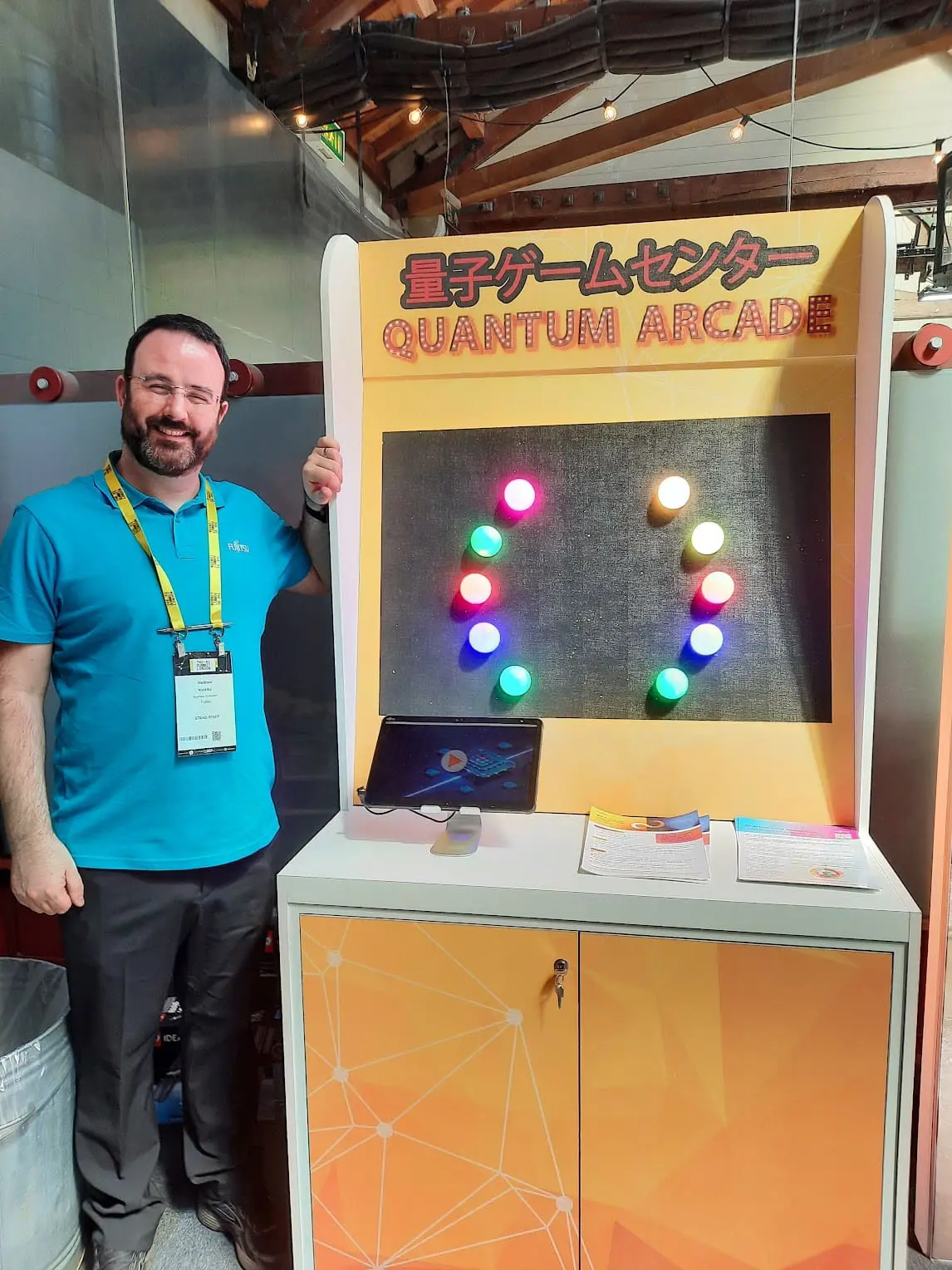
We love games, especially quantum games. At the latest UK Quantum Summit, we saw the impressive stand from Fujitsu which aimed to showcase the work that the Japanese giant has been doing in the quantum space with the likes of household names such as HSBC.
Despite being a large conglomerate with tens of thousands of employees around the globe, Fujitsu has a dedicated UK based quantum team actively working with clients to explore the promise of quantum computing in a range of different sectors. The team has worked with the likes of BMW and HSBC on myriad technical challenges of optimisation. What makes Fujitsu different according to our conversations is that that they remain steadfastly focused on business outcome rather than technological implementation. Fujitsu have their own technology, the Digital Annealer which is rather akin to the quantum annealers from the likes of D-Wave for example but instead Quantum-Inspired computing technology. Crucially this “DA” comprises unique digital circuit design inspired by quantum phenomena. However engagement with Fujitsu isn’t limited to their own hardware and their consulting team are agnostic about technology choices, whether that means planning for 20,000 qubit devices or consider more near term objectives.
One of the panel discussions talked about how HSBC has engaged with Fujitsu on their journey to help them segue into exploring more advanced forms of computation. Devices such as the DA can provide a bridging technology – between the purely classical world and the quantum world, enabling users to get a head start on formulating problems that might be very amenable in the quantum space.
Fujitsu are busy engaging with businesses via their “Quantum Value Assessment” which focuses on relevant challenges that business has. Via collaborate and education workshops they aim to bring insight and expertise to the organisations wanting to implement an effective strategy to implement value realisation of quantum computing. The result of this engagement is to provide the business with the action points to readily implement a quantum strategy.
The key components of the Fujitsu methodology are to: Align, Educate, Discover, Analyse and Model. With the culmination into a report which and work that provides Quick wins, Timeline, Models, Capabilities, Skillsets, Test concepts and Partnerships.



See today’s quantum computing news on Quantum Zeitgeist for the latest breakthroughs in qubits, hardware, algorithms, and industry deals.