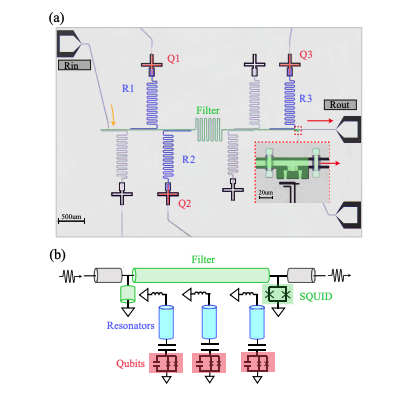
Achieving fast, accurate measurement of quantum information remains a central challenge in building practical quantum computers, and recent work addresses this need with a novel approach to qubit readout. Yuzhe Xiong, Zilin Wang, and Jiawei Zhang, alongside colleagues at their institutions, demonstrate a high-performance system for simultaneously reading multiple superconducting qubits using a tunable broadband Purcell filter. This innovative filter dynamically balances measurement speed with minimising unwanted noise, a crucial step towards reliable quantum error correction. The team achieves remarkably high readout fidelities, exceeding 99. 5% for three qubits measured in parallel, and proposes a scalable architecture that promises faster and more efficient quantum computations.
Superconducting Qubit Readout, Speed and Fidelity
The central challenge in superconducting quantum computing lies in improving the fidelity, speed, and scalability of qubit readout. Traditional methods often suffer from weak signals overwhelmed by noise, slow measurement speeds, and interference as the number of qubits increases, contributing to qubit instability and reduced coherence times. The goal is to develop techniques that overcome these challenges, enabling larger, more reliable quantum processors. The team details several advancements, most notably the use of nonlinear Purcell filters. These filters enhance the qubit signal while suppressing noise, and their nonlinear characteristics allow for better signal discrimination.
They also integrated these filters directly into the qubit resonator design, alongside fast tuning of readout resonators for multiplexing, Josephson parametric amplifiers to boost weak signals, and optimised resonator designs to maximise signal coupling and minimise noise. High-suppression-ratio filters, fast qubit reset techniques, and progress towards implementing the colour code quantum error correction scheme also contribute to these advancements. These techniques have led to significant improvements in qubit readout fidelity, approaching and exceeding 99. 9% in some cases. Readout speeds have also increased, and noise levels have been significantly reduced, improving qubit coherence times.
The techniques are compatible with scaling up the number of qubits in a quantum processor, and progress has been made in implementing and testing the colour code error correction scheme. This work is highly significant because it enables larger quantum processors, advances quantum error correction, and accelerates research in all areas of quantum computing. The improvements in qubit readout and control are essential for building larger, more powerful quantum computers, and high-fidelity qubit readout is a critical requirement for implementing quantum error correction schemes. These advancements bring us closer to building practical quantum computers that can solve real-world problems.
Fast, High-Fidelity Multiplexed Qubit Readout Demonstrated
Scientists have demonstrated a high-performance multiplexed readout system for superconducting qubits, utilising a tunable broadband Purcell filter to overcome the traditional trade-off between measurement speed and signal degradation. This work establishes a method for suppressing noise-induced qubit instability when the system is idle, while simultaneously enabling rapid, high-fidelity readout during measurement. Experiments reveal a single-shot readout fidelity of 99. 6% achieved with a 100 nanosecond readout pulse, limited primarily by the natural relaxation time of the qubits. Further refinement of the technique, employing a multilevel readout protocol, elevates the fidelity to 99.
9% with a significantly reduced 50 nanosecond pulse duration. The team successfully demonstrated simultaneous readout of three qubits using 100 nanosecond pulses, achieving an average fidelity of 99. 5% with minimal interference between qubits. Crucially, the readout exhibits high nondemolition performance, maintaining 99. 4% fidelity over repeated measurements and exhibiting a low leakage rate below 0.
1%. Measurements of the system’s performance confirm a substantial improvement in qubit coherence, with noise-induced instability suppressed to a remarkable degree. The researchers achieved a pure dephasing time of 200 microseconds, demonstrating the effectiveness of the tunable filter in protecting qubit coherence. By optimising the system to maximise the signal-to-noise ratio, they enabled both rapid and accurate measurements. The team proposes a scalable readout scheme for surface code quantum error correction, leveraging the enhanced multiplexing capability of the tunable broadband filter, offering a promising pathway towards fast and scalable quantum computation.
High-Fidelity Multiplexed Qubit Readout Demonstrated
Researchers have achieved significant advances in the readout of superconducting qubits, a crucial step towards practical quantum computing. They demonstrate a high-performance multiplexed readout system utilising a tunable broadband Purcell filter, effectively addressing the longstanding trade-off between measurement speed and unwanted signal noise that degrades qubit stability. By dynamically adjusting the filter, the team suppressed noise-induced qubit instability by a factor of seven while maintaining rapid measurement capabilities. This innovative approach yields remarkably high readout fidelities, reaching 99.
6% with 100 nanosecond pulses and improving to 99. 9% using a 50 nanosecond multilevel readout protocol. Furthermore, simultaneous readout of three qubits achieved an average fidelity of 99. 5% with minimal interference between them, and the system exhibits excellent nondemolition measurement performance with low leakage. The team acknowledges that current performance is primarily limited by the natural relaxation time of the qubits themselves. Building on these results, they propose a scalable readout architecture for surface code quantum error correction, suggesting a pathway towards building larger and more robust quantum computers. This work demonstrates the potential of tunable Purcell filters to significantly enhance the speed and scalability of quantum error correction implementations.
🗞 High-performance multiplexed readout of superconducting qubits with a tunable broadband Purcell filter
🧠 ArXiv: https://arxiv.org/abs/2509.11822