Neutral atom quantum computing represents a promising avenue for building powerful, scalable quantum processors, but achieving high fidelity and resilience to errors remains a significant challenge. Sinchan Snigdha Rej and Bimalendu Deb, both from the Indian Association for the Cultivation of Science, and their colleagues demonstrate a new approach to performing quantum calculations using neutral atoms, employing a technique called adiabatic passage to create highly accurate multi-qubit gates. This method constructs gates that are inherently more robust to disturbances than existing techniques, achieving fidelities of up to 99% and exhibiting strong resilience against fluctuations in system parameters. By successfully simulating Grover’s search algorithm with multiple qubits, the team establishes this work as a physically feasible and scalable pathway towards realising fault-tolerant quantum computation with neutral atoms, offering a significant step forward in the development of practical quantum technologies.
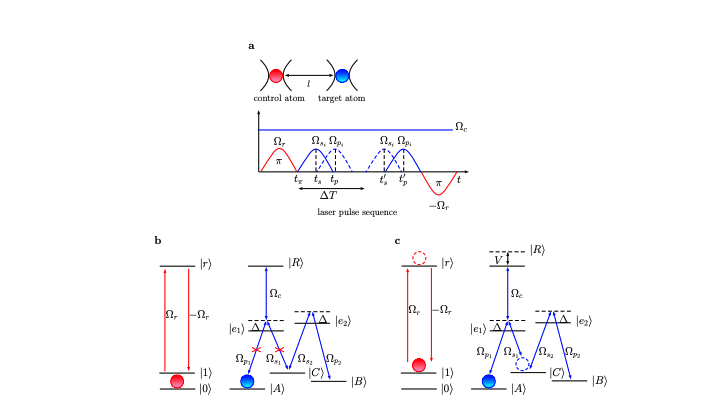
Their approach utilizes adiabatic geometric phase control, a technique that leverages the inherent properties of quantum systems to achieve high fidelity operations. This method relies on carefully manipulating the energy levels of atoms and applying tailored laser fields to induce transitions between states, effectively imprinting a controllable geometric phase on the qubits. The team has successfully demonstrated two- and multi-qubit gates using a double-stimulated Raman adiabatic passage technique, achieving precise control over qubit interactions.
A significant advantage of this method is its scalability; the system requires no additional laser application to target individual atoms as the number of qubits increases, simplifying experimental setup and reducing complexity. Through detailed numerical analysis, researchers demonstrate that these gates can achieve remarkably high fidelities, reaching 98% to 99% with gate times of approximately 0. 6 microseconds. This level of precision is crucial for performing complex quantum computations with minimal errors. Furthermore, the research highlights the resilience of these gates against common experimental imperfections, such as fluctuations in laser intensity and slight variations in atomic positions.
Rydberg Atoms Enable High Fidelity Gates
Researchers are harnessing the unique properties of Rydberg atoms to build high-fidelity quantum gates. Rydberg atoms, created by exciting atoms to very high energy levels, exhibit strong interactions with each other, making them ideal for creating controlled interactions between qubits. By trapping individual Rydberg atoms using optical tweezers, scientists can precisely control their positions and interactions, forming the basis for a scalable quantum computer. The strong interactions between Rydberg atoms create a phenomenon known as the Rydberg blockade, where the excitation of one atom inhibits the excitation of nearby atoms, effectively creating a repulsive force between qubits.
This Rydberg blockade is exploited to implement multi-qubit gates, allowing for the creation of entangled states essential for quantum computation. The team focuses on controlled-Z (CZ) gates, a fundamental building block for universal quantum computation, and has conducted detailed theoretical analysis to optimize gate fidelity and minimize error rates. Their calculations demonstrate the feasibility of achieving high-fidelity gates with this approach, paving the way for building larger and more complex quantum circuits. Researchers are also actively investigating strategies to mitigate potential sources of errors, such as atomic motion and decoherence, to further improve the reliability of the system. This research contributes to the advancement of quantum computing by providing a promising pathway towards building scalable and fault-tolerant quantum computers based on Rydberg atom technology.
Adiabatic Geometric Control Achieves High Fidelity Gates
Scientists have demonstrated a novel approach to building multi-qubit gates using adiabatic geometric phase control in neutral atom systems. This technique relies on carefully controlling the evolution of quantum states to achieve high-fidelity operations, offering enhanced robustness against external disturbances. The team successfully implemented two- and multi-qubit gates based on a double-stimulated Raman adiabatic passage technique, which precisely imprints a controllable geometric phase on the qubits. A key achievement is the ability to operate the system without requiring additional lasers for each target atom as the system scales, simplifying experimental complexity and reducing the demands on laser control systems.
Numerical analysis indicates that these gates can achieve high fidelities, reaching 98% to 99% with gate times of approximately 0. 6 microseconds. Detailed error analysis reveals strong resilience against fluctuations in Rabi frequencies, limited blockade strength, and positional uncertainties of the atoms, demonstrating the robustness of the method against common experimental imperfections. To demonstrate practical application, the team simulated Grover’s search algorithm using two, three, and four qubits, achieving high success probabilities and validating the scalability of the proposed gates for computation. These results establish a physically feasible and scalable pathway toward fault-tolerant quantum computation with neutral atoms.
🗞 Neutral-atom quantum computation using multi-qubit geometric gates via adiabatic passage
🧠 ArXiv: https://arxiv.org/abs/2511.04359