
Quantum Computing is an emerging technology that is maturing. Several notable publicly listed quantum companies already exist. Retail and institutional investors can invest directly in the quantum industry. We analyze how much a $1000 investment in these companies 365 days ago would be worth today.
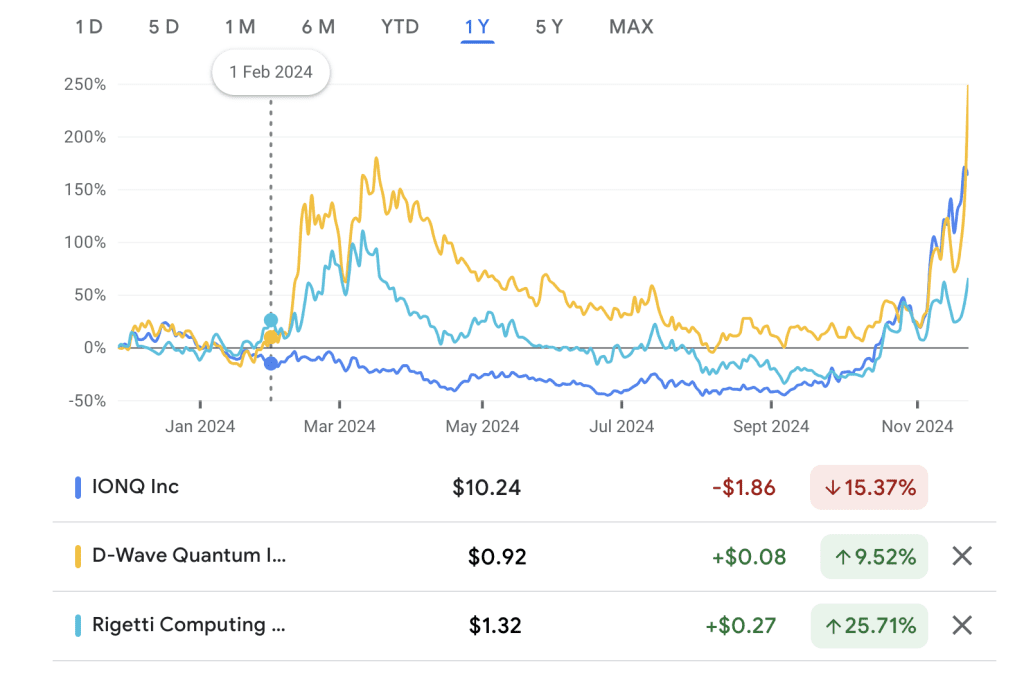
This is not investment advice. Instead, it is a look back at how the market has performed over the past year for three quantum companies. It has been a rocky year. Some publicly listed companies received warnings from the stock market (NASDAQ). Their stock price is too low, falling below one dollar. Couple that with one of the companies, Zapata AI, which initially focused on Quantum Computing, collapsed. Also adding to the misery was the UK investment vehicle Quantum Exponential, which hit the skids and delisted. The company has invested in private and public companies like AegiQ, QLM Technology, and Universal Quantum.
Public Quantum Companies
There aren’t that many companies to choose from. We will outline each one here and highlight its own benefits and strengths. Of course, these are “Pure Play” Quantum companies that only do quantum. This is not the only way to invest. Large tech players like Google, IBM, Amazon, Honeywell, and Microsoft are all working on quantum computing and quantum technologies. But for those companies focused 100% on quantum technologies, there are a few listed companies.
Rigetti (NASDAQ:RGTI)
Rigetti Computing, founded in 2013 by Chad Rigetti, has been a pioneer in quantum computing. The company established itself as a full-stack quantum computing provider, emphasizing the integration of hardware and software. Rigetti made a significant impact with its cloud-based quantum computing services, which began in 2017. This platform allowed enterprises, governments, and researchers to access quantum systems remotely, allowing broader quantum computing adoption. Rigetti’s proprietary quantum chips are manufactured in its in-house facility, Fab-1, the first dedicated quantum fabrication site globally, showcasing its commitment to innovation and scalability.
The company has developed a reputation for advancing superconducting qubit technology, focusing on modular multi-chip architectures to scale quantum systems. Notable achievements include the release of the Ankaa-class quantum processors, which have achieved higher fidelities and gate speeds. Rigetti has also engaged in collaborations with institutions like NASA and Moody’s to explore optimization and machine learning applications in real-world scenarios, reflecting its focus on achieving quantum advantage across various industries.
In recent years, Rigetti has undergone leadership changes and strategic realignments to enhance operational efficiency and focus on achieving technological milestones. Its roadmap includes ambitious goals such as the development of a 336-qubit system, the Lyra, which represents a leap in scalability and performance.
24th November 2023: $1.05
22nd November 2024: $1.74
Percentage Gain for RGTI: 65.7%
D-Wave (NASDAQ:QBTS)
D-Wave Systems, founded in 1999 and headquartered in Burnaby, Canada, is a pioneer in the field of quantum computing. It developed the first commercial quantum computer in 2011, focusing on quantum annealing—a specialized approach for solving optimization problems. Unlike gate-based systems, quantum annealing excels at exploring solution spaces to find optimal configurations for combinatorial problems. Over the years, D-Wave has released five generations of quantum systems, including its Advantage series, which boasts over 5,000 qubits and is designed for practical applications in logistics, machine learning, and material science
In 2021, D-Wave announced an expansion of its roadmap under the “Clarity” initiative. This marked a strategic shift as the company began integrating gate-model quantum computing into its offerings. D-Wave combines quantum annealing and gate-based approaches to address a broader range of computational problems. This includes error-corrected quantum systems for material science and drug discovery. Their next-generation system, the Advantage2, will feature over 7,000 qubits with enhanced connectivity and coherence, further solidifying their leadership in scalable quantum hardware
D-Wave is also active in collaborations to advance quantum technology and workforce development. For example, partnerships with institutions like the University of Waterloo aim to improve the design and coherence of superconducting qubits. Canada’s National Quantum Strategy supports these projects and highlight D-Wave’s commitment to both technological innovation and societal impact. The company continues to lead in delivering practical quantum solutions through its hardware, hybrid solvers, and cloud-based Leap platform.
24th November 2023: $0.86
22nd November 2024: $2.93
Percentage Gain for QBTS: 240.7%
IonQ (NYSE:IonQ)
Christopher Monroe and Jungsang Kim founded IonQ in 2015. It emerged from their pioneering work on trapped ion quantum computing. This technology uses individual ions as qubits. The company quickly established itself as a leader in the field by focusing on systems that offer high fidelity and long coherence times. In its early years, IonQ developed quantum computers that were accessible via cloud platforms like Amazon Braket, Microsoft Azure, and Google Cloud, making quantum technology more accessible to businesses and researchers globally. Their focus on hardware scalability and accessibility helped them distinguish their approach within the quantum computing industry
In recent years, IonQ has advanced its roadmap to achieve commercial quantum advantage, a key milestone where quantum systems surpass classical counterparts in solving specific problems. The introduction of their systems, such as IonQ Forte and IonQ Tempo, showcases this ambition. These systems are designed for enterprise and government use, tackling complex tasks like process optimization and quantum machine learning. The Tempo system, in particular, offers computational power significantly beyond its predecessors, marking a leap in performance and application readiness
IonQ also opened a quantum computing factory in Seattle, the first in the U.S., solidifying its commitment to scaling production and creating a robust quantum ecosystem. This facility, along with collaborations with industry leaders such as Airbus and Hyundai, underscores IonQ’s strategy to integrate quantum technology into diverse sectors. Their partnerships and projects with institutions like the U.S. Air Force further demonstrate IonQ’s role in pushing quantum computing toward mainstream adoption.
24th November 2023: $12.36
22nd November 2024: $31.80
Percentage Gain for IonQ: 157.3%
Profit or Peril from Quantum?
If you had an equal weighting of each of these stocks and divided it up into these three companies alone, that’s $333.33 for each company. You’d have approximately $552.32 from RGTI, $1135.66 from D-Wave, and $857.66 from IonQ. That gives a grand total of $2545.64, which is a profit of $1545.64.
Zapata AI has been left off, particularly as it moved away from its core initial focus of quantum computing and more into AI. Yet, adding this company would have pretty much zeroed out your allocation in this company.
Of course, Quantum Computing and allied technologies are being developed by large technology companies, so this can be one way of getting exposure to quantum companies without putting all your eggs into a quantum company.