Cyclo-graphyne, a newly explored two-dimensional carbon material, presents a unique combination of porosity and electronic properties that could revolutionise several technological fields. Jhionathan de Lima and Cristiano Francisco Woellner, from the Federal University of Parana, lead a team that comprehensively characterises this innovative allotrope, revealing its potential for applications ranging from gas separation to flexible electronics. Their research demonstrates that cyclo-graphyne possesses both structural and thermal stability, alongside a distinctive semimetallic behaviour featuring Dirac cones within its electronic structure. Importantly, the material exhibits exceptional flexibility and a strong response across the ultraviolet and infrared spectrums, positioning it as a highly promising candidate for advanced materials science and nanotechnology.
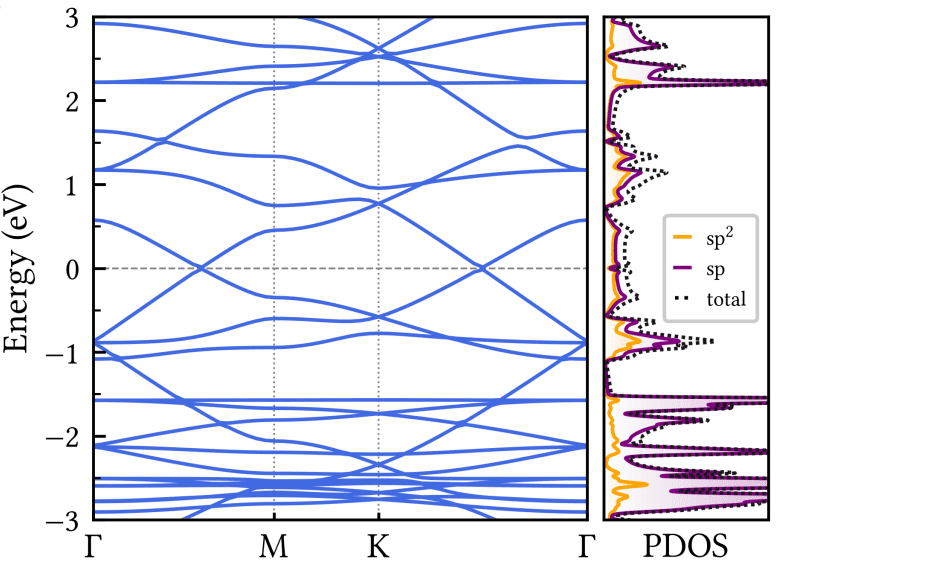
This research thoroughly investigates its electronic and structural properties, revealing its potential for diverse applications. Scientists employed advanced computational methods to determine the stability and characteristics of this novel material. Results demonstrate that Cyclo-graphyne exhibits semimetallic behaviour, featuring Dirac cones near its Fermi level, which indicates high carrier mobility and potential for use in electronic devices. Detailed calculations of its vibrational modes confirm the structure’s dynamic stability, while analysis of its electronic band structure explains the origin of its semimetallic properties. Further investigation into its mechanical properties reveals remarkable flexibility and resilience, suggesting suitability for flexible electronics and nanomechanical systems. This work provides a detailed understanding of Cyclo-graphyne, paving the way for its exploration as a promising material in nanotechnology and materials science.
Calculated energies confirm its energetic viability compared to other synthesized carbon materials, while calculations of its vibrational modes confirm its dynamic stability. Simulations indicate thermal stability up to at least 1000 K. Electronic calculations reveal that the material is a semimetal with an extremely narrow band gap and features two Dirac cones in its electronic structure. Mechanically, the material is highly compliant.
Cp-graphyne Exhibits Double Distorted Dirac Points
This research details the investigation of Cp-graphyne, a novel two-dimensional carbon material. Scientists discovered that Cp-graphyne is energetically stable, making it a potentially realizable material. A crucial finding is the presence of double distorted Dirac points in its electronic band structure. Dirac points are special features in the electronic structure that lead to unique electronic properties, such as high electron mobility. The double distortion is a specific characteristic of these points in Cp-graphyne.
This unique electronic structure potentially offers different properties compared to other carbon materials. The material also exhibits good mechanical stability, suggesting it can withstand stress and strain. The research also explores the optical properties of Cp-graphyne, which could be relevant for optoelectronic applications.
Cyclo-graphyne’s Stability, Semimetallic Properties, and Flexibility
This research presents a comprehensive characterization of Cyclo-graphyne, a recently discovered two-dimensional carbon material distinguished by its porous structure and unique arrangement of carbon atoms. Calculations confirm the material’s energetic, dynamic, and thermal stability, with simulations demonstrating robustness up to 1000 K. Scientists discovered that Cyclo-graphyne behaves as a semimetal with an extremely narrow band gap and possesses two Dirac cones in its electronic structure, suggesting potential applications in advanced electronics. Mechanically, Cyclo-graphyne exhibits exceptional flexibility and isotropic behaviour, displaying a Young’s modulus significantly lower than that of graphene. Optical simulations reveal strong ultraviolet absorption and infrared reflectivity, alongside a distinctive response to light.
Importantly, the researchers identified specific Raman and infrared signals that serve as a unique spectroscopic fingerprint for this material, aiding in its future identification and differentiation from other carbon materials. These findings position Cyclo-graphyne as a promising candidate for applications including gas capture, flexible nanoelectronics, and optoelectronic devices.
👉 More information
🗞 Cyclo-Graphyne: A Highly Porous and Semimetallic 2D Carbon Allotrope with Dirac Cones
🧠 ArXiv: https://arxiv.org/abs/2509.18299